Part I · The Survey
How the Roll Was Checked
Public listings first, museum records next, humans throughout
The July 2026 survey began with 677 mapped locations from Google Places. Duplicates and false positives were removed, leaving 118 public aviation museums, heritage centres and preserved airfield collections; 1,180 first-hand visitor reports were then read in full and the resulting opening times, adult admission prices and aircraft inventories checked against museum listings and collection records.
Part II · The Machinery
Tools on Charge
What each machine did, and what it did not
The division of labour was straightforward. Claude Fable (Anthropic) wrote the content and built the design — the 1940s Air Publication conceit, the camouflage heroes, the ledger tables, the supplements on the Spitfire and the Vampire, and most of the code behind them, all produced in conversation with the editor. Cursor handled general editing — the day-to-day trimming, fixing and rearranging that any manuscript needs. Gemini Nano Banana (Google) generated the images: the photographic plates, silhouettes and line drawings that fly formation alongside the text.
| Station | Trade | Duties |
|---|---|---|
| Claude Fable | Anthropic | Content & design — prose, page architecture, the AP 118 house style, most of the code |
| Cursor | AI code editor | General editing — revisions, refactors, housekeeping across the manuscript |
| Gemini Nano Banana | Image generation — plates, artist’s impressions, silhouettes, line drawings | |
| Marcus Greenwood | Human | Editor & compiler — direction, taste, fact-checking, corrections, final say on everything |
MachineHumanHOSTING: CLOUDFLARE WORKERS · SURVEY DATA: PUBLIC LISTINGS & VISITOR REPORTS
None of the tools flew solo. Every article was prompted, questioned, re-prompted and edited; the aircraft histories draw on the commonly published figures and were checked against them. AI wrote the first — and often the fifth — draft. A human decided which draft shipped.
Part III · The Compiler
The Editor of Record
Marcus Greenwood — enthusiast first, everything else second

Marcus is a military-aircraft enthusiast who spends an unreasonable amount of his free time in the UK’s brilliant aviation museums — the great national collections and the volunteer-run hangars alike. This site is the logbook of that habit: 118 museums visited or researched, one aircraft compendium, and counting.
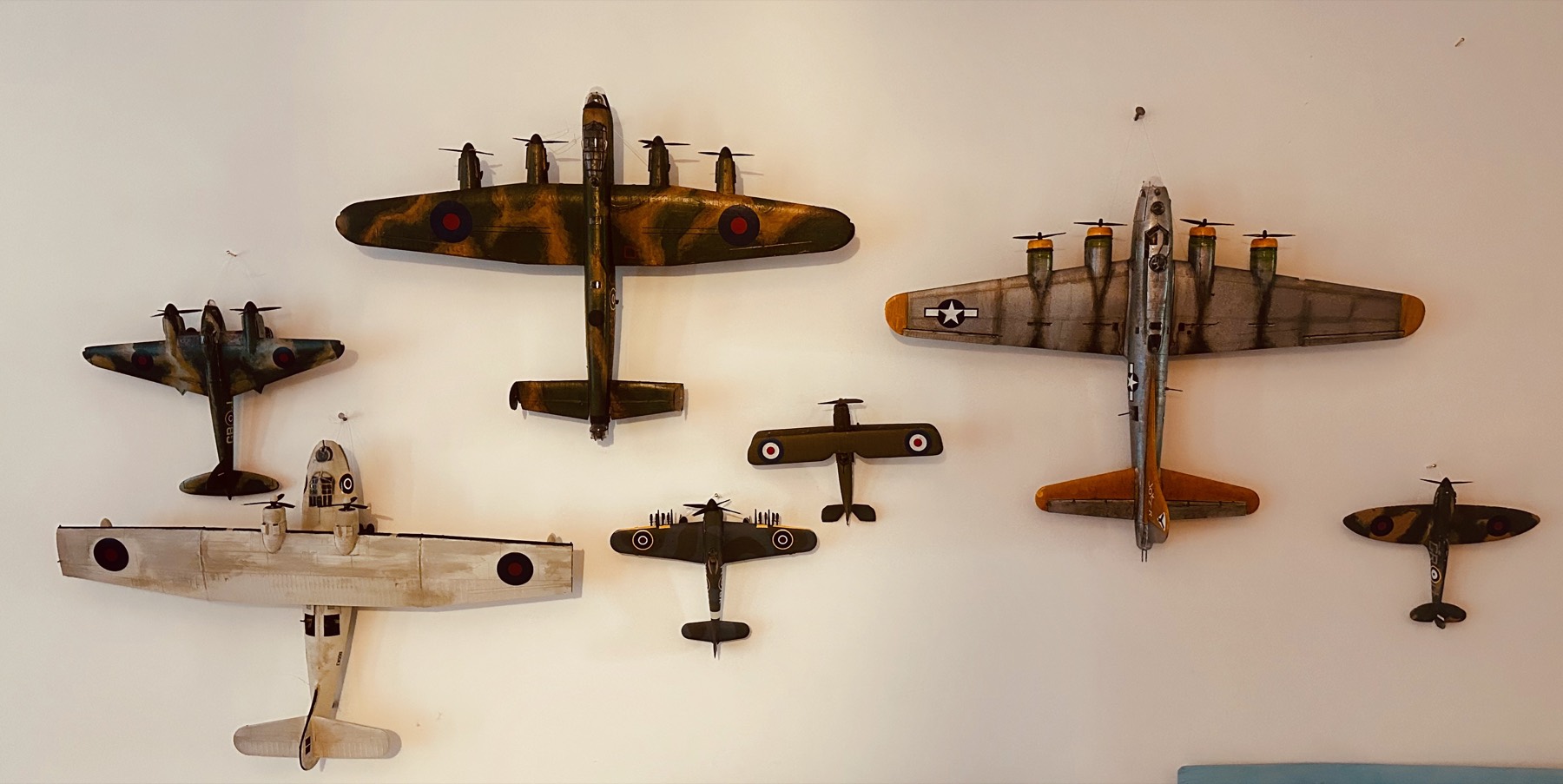
The enthusiasm does not stop at the museum gate. At home he builds model aircraft with his son Leo; part of their combined squadron flies in permanent formation on the wall below. By day Marcus runs UBIO, a web-automation company in London — which explains how the site got built, if not why it got this out of hand.
Leo also keeps a digital fleet in Plane Crazy on Roblox — a junior detachment of this publication.
Part IV · Full Disclosure
On the Use of Machines
What AI authorship means for what you read here
We see no point pretending otherwise: most of the words on this site were generated by a machine. So was most of the design, and all of the artwork — the plates are labelled “artist’s impressions” because the artist is a model, not a photographer. What the machines did not supply was judgement: which stories to tell, which figures to trust, which jokes to keep, and when the fifth draft was finally the right one. That was human work, and it was most of the work.
The practical consequences for you, the reader: aircraft histories use the commonly accepted published figures, but errors can survive editing here just as they do in print — if you find one, report it to the compiler and it will be corrected with thanks. Museum opening hours, prices and phone numbers are a survey-date snapshot of public listings; verify before travelling. And the photographic plates depict real events but are generated images — treat them as illustrations, never as historical photographs.
The rivet-counters. Several readers have already written in with corrections, and every one made the site better. This is the system working as designed.
Part V · Further reading
Sister publications
Other projects from the same compiler
The Castle Rolls
If battlements interest you as much as bombers, see The Castle Rolls — an independent site listing every visitable castle across the four nations (English Heritage, National Trust, Cadw, Historic Environment Scotland, and the independents), with ratings, free-entry lists, places you can sleep, and county-by-county rolls. It is not affiliated with this gazetteer.
429 castles on the roll, including 118 free to enter: thecastlerolls.co.uk.
my3dhouse
For a different kind of model-building, see my3dhouse — turn photos, floor plans and elevations into an interactive 3D model of your home (or any other building). Another side project from the same desk as this gazetteer.
Photos & plans in, your house in 3D out: my3dhouse.app.