Chapter I · 1941–1943
A Jet from the Furniture Trade
Spec E.6/41, one engine, two booms, and a codename nobody kept
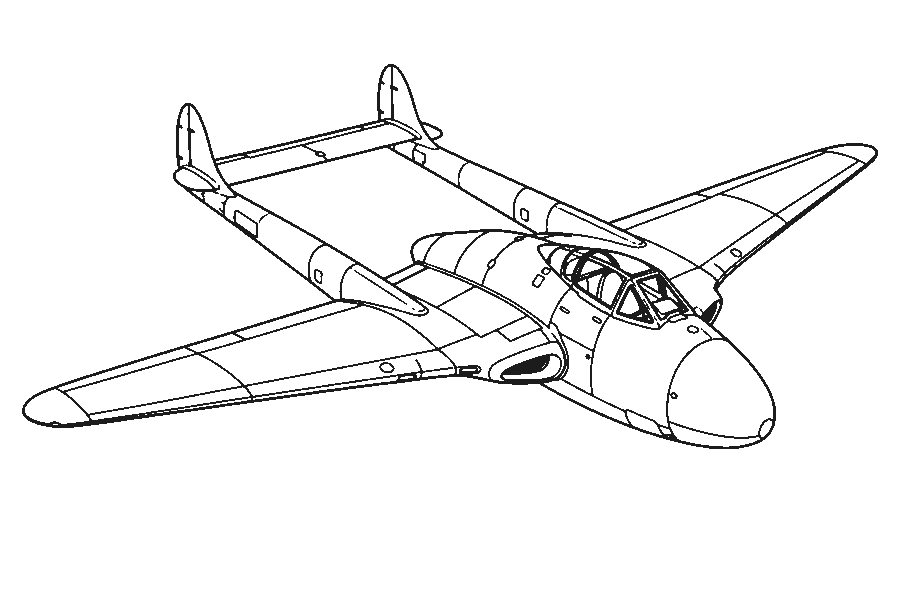
Britain’s second jet fighter was designed at Hatfield while the factory was building Mosquitos and dodging air raids. Around Frank Halford’s new H.1 turbojet — a big, honest centrifugal engine soon renamed the Goblin — de Havilland drew the simplest possible aeroplane: one engine in a stubby central pod, and twin booms carrying the tail, so the jet pipe could be kept short and waste as little of the engine’s modest 2,700 lb of thrust as possible.
The pod itself was pure de Havilland: moulded plywood and balsa sandwich, Mosquito fashion, with sub-contracts flowing out to furniture and piano makers who had spent the war learning to build warplanes out of wood. The project went by the magnificent internal name Spider Crab, which mercifully did not survive contact with the marketing department. The prototype, LZ548, flew from Hatfield on 20 September 1943 with Geoffrey de Havilland Jr at the controls — six months behind the Meteor, and a whole war too late to fight in one.
America’s first true jet fighter owes it a debt: the prototype Lockheed XP-80 flew on a de Havilland-supplied Goblin, shipped across the Atlantic because no American engine was ready — and when the first was wrecked on ground test, de Havilland sent another, delaying a British prototype to keep the Americans flying.
Chapter II · 3 December 1945
The Naval Party Trick
HMS Ocean, a pitching deck, and the world’s first jet carrier landing
Before the Vampire had even reached an RAF squadron, it made history in the Navy’s hands. The Admiralty doubted a jet could ever operate from a carrier at all — no propeller meant no instant response when the pilot opened the throttle, and early jet engines spooled up with the urgency of a kettle. The man sent to find out was Lieutenant Commander Eric ‘Winkle’ Brown, the Fleet Air Arm’s test pilot of test pilots.
On 3 December 1945, in a modified Sea Vampire, LZ551, Brown put down on HMS Ocean in the Channel — on a deck pitching enough that the trial nearly scrubbed — and became the first person ever to land a pure jet aboard a ship. He then took off from her and did it again, several times, before the weather closed in. The world’s navies took note; the age of the carrier jet starts here, with a wooden-nosed aeroplane and a Scotsman of legendary calm.
LZ551 herself — the actual airframe, not a sister — hangs in the Fleet Air Arm Museum at Yeovilton. Very few museum aircraft anywhere are the machine that did the historic thing. This one is.
Chapter III · 1946–1948
Into Service
247 Squadron, and the first RAF aeroplane past 500 mph
The Vampire F.1 reached No. 247 Squadron in April 1946, the RAF’s second jet fighter and immediately its fastest aeroplane: 540 mph, the first in squadron service to pass 500 in level flight. After six years of taildragging piston fighters it felt like the future had been delivered early — no torque swing on takeoff, no great nose blocking the view, a tricycle undercarriage, and handling so light and honest that pilots ran out of complaints somewhere around the fuel gauge.
The fuel gauge deserved the attention. Endurance was well under an hour if flown with enthusiasm, and the early aircraft had neither ejection seat nor cockpit pressurisation. Nobody much cared. The Meteor was the RAF’s headline jet — twin-engined, record-setting, grown-up; the Vampire was the one pilots talked about at the bar, a machine flown with the wrists rather than the shoulders.
Chapter IV · 1948
The Year of Showing Off
First jets across the Atlantic — and higher than anyone, ever
1948 was the Vampire’s annus mirabilis. On 23 March, John Cunningham — ‘Cat’s Eyes’ himself, the night-fighter ace turned de Havilland test pilot — took a Vampire fitted with the new Ghost engine and extended wingtips to 59,446 feet over Hatfield, a world altitude record, wearing little more oxygen equipment than optimism strictly required.
Then in July, six Vampire F.3s of No. 54 Squadron hopped Stornoway–Iceland–Greenland–Labrador to become the first jet aircraft ever to cross the Atlantic, arriving in America to a goodwill tour of air displays that the US press covered with the slightly gritted enthusiasm of hosts being out-flown at their own party. For an aeroplane designed as a wartime stopgap, it was quite a year’s work.
Chapter V · 1949–1955
The Workhorse Years
The FB.5, the FB.9, and a jet for every corner of the map
The definitive Vampire was the FB.5 fighter-bomber of 1949: clipped wings, stronger legs, and racks for bombs and rockets under the wings. More than 1,100 were built — the majority not by de Havilland at all but by English Electric at Preston, whose production lines the Vampire kept warm until a certain Canberra was ready for them. FB.5s equipped RAF Germany, the Middle East and the Far East, and flew strikes against insurgent camps in the Malayan Emergency — the type’s only sustained shooting war in British hands.
For the tropics came the FB.9, whose principal upgrade was air conditioning — an innovation pilots in Aden and Singapore rated somewhere above the jet engine itself. By the early 1950s the Vampire was simply what an RAF fighter squadron looked like, anywhere east or south of Kent.
Chapter VI · 1950–1966
The Schoolroom
The T.11 — the aeroplane on which the RAF learned to be a jet air force
Two lesser-known family members came first: the NF.10, a stopgap night fighter with a Mosquito-style two-seat wooden nose and radar, which held the line until the Venom and Javelin arrived. But the Vampire that touched the most lives was the T.11 trainer of 1952 — two seats side by side, dual controls, and eventually ejection seats, after the first batches made do without and everyone pretended that was fine.
Some 731 were built, and for a decade virtually every RAF pilot’s first jet solo was a Vampire solo. An entire generation — the men who went on to Hunters, Lightnings and Vulcans — made their first acquaintance with jet flight in that snug wooden cockpit, an instructor’s elbow in their ribs. The T.11 soldiered in RAF service until 1966, and one flew on with the Central Flying School’s ‘Vintage Pair’ display into the 1980s. It is also, not coincidentally, the reason nearly every aviation museum in Britain owns a Vampire: when the schoolrooms closed, the class was dismissed en masse.
Count them in the appendix below: of the sixteen gazetteer museums holding the family, most have a T.11. If a British museum has exactly one jet, it is statistically a Vampire T.11, and spiritually a Vampire T.11 even when it isn’t.
Chapter VII · 1946–1961
Everyone Buys the Vampire
Thirty-one air forces, four licence lines, one very loyal Alpine customer
Cheap, simple, docile and available, the Vampire became the world’s entry ticket to the jet age. Some thirty-one air forces flew it. India’s Vampires of 1948 made it the first air force in Asia with jets; Sweden flew it as the J 28; France built its own Nene-engined version, the Mistral, at Marseilles; Australia built Nene-Vampires in Sydney; and Switzerland, having bought a batch, set up its own licence line at Emmen and built the FB.6 — then looked after its Vampires with Alpine thoroughness for the next four decades.
That Swiss habit matters to this gazetteer. When Switzerland finally retired the fleet, its immaculate, low-hours Vampires and Venoms flooded onto the collector market at prices a syndicate of dentists could manage — which is why so many aircraft in British museums today wear, under the paint or on it, a Swiss J- serial and an expression of mild surprise at the weather.
Chapter VIII · 1949–1957
The Venomous Offspring
Thinner wing, bigger engine, and the family’s only major war
Stretch the formula and you get the Venom: same twin-boom layout, but a new thin wing and the Ghost engine at 4,850 lb of thrust — 640 mph and a proper fighting margin over the first-generation jets. RAF Venom fighter-bombers took over the colonial beat from the Vampire, and the Royal Navy’s radar-nosed Sea Venoms gave the fleet its first all-weather jet fighter.
The family’s biggest war came in November 1956, when RAF Venoms and Fleet Air Arm Sea Venoms flew ground-attack sorties throughout the Suez campaign. Venoms fought on over Aden and Oman into the late 1950s before the Hunter swept them from the front line. The twin-boom de Havillands never made headlines the way their parent company’s Comet did — but between them, Vampire and Venom carried British squadron aviation across the entire awkward decade between the piston and the transonic.
Chapter IX · 1966–1990
The Long Fade
Everyone else moved on. Switzerland, quietly, did not.
The RAF was done with the Vampire by 1966; the export customers followed through the sixties and seventies as MiGs and Mirages arrived. And then there was Switzerland, where the Vampire had settled into the training and ground-attack roles like a cat into a sunbeam. Swiss Vampires flew on — maintained to watchmaking standards, parked in mountain caverns — through the entire Cold War, until the last were finally retired in 1990. Forty-seven years after LZ548 first lifted off from Hatfield, the final military Vampires anywhere on earth stood down.
The retirement sale that followed was the greatest warbird bargain of the century: airworthy jets, thousands of spares, sold by sealed bid. Museums, collectors and the merely over-enthusiastic bought them by the dozen. It is the reason the Vampire remains one of the easiest classic jets in the world to stand next to — and, in a few lucky countries, still to see fly.
No UK museum in this gazetteer flies a Vampire, but ex-Swiss examples still display on the European circuit most summers — the unmistakable whistle of a Goblin is worth crossing an airfield for.
Chapter X · The present day
The Class Reunion
Britain’s museums are full of Vampires — and that is exactly right
The Spitfire survives as an aristocrat: sixty flying, millions changing hands, air shows in its honour. The Vampire survives as something better — the people’s exhibit. Sixteen museums in this gazetteer hold one or more of the family, from the complete dynasty at the de Havilland family shrine near St Albans to lone T.11s standing guard in Cumbria, Caernarfon and County Antrim. Most are close enough to touch. Many will let you sit in the cockpit, which, being side-by-side and wooden, smells faintly and correctly of glue.
And one of them is not like the others: at Yeovilton hangs LZ551 herself, the first jet ever to land on a ship — not a replica, not a sister airframe, but the machine. The full squadron list follows below, with links into the main gazetteer for opening hours, ratings and tea-hut intelligence.