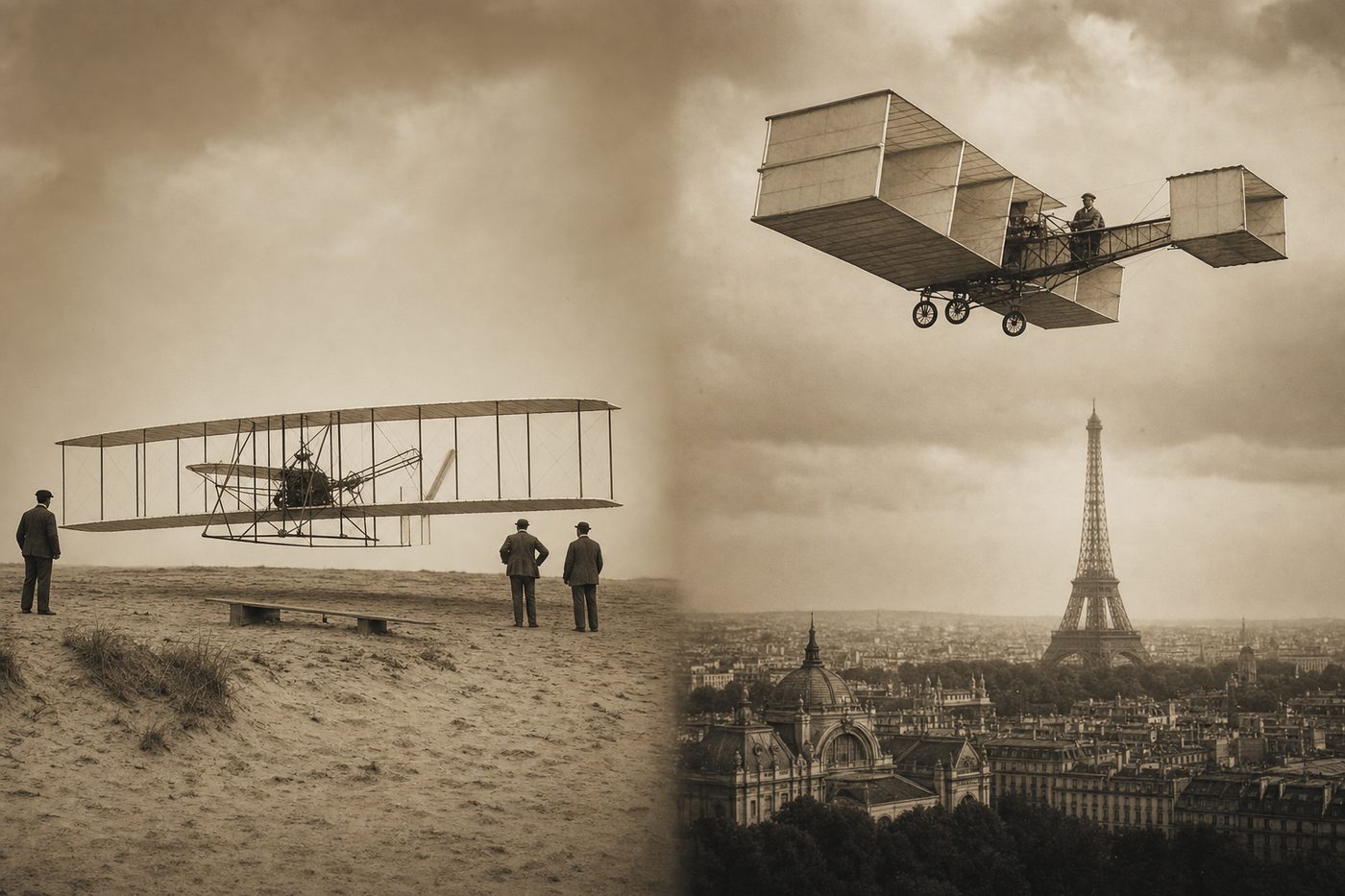
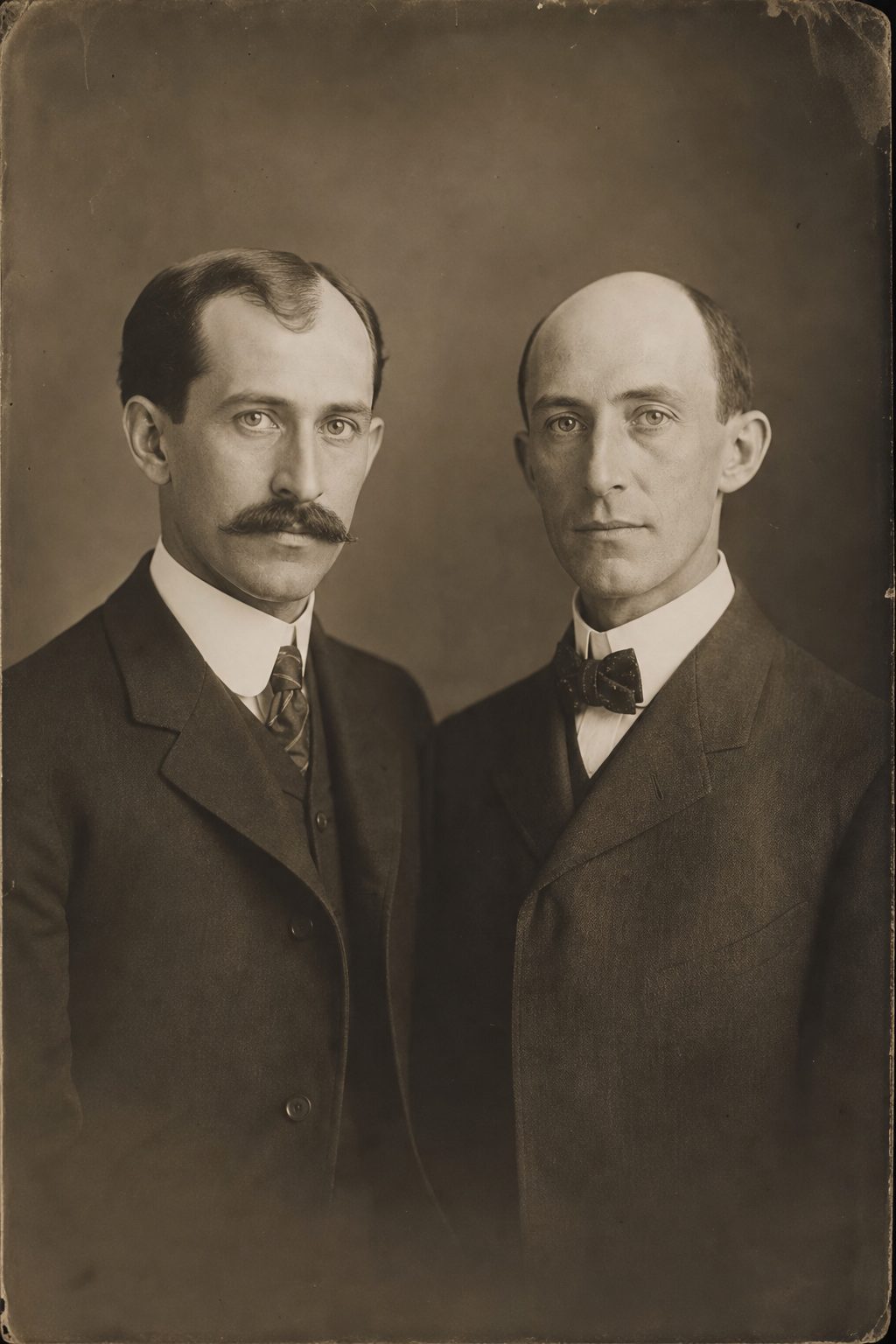
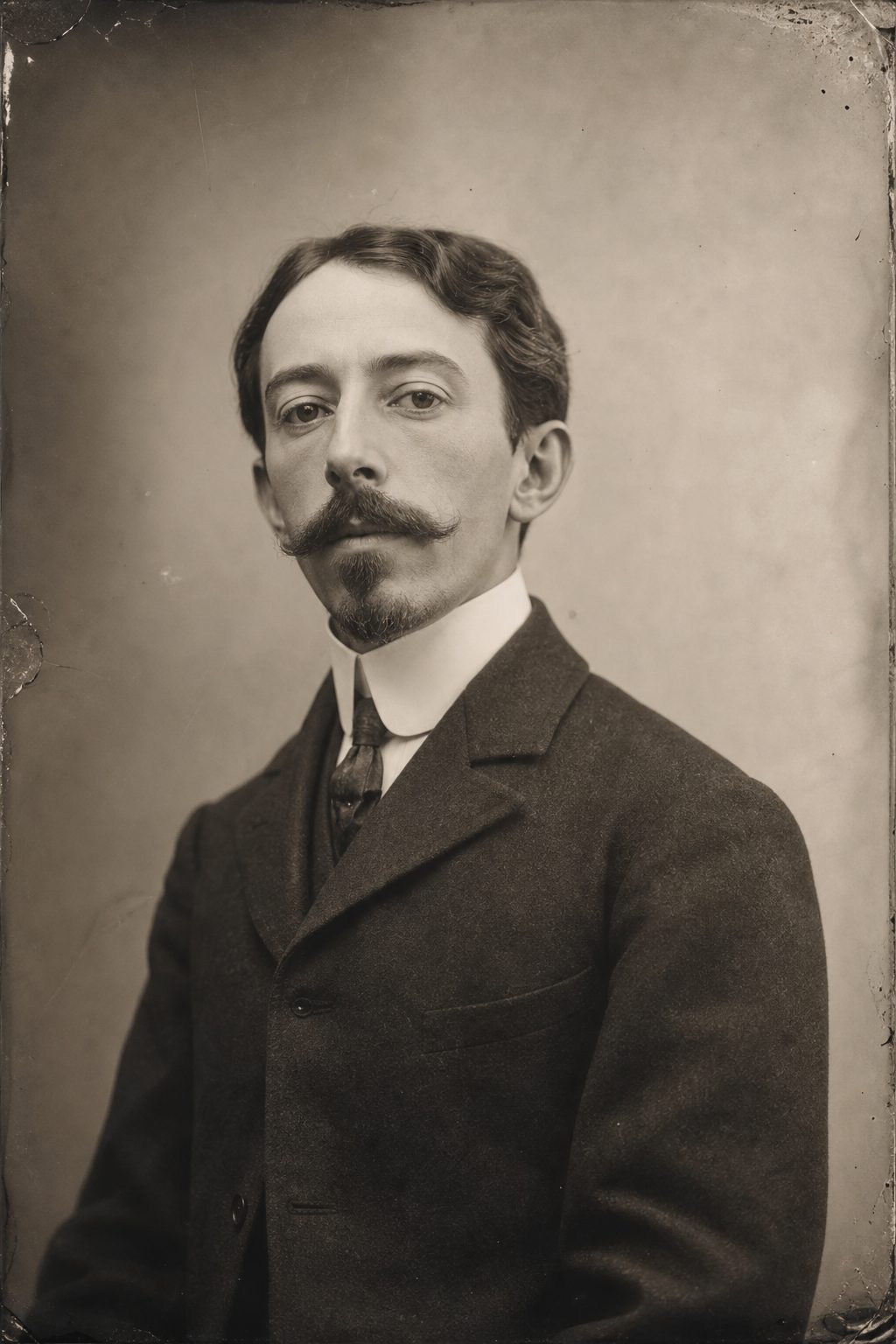
Two bicycle mechanics on a North Carolina sand dune. A wealthy Franco-Brazilian aristocrat in a Paris park. Three years and four thousand miles apart — and a century of argument that shows no sign of touching down.
17 DEC 1903
Wright Flyer · Kitty Hawk
23 OCT 1906
14-bis · Bagatelle
120 FT
First Wright hop
60 M
First certified 14-bis flight
Reading brief
The argument in one paragraph
On 17 December 1903, Orville Wright flew a powered biplane 120 feet in twelve seconds at Kitty Hawk, North Carolina. The Wright brothers had solved three-axis control, built their own light engine, and — crucially — flown before almost anyone in Europe had seen them do it. On 23 October 1906, Alberto Santos Dumont flew his 14-bis sixty metres before officials of the Aéro-Club de France at the Parc de Bagatelle in Paris — the first flight certified under rules the Europeans actually recognised.
Americans say the Wrights flew first. Brazilians — and a fair number of French historians — say Santos Dumont did, because his machine took off under its own power from wheels on flat ground, in public, in front of witnesses who wrote it down. Both sides are arguing about different definitions of “first.” Neither is entirely wrong. This article explains why.
LAST VERIFIED: JULY 2026 · PRIMARY SOURCES LINKED BELOW · WIRE FRAMES AND PLATES: ARTIST’S IMPRESSIONS WHERE MARKED
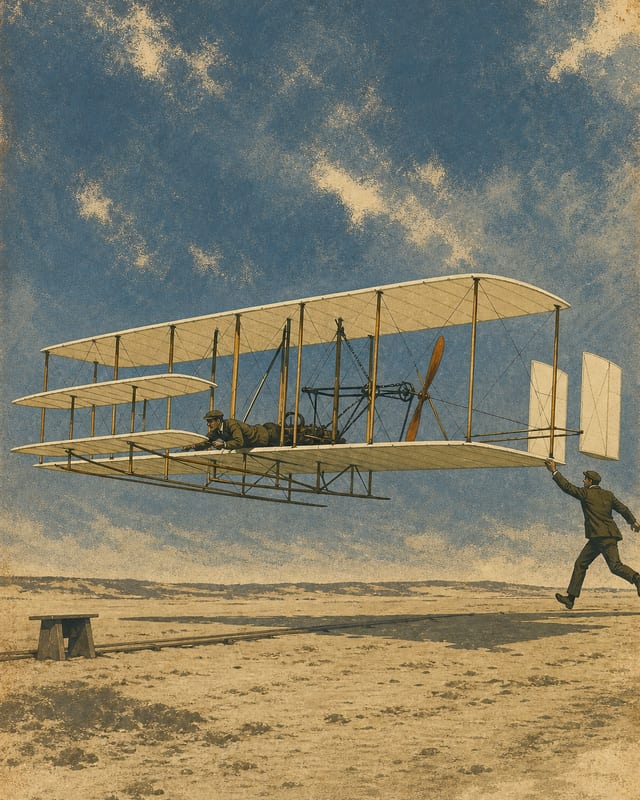
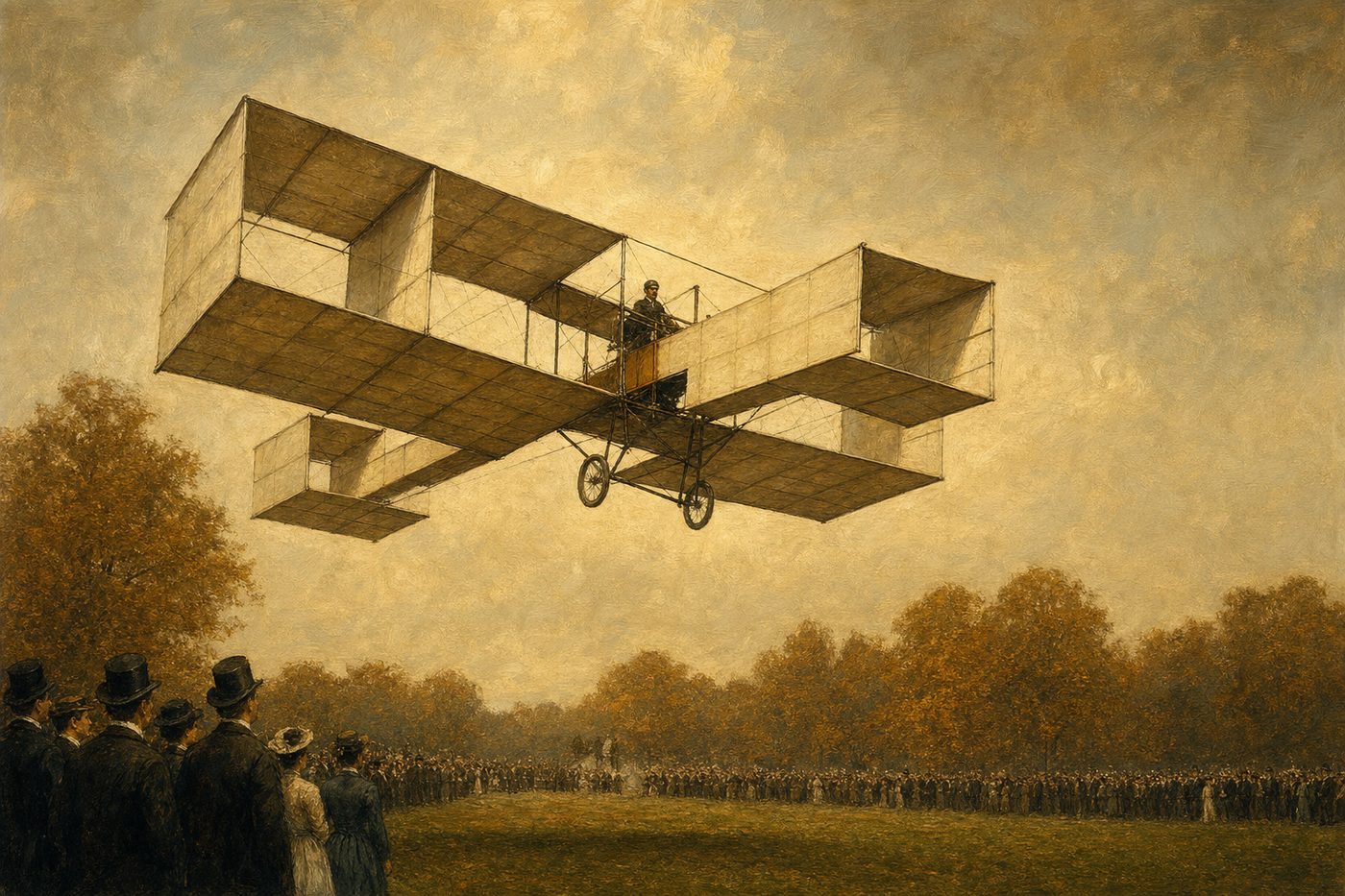
Plate A · Artist’s impression · Kitty Hawk 1903 and Paris 1906 in parallel
Methodical, secretive, and technically ahead of everyone else on the planet for about five years. They treated flight as a control problem first and a power problem second — and they were right.
Claim: first sustained, powered, controlled flight of a heavier-than-air machine — 17 December 1903.
Alberto Santos Dumont
Paris · Franco-Brazilian pioneer, dirigible celebrity, national hero
Small, dapper, fabulously rich, and adored by Paris. He built light aeroplanes in plain sight, flew them in public parks, and shared everything he learned — the opposite of the Wrights’ approach.
Claim: first officially witnessed, unassisted take-off of a heavier-than-air aeroplane — 23 October 1906.
Chapter I · Kill Devil Hills
The Wright Brothers
17 December 1903 · Kitty Hawk, North Carolina
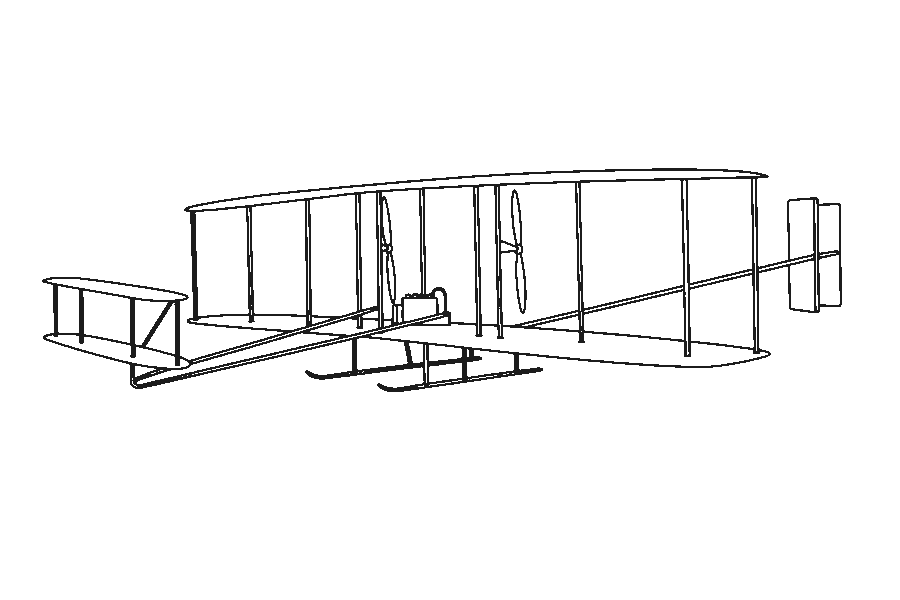
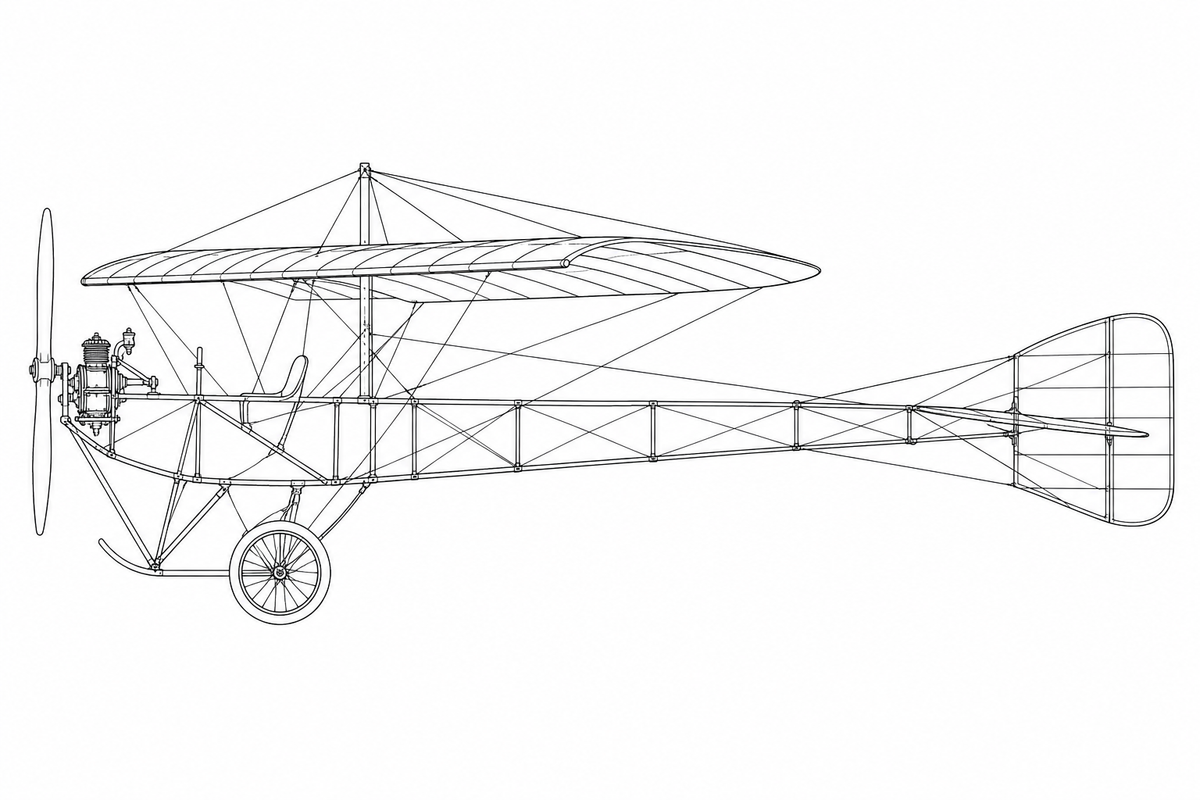
Wilbur and Orville Wright were not the first to fly. Otto Lilienthal had died gliding in 1896; Samuel Langley’s aerodrome had plunged into the Potomac that same year; and a dozen experimenters on both sides of the Atlantic were building machines that hopped, glided or crashed with varying degrees of intent. What the Wrights did that nobody else had managed was control: wing-warping for roll, a forward elevator for pitch, and a rear rudder for yaw — all linked, all practised in gliders first, all understood before they bolted on an engine.
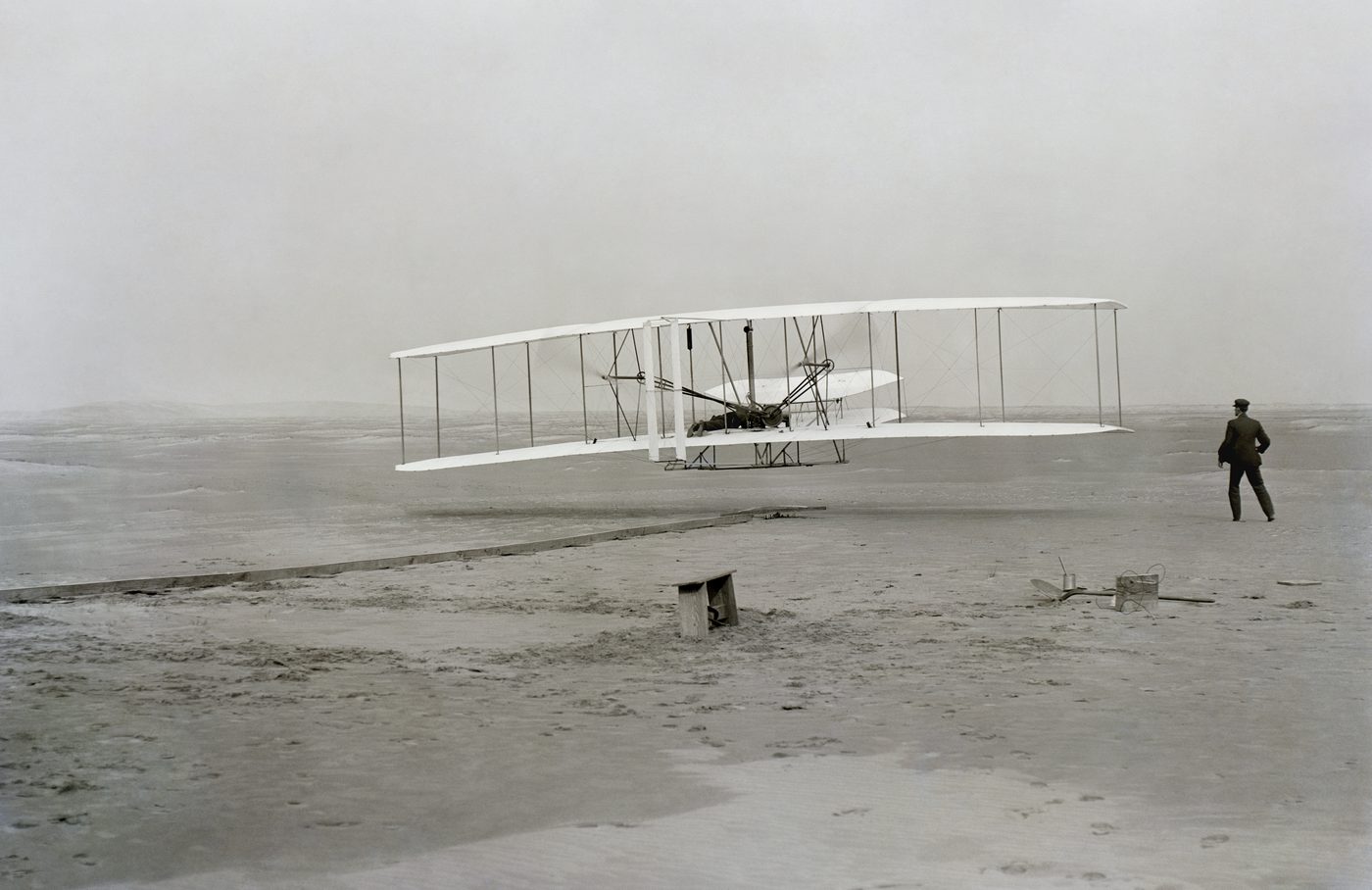
On the morning of 17 December 1903, with a 27 mph wind blowing across the dunes at Kill Devil Hills, Orville Wright lay prone on the lower wing of their Flyer and released the restraint. The machine rose, flew roughly level, and landed 120 feet away in twelve seconds. Three more flights followed that day. Wilbur’s last effort covered 852 feet in 59 seconds — the one that, in retrospect, actually proved the point.
“We were lucky enough to grow up in an environment where there was always much encouragement to children to pursue intellectual interests; to investigate whatever aroused curiosity.”
Orville Wright
John T. Daniels, a member of the Kill Devil Hills Life-Saving Station, took a photograph of the first flight that has become the most reproduced image in aviation history. Five witnesses were present. The Wrights filed for a patent in 1903 and did not stage public demonstrations until 1908 — by which time much of Europe had decided they were either bluffing or irrelevant.
Why it matters
The Wrights flew a true aeroplane with three-axis control before anyone else. Their 1905 Flyer III could fly circles for half an hour. By any engineering measure, they invented practical powered flight. The argument is not about whether they flew — it is about whether the world was allowed to know, and whether their launch method counts.
AircraftWright Flyer (1903)
Engine12 hp inline, home-built
Wingspan40 ft 4 in
Weight~605 lb with pilot
Best flight852 ft / 59 sec
LaunchRail + skid; no wheels
First flight · 10:35 local time, 17 December 1903
Photograph: John T. Daniels · Wikimedia Commons (public domain)Plate B · Wright Flyer
Artist’s impression · AP 118 photographic sectionWireframe · Wright Flyer
Recognition drawing · canard biplane, wing-warping
Alberto Santos Dumont had already made his name with dirigibles — small, personal airships he flew over Parisian rooftops, parking them outside his apartment and descending by rope ladder. He was, by 1906, the most famous aviator alive. When he turned to heavier-than-air machines, he did so in full view of the press, the Aéro-Club de France, and half of Parisian society.
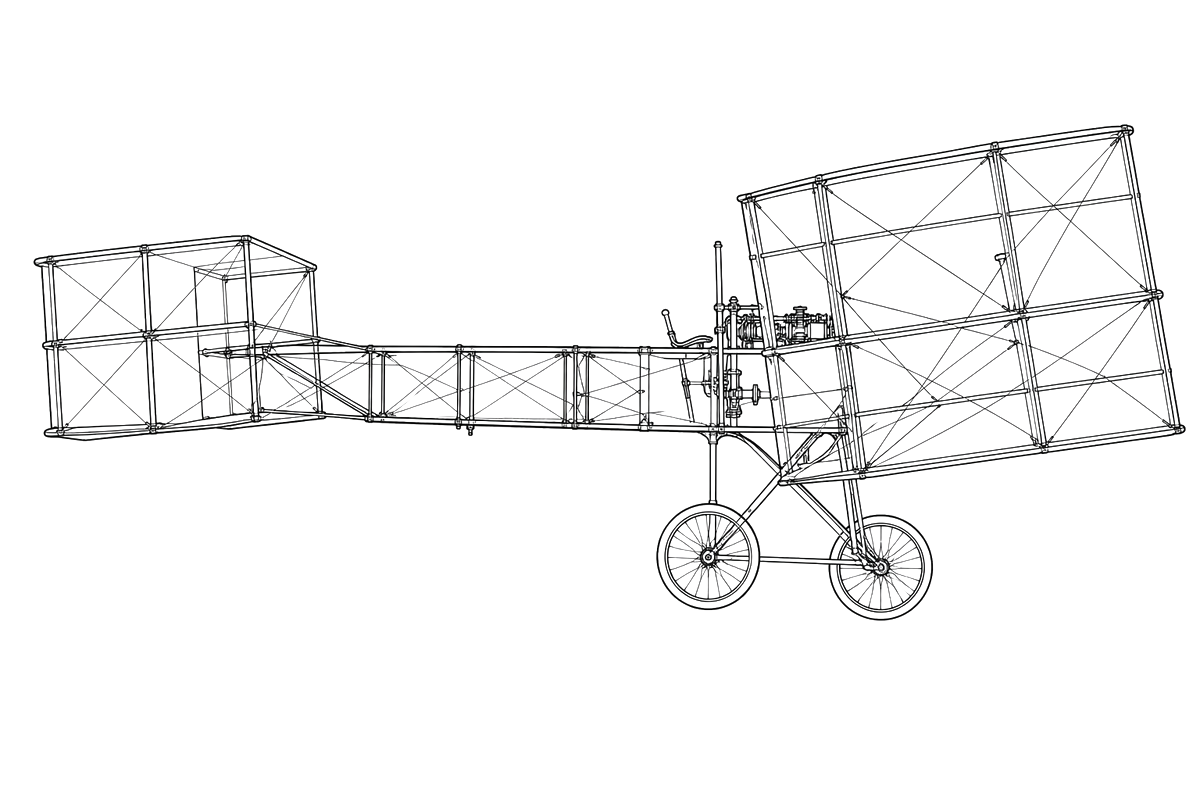
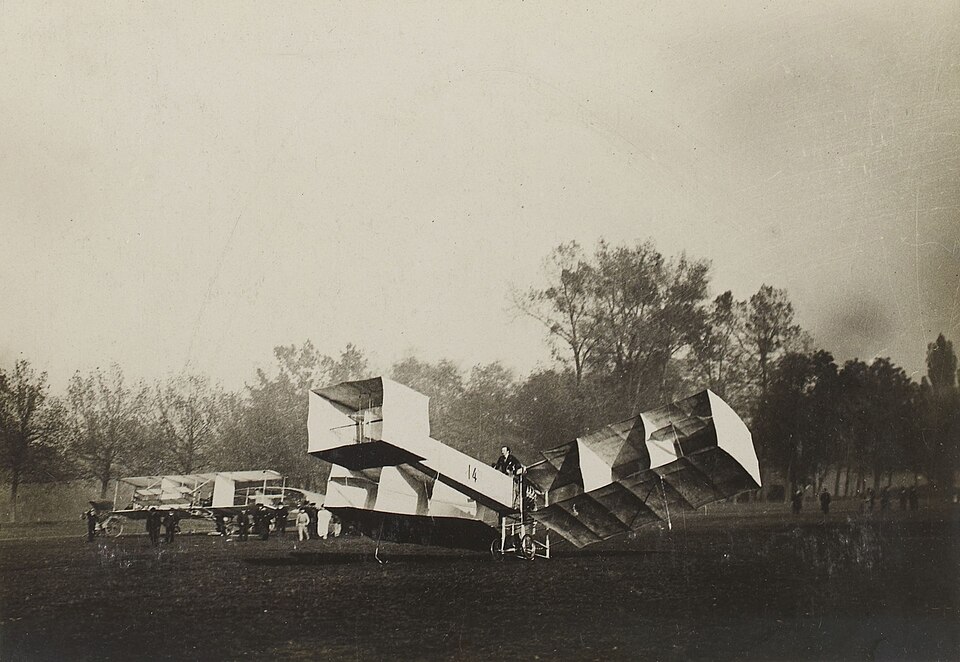
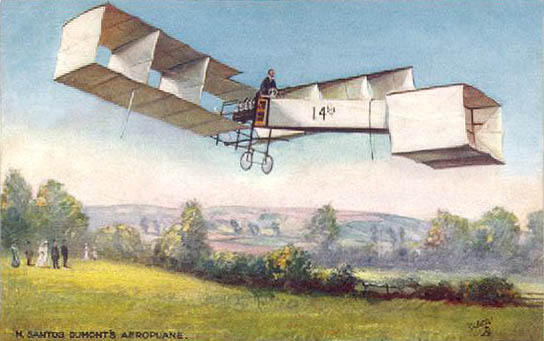
His 14-bis (“fourteen mark two”) was a box-kite biplane canard: a cellular wing structure with a forward elevator, an Antoinette V-8 engine behind the pilot, and a wheeled undercarriage. It looked nothing like the Wright Flyer. It did not need a rail, a catapult, or a headwind strong enough to blow your hat into the Atlantic.
On 23 October 1906, before officials of the Aéro-Club de France, Santos Dumont ran the 14-bis across the grass of the Parc de Bagatelle, lifted off under its own power, flew about sixty metres at roughly two metres altitude, and landed. He had won the Deutsch-Archdeacon Prize for the first flight of more than twenty-five metres. On 12 November he flew 220 metres — and the European aviation establishment wrote it down, published it, and celebrated.
“I have never felt such a pure sensation of joy. The machine responded to my every thought.”
Alberto Santos Dumont (attributed, post-1906)
In Brazil, Santos Dumont is O Pai da Aviação — the Father of Aviation. Brazilian federal law (12.364/2010) designates him as such and marks 23 October as the national Day of the Aviator. In the United States, the same date passes unnoticed. National pride is not a minor factor in this dispute.
Why it matters
Santos Dumont’s flights were public, certified, and met the rules Europeans had written. His machine took off from flat ground on wheels with no catapult assist. For the Aéro-Club de France and the Fédération Aéronautique Internationale, this was the first flight that counted — because it was the first flight they had officially watched.
Aircraft14-bis (Demoiselle followed in 1907)
EngineAntoinette V-8, ~50 hp
Wingspan~39 ft
First certified60 m / ~23 Oct 1906
Best flight220 m / 12 Nov 1906
LaunchWheels · unassisted ground run
14-bis in final form · November 1906, Bagatelle
Photograph: Jules Beau · Wikimedia Commons (public domain)Plate C · 14-bis at Bagatelle
Artist’s impression · AP 118 photographic sectionPostcard · 14-bis in flight
Wikimedia Commons (public domain)
Every side in this argument is really arguing about criteria. There is no single international treaty that says “the first flight is defined as X.” Instead, there are several overlapping standards — and the Wrights and Santos Dumont satisfy different ones.
Powered and heavier-than-air. Both machines qualify. The Wrights’ 1903 Flyer and Santos Dumont’s 14-bis were powered aeroplanes, not gliders or airships.
Controlled flight. The Wrights had this in 1903 — barely, but genuinely. Santos Dumont’s early 14-bis hops were more ballistic than elegant; his control improved with each attempt through November 1906.
Sustained flight. Here the Wrights lead, decisively — but not on the day that gets printed on calendars. Their 1903 flights lasted seconds. Their 1905 Flyer III at Huffman Prairie flew for over half an hour and covered twenty-four miles. By 1905, nobody else was close. Santos Dumont’s certified flights in 1906 were measured in metres, not minutes.
Unassisted take-off. This is the crux of the Brazilian and French case. The Wright Flyer used a rail and, from 1904 onwards, a catapult derrick to assist take-off in low winds. It had no wheels; it landed on skids. Santos Dumont’s 14-bis ran across grass on its own wheels and lifted without external assistance. European prize rules — and later FAI practice — cared about this distinction.
Public demonstration and official witnesses. Santos Dumont flew before certifying officials in a public park. The Wrights flew before five men on a remote beach and then went home to Ohio without telling the press. Secrecy was a commercial and patent strategy; it was also a propaganda own-goal.
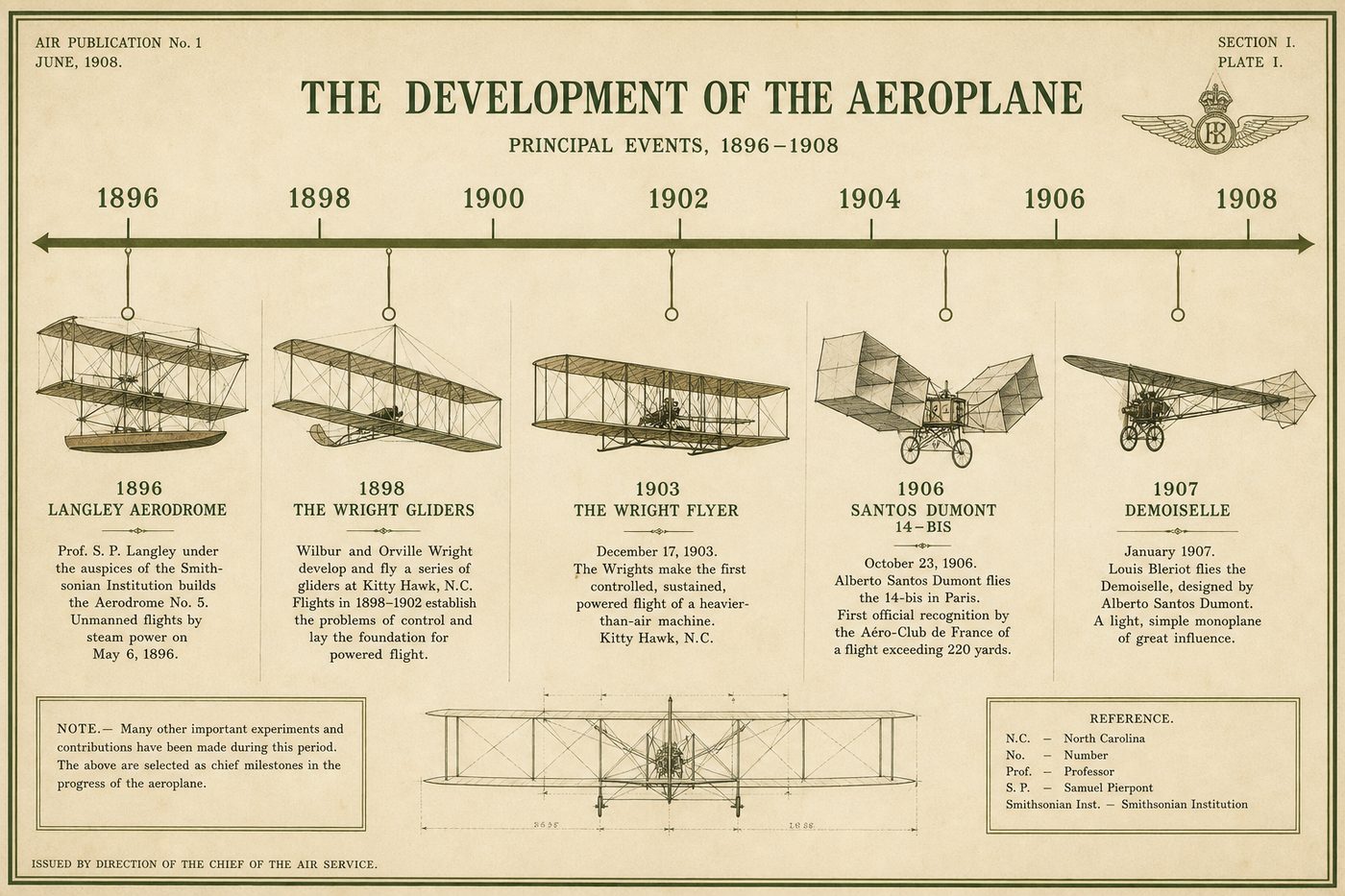
Plate D · Pioneer era timeline · Artist’s impression · key dates in the first-flight dispute
Other claimants (briefly)
Richard Pearse in New Zealand, Gustave Whitehead in Connecticut, Clement Ader in France, and Samuel Langley in Washington have all been proposed as “first” by someone. None commands the evidence or the institutional recognition of the Wrights or Santos Dumont. The Fédération Aéronautique Internationale — founded 1905 in Paris — is the usual arbiter for aviation records; its position on the Wrights has shifted over the decades as new evidence emerged.
Chapter IV · Institutional combat
The Smithsonian War
Langley vs Wright vs Curtiss · 1903–1948
The dispute was not only transatlantic. It was also fought inside the United States — and at its centre was the Smithsonian Institution, which had spent $50,000 of US government money on Samuel Langley’s Aerodrome, watched it collapse into the Potomac twice in 1903, and then found itself with a vested interest in not crediting two bicycle mechanics from Ohio.
When the Wright Flyer finally reached the Smithsonian in 1948, Orville Wright insisted on a label stating that the museum recognised the 1903 Flyer as the first heavier-than-air machine “capable of flight.” He had previously loaned the aircraft to the Science Museum, London for twenty years rather than let the Smithsonian display it with Langley’s machine credited as first. The feud lasted decades.
Glenn Curtiss, meanwhile, had modified Langley’s Aerodrome in 1914 to make a brief hop and claimed Langley had been first — a demonstration widely regarded as rigged. The Wright patent wars with Curtiss nearly bankrupted the American aviation industry. National museums, national heroes, and national pride were never far from the surface.
Why historians care
The Smithsonian case shows that “who flew first” was never a purely technical question. It was always about patents, prestige, government funding, and which country got to tell the story. Brazil’s embrace of Santos Dumont is the same phenomenon from the other side of the equator.
Moving pictures
Smithsonian National Air and Space Museum · The Story a Photo Tells
Santos Dumont & the 14-bis · Bagatelle flights of October–November 1906
Chapter V · Ledger
Side by Side
The comparison table both sides refuse to sit down and write together
Criterion
Wright Brothers (1903)
Santos Dumont (1906)
Date of defining flight
17 Dec 1903
23 Oct 1906
Three-axis control demonstrated
Yes — wing-warping + rudder
Limited on early hops; improved by Nov
Duration of defining flight
12 sec (first) / 59 sec (best that day)
~7 sec (60 m hop)
Sustained practical flight
1905 Flyer III — 24+ miles
Not demonstrated in 1906
Unassisted wheel take-off
No — rail, skids; catapult from 1904
Yes — grass run on wheels
Official witnesses & certification
Five local witnesses; no FAI record
Aéro-Club de France; FAI recognised
Public demonstration
Remote beach; press not invited
Paris park; press and public
Photographic evidence
Iconic Daniels photograph
Photographs and postcards from 1906
US national narrative
Founding myth of aviation
Little known until recently
Brazilian national narrative
Denied by federal law
“Pai da Aviação” by law
Chapter VI · Dispatch
The Verdict
If you mean who first solved powered flight as an engineering problem and flew a controllable aeroplane — the answer is the Wright brothers, in 1903, with a machine that by 1905 could stay aloft for half an hour. No serious aviation historian disputes this.
If you mean who first flew before official witnesses, under European rules, in an unassisted wheeled take-off that the contemporary aviation establishment certified — the answer is Alberto Santos Dumont, in Paris, on 23 October 1906. That is what the FAI recorded. That is what Brazil celebrates. That is also true.
Both answers are right. They measure different things. The tragedy is that two genuine pioneers have been drafted into a zero-sum national argument neither of them entirely deserved. Santos Dumont admired the Wrights’ achievement; the Wrights, once they stopped being secretive, changed the world. The sky was big enough for both.
For the Wrights
First powered, controlled, heavier-than-air flight. Three years ahead. The entire modern aeroplane — every 737, every Spitfire in our Compendium, every jet at the Mach Loop — descends from their control system and their method.
For Santos Dumont
First certified public flight under rules that Europe wrote and kept. The father of aviation in Brazil. A pioneer who shared his designs openly and flew in full view of the world — including from a machine with wheels, which is how every airliner at Heathrow still takes off.
On charge in Britain
See a Wright Flyer in the UK
The gazetteer holds no original 1903 Flyer — the real machine hangs in the Smithsonian. But you can stand next to a replica at the Yorkshire Air Museum (Elvington), which opens the pioneer era in our Compendium ledger alongside Cayley’s glider and the rest of the pre-war story.
Wire Wright Flyer wireframe — derived from AP 118 Compendium line-drawing set
LAST VERIFIED: 17 JULY 2026
AIR PUBLICATION 118 · SPECIAL ARTICLE · WHO FLEW FIRST? · JULY 2026
The Wright Brothers vs Alberto Santos Dumont — two firsts, one sky. Return to the Aviation Gazetteer for all 118 UK aviation museums.
ERRORS & OMISSIONS: report to the compiler. KEEP CALM AND CHECK NOTAMS.