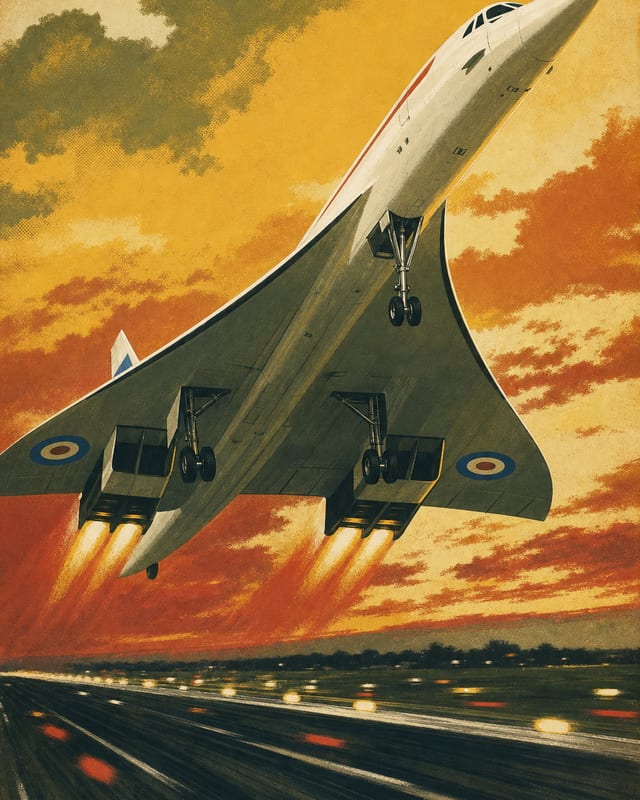
Concorde retired in October 2003 and has spent the two decades since drawing quiet crowds in museum hangars, because it remains the only supersonic airliner that ever worked — and, increasingly, the only one that ever will. London to New York in under three hours, Mach 2.04 at 60,000 feet, champagne level throughout. No aircraft in this gazetteer gathers a more reverent semicircle at the nose.
This page lists every Concorde you can visit in the United Kingdom, what makes each airframe particular, and what to expect when you get there.
The six, at a glance
| Airframe | Where | Why this one matters |
|---|---|---|
| G-BOAA | National Museum of Flight, East Fortune (Scotland) | The first Concorde to fly a British Airways commercial service, 1976 |
| G-BOAC | Runway Visitor Park, Manchester Airport | The fleet flagship — the registration carries the airline's initials |
| G-BOAF | Aerospace Bristol, Filton | The last Concorde ever built, and the last ever to fly — home to Bristol, 26 November 2003 |
| G-AXDN | IWM Duxford, Cambridgeshire | Pre-production development aircraft; flew to Duxford in 1977 |
| G-BSST | Fleet Air Arm Museum, Yeovilton | Concorde 002 — the first British-assembled Concorde, second of the type ever to fly (April 1969) |
| G-BBDG | Brooklands Museum, Weybridge | Development-production aircraft that proved the type for service; Brooklands also holds the simulator that trained every UK Concorde pilot |
A seventh British airframe, G-BOAB, is stored at Heathrow and visible from some airport vantage points, but is not on public display.
Choosing your Concorde
For the complete story: Aerospace Bristol. Alpha Foxtrot (G-BOAF) sits in a purpose-built hangar at Filton, where every British Concorde was assembled, and the museum around it tells the whole programme — Anglo-French politics included. Watching the last Concorde ever to fly, parked a few hundred yards from where she was built, is the closest the programme has to a homecoming.
For the cockpit-to-tail walkthrough: Manchester or East Fortune. Both offer boarding — East Fortune with Scotland's national collection around it, Manchester with live airport traffic outside the window as a reminder of what subsonic looks like.
For the engineering: Duxford and Yeovilton. G-AXDN and G-BSST are the development aircraft — heavier, stranger, fitted with test equipment the production fleet shed. 002 at Yeovilton is the machine that made the British half of the programme real; it shares a hall with the Fleet Air Arm's carrier jets, which is bracing company.
For the pilot's seat: Brooklands. Delta Golf hosts cabin tours, and the museum operates the original UK Concorde flight simulator — bookable, for a fee, and flown under the supervision of people who will let you discover how quickly Mach 2 uses up the English Channel.
Frequently asked
How many Concordes are left?
Eighteen of the twenty airframes survive, split between Britain, France, the United States, Germany and Barbados. Britain's six public examples are the largest national group.
Can you go inside Concorde?
Yes — at most UK sites boarding is included or available as a tour. The cabin is smaller than most first-time visitors expect: 2+2 seating in a fuselage barely wider than a regional turboprop. The ticket bought speed, not space.
Will Concorde ever fly again?
No. Beyond the engineering, the certification, spares and support that supersonic passenger flight required have gone. What remains is generously distributed and beautifully kept — this page is the itinerary.
What was the fastest crossing?
New York to London in 2 hours 52 minutes 59 seconds, in 1996. The record for a subsonic airliner is around five hours. It stands as a rebuke.
Aircraft occasionally close for conservation work; boarding arrangements and tour prices vary by site. Check each museum's gazetteer entry and official website before travelling.