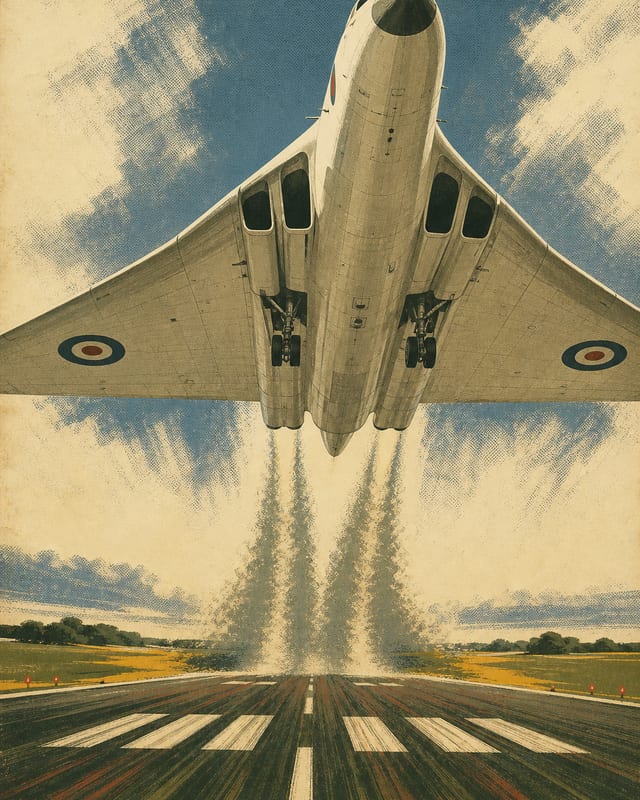
One hundred and thirty-six Vulcans were built; the type retired from RAF service in 1984, two years after flying the longest bombing raid in history to crater a Falklands runway. The last airworthy example, XH558, made its final flight in October 2015, and no Vulcan will fly again. That is the bad news, and it is the only bad news: Britain has preserved the Vulcan more generously than almost any large aircraft in this gazetteer, and — the part first-time visitors don't expect — several of them are still live, taxiing under their own power at public events.
Hear one first: the live Vulcans
A parked Vulcan is impressive. A Vulcan at full power is a physical event — the famous intake "howl" arrives through your chest before your ears. Three survivors still run:
| Aircraft | Where | What happens |
|---|---|---|
| XH558 — the Spirit of Great Britain | The Vulcan Experience, Doncaster | The last Vulcan to fly, now the centrepiece of its own visitor attraction, with engine ground runs at ticketed events |
| XL426 | Vulcan Restoration Trust, Southend | Kept in taxiable condition by the trust; public visit days and ticketed fast-taxi runs |
| XM655 | Wellesbourne Wartime Museum, Warwickshire | Regular ticketed taxi-run days |
Taxi-run tickets sell out, and dates shift with maintenance — book ahead through each organisation, and treat every scheduled run as provisional. Jet engines from 1958 keep their own diary.
Museums with a Vulcan on display
The Compendium records the Vulcan on charge at eleven of the gazetteer's major museums, with several more across the wider survey:
The complete airframes
| Museum | Aircraft | Notes |
|---|---|---|
| RAF Museum London (Hendon) | XL318 | In the Bomber Command hall — the Vulcan in its institutional context, beside the Lancaster lineage it succeeded. Free entry. |
| RAF Museum Midlands (Cosford) | XM598 | Part of Cosford's V-bomber trio — Vulcan, Victor and Valiant under one roof, the only place all three can be compared. Free entry. |
| IWM Duxford | XJ824 | |
| National Museum of Flight (East Fortune) | XM597 | The Black Buck veteran — flew anti-radar missions in the Falklands war and famously diverted to Brazil with a jammed refuelling probe. The most storied Vulcan on display. |
| Newark Air Museum | XM594 | |
| Midland Air Museum (Coventry) | XL360 | |
| Avro Heritage Museum (Woodford) | XM603 | The white one — anti-flash finish, on the site of the factory that built it. |
| Solway Aviation Museum (Carlisle) | XJ823 | |
| East Midlands Aeropark | XM575 | |
| City of Norwich Aviation Museum | XM612 | |
| North East Land, Sea and Air Museums (Sunderland) | XL319 |
Cockpits and sections
Several museums hold Vulcan cockpit sections you can actually climb into — often with a volunteer who flew or serviced the type sitting in the other seat, which is worth more than any information panel.
The five-minute Vulcan briefing
- First flight: 30 August 1952 — a tailless delta bomber four years after most air forces had accepted the future was straight wings and caution.
- The job: Britain's airborne nuclear deterrent, 1957–1969, held at fifteen-minute readiness. The crews' scramble drills were measured in seconds.
- The encore: Operation Black Buck, 1982 — 7,700-mile round trips from Ascension Island to the Falklands, then the longest bombing missions ever flown.
- The howl: an accident of intake acoustics at high power, never designed, never explained to anyone's full satisfaction, and now the most beloved noise in British aviation preservation. The taxi-run organisations above are its custodians.
Frequently asked
Can I see a Vulcan fly?
No — XH558's 2015 retirement ended Vulcan flight permanently; the engineering authority and funding required to keep one airworthy no longer exist. The taxi runs are the closest surviving experience, and they are closer than you might think: full power, brakes off, nose lifting — everything but the leaving.
Which is the best Vulcan to visit?
For the aircraft alone, Cosford (context of the full V-force) or East Fortune (the combat veteran). For the experience, any of the three live airframes on a running day — no static display compares.
How many survive?
Nineteen complete Vulcans exist worldwide, most of them in Britain — the largest group of preserved V-bombers anywhere.
Engine-run and taxi events are scheduled by volunteer organisations and are always subject to serviceability. Verify dates on each trust's official site before travelling.