Types you’ll see alongside
Airspeed Horsa & Waco Hadrian, British Aerospace 146, Cierva C.30 / Avro Rota, de Havilland Canada Chipmunk, de Havilland Comet.
Aircraft hub · 1944 · Early jet age
The Mosquito slimmed into a single-seat long-range fighter, a little too late for the war. No complete one survives. The gazetteer currently lists it at 1 UK museum.
Last verified 2026-11-20 against the gazetteer Compendium. Airframes move — confirm on museum pages before travel.
On charge
The gazetteer records 2 de Havilland Hornet & Sea Hornet airframes (including cockpit sections and replicas where noted) across 1 UK collection, in one region: London & Around.
| Museum | City | Region | Airframes recorded |
|---|---|---|---|
| De Havilland Aircraft MuseumChecked 2026-10-08 | St Albans | London & Around | de Havilland DH.103 Sea Hornet NF.21 tail section VX250 Cockpit or section de Havilland DH.103 Sea Hornet NF.21 rear fuselage VW957 Cockpit or section |
3D model
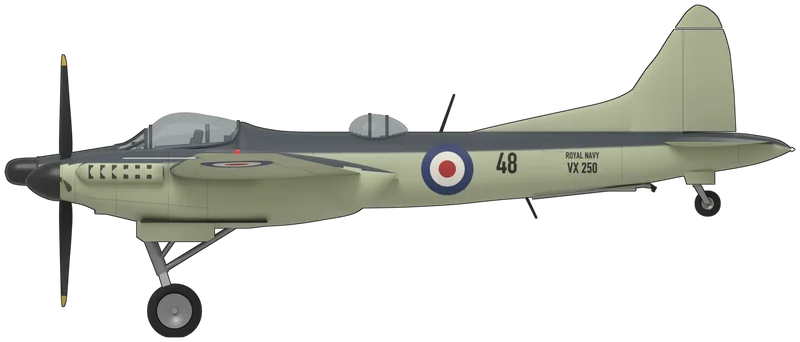
A procedural model built in Blender from the type’s published dimensions, painted as VX250, a de Havilland Sea Hornet NF.21 of the Fleet Air Arm, taken on charge in March 1950 and broken up at St Davids in December 1956: the two-seat radar night fighter version of the Hornet, de Havilland’s slender single-seat development of the Mosquito, with a wooden and light-alloy airframe, two handed 2,030 hp Rolls-Royce Merlin 134 and 135 engines driving four-bladed propellers that turn in opposite directions, flame dampers over the exhausts, an ASH radar in a thimble nose, the observer under a bubble canopy behind the wing, folding outer wings, an arrester hook and a dorsal fin fillet, shown standing tail-down on its main wheels and tail wheel with its wings spread: Extra Dark Sea Grey upper surfaces over Sky sides and undersides, a Sky fin and rudder, a black radome and spinners, black propellers with yellow tips, Type D roundels on the rear fuselage and above and below the wings, and ‘ROYAL NAVY’ over ‘VX 250’ with a large black ‘48’ ahead of it on both sides of the rear fuselage (shape from Ian Huntley’s NF.21 and F.1 drawings, cross-checked against a Wikimedia Commons three-view and photographs of Sea Hornets in service; the rear-fuselage markings follow the surviving section of VX250, which shows only the first two digits of its side number, so no third digit is painted; the rest of the scheme follows photographs of other NF.21s of the period, as no photograph of VX250 complete was found); no complete Hornet or Sea Hornet survives: the de Havilland Aircraft Museum at London Colney holds VX250’s rear fuselage and the rear fuselage of VW957. Drag to orbit, scroll or pinch to zoom · all 547 models · download .glb (1.1 MB) · Plate 279 in The Hangar
Computed from the survey
Airspeed Horsa & Waco Hadrian, British Aerospace 146, Cierva C.30 / Avro Rota, de Havilland Canada Chipmunk, de Havilland Comet.
London & Around has 1 collection recording the type.
de Havilland DH.103 Sea Hornet NF.21 rear fuselage; de Havilland DH.103 Sea Hornet NF.21 tail section.
Type notes
| Type | de Havilland Hornet & Sea Hornet (F.3, NF.21) |
|---|---|
| UK museums holding one | 1 |
| Airframes recorded in this survey | 2 |
Serials are the gazetteer's survey snapshot of what each collection records on charge — restorations move between workshops and reserve hangars, so check the museum page for opening times and current display status before travelling. Every type across 119 museums is indexed in the Compendium.
Aircraft questions
The Aviation Gazetteer records 2 de Havilland Hornet & Sea Hornet airframes in UK collections.
De Havilland Aircraft Museum has the most in this survey, with 2 recorded airframes.