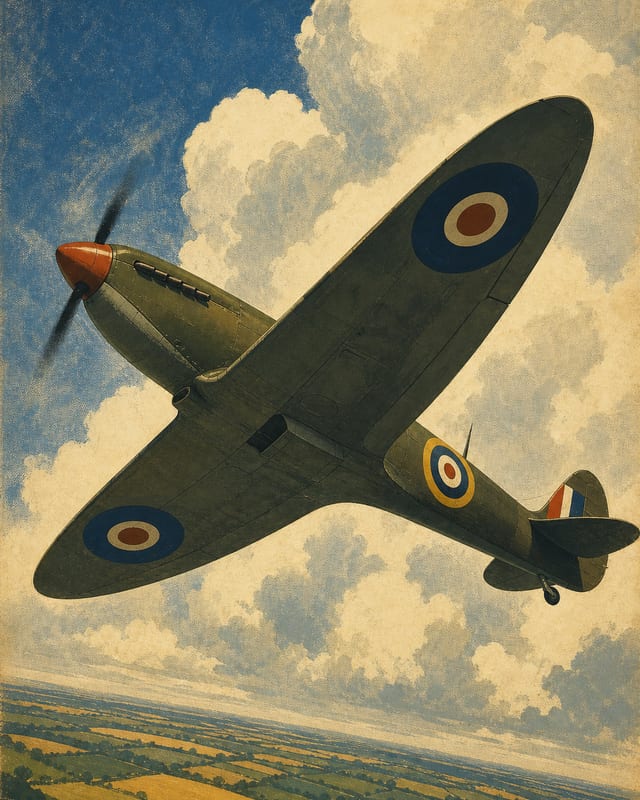
Twenty thousand three hundred and fifty-one Spitfires were built, plus 2,334 Seafires, and for a machine produced in such quantities it is now surprisingly easy to stand in the wrong county. Around 60 remain airworthy worldwide, and Britain — reasonably enough, having invented it — keeps the largest share. This page is the complete United Kingdom answer: where the static ones live, where the flying ones fly, and where you can be strapped into one yourself.
This is the gazetteer's single Spitfire finder: where the Spitfires in the UK are, which museums are dedicated to the type, and which of them can put a Merlin over your head. For the aeroplane's biography — all 24 marks of it — see Supplement No. 1: The Spitfire, and for the 2026 anniversary programme see The Spitfire at 90.
The short version
- Most Spitfires under one roof: Biggin Hill Heritage Hangar, Kent — a working stable of airworthy examples and restorations.
- The oldest survivor: Spitfire Mk Ia K9942 at the RAF Museum Midlands, Cosford.
- Guaranteed to fly: the Battle of Britain Memorial Flight, RAF Coningsby — five airworthy Spitfires, displaying all season, contracted to keep flying until at least 2035.
- Free to visit: RAF Museum London, RAF Museum Midlands, and the Spitfire & Hurricane Memorial Museum at Manston all cost nothing at the door.
- Sit in one: RAF Museum London's Spitfire Experience puts you in the cockpit of a genuine wartime Mk XVI.
Museums with a Spitfire on display
The gazetteer records the Spitfire family — Mks I to 24, plus Seafires — on charge at thirteen of its major museums, with several dedicated Spitfire sites besides. By region:
London & Around
| Museum | What you'll see | Notes |
|---|---|---|
| RAF Museum London (Hendon) | Spitfire(s) in the main halls | Free entry. Also home of the paid Spitfire Experience (below). |
| Biggin Hill Heritage Hangar (Westerham) | The largest working collection of airworthy Spitfires in the world | A restoration hangar, not a formal museum — tours and flights bookable. This is where Spitfires go to live, not retire. |
East of England
| Museum | What you'll see | Notes |
|---|---|---|
| IWM Duxford | Multiple Spitfires, static and airworthy — including Mk Ia N3200, the "Dunkirk Spitfire" of 19 Squadron, the first squadron to fly the type | Resident operators fly Spitfires from the aerodrome; on a good day you don't need an airshow ticket to hear a Merlin. |
| The Shuttleworth Collection (Old Warden) | Airworthy Spitfire flown at the collection's evening airshows | The most intimate place in Britain to watch one fly. |
South East England
| Museum | What you'll see | Notes |
|---|---|---|
| Solent Sky (Southampton) | Spitfire Mk 24 PK683 — the final shape of the breed, a mile from where R.J. Mitchell designed the first | Southampton is the Spitfire's home town; the prototype first flew from Eastleigh, up the road. |
| Tangmere Military Aviation Museum (Chichester) | Full-scale replica of prototype K5054, presented by the Spitfire Society in 2013 | The real K5054 no longer exists; this is as close as you can stand to the aeroplane of 5 March 1936. |
| Spitfire & Hurricane Memorial Museum (Manston, Kent) | Spitfire Mk XVI TB752, a combat veteran of the North-West Europe campaign | Free admission. |
| Kent Battle of Britain Museum (Hawkinge) | Full-scale replicas amid the largest collection of Battle of Britain artefacts anywhere | Not a flying site — a shrine. |
Midlands & Lincolnshire
| Museum | What you'll see | Notes |
|---|---|---|
| RAF Museum Midlands (Cosford) | Spitfire Mk Ia K9942 — the oldest surviving Spitfire in the world, built 1939 | Free entry. |
| Battle of Britain Memorial Flight Visitors Centre (Coningsby) | The BBMF's five airworthy Spitfires at home, including P7350 — the only Spitfire still flying that fought in the Battle of Britain | Guided hangar tours; aircraft may be away displaying in summer, which is rather the point of them. |
| The Potteries Spitfire Gallery (Stoke-on-Trent) | Spitfire Mk XVIe RW388, given to the city in 1972 in honour of Stoke's own R.J. Mitchell | A Spitfire in a city museum, for the designer's home town. |
Northern England
| Museum | What you'll see | Notes |
|---|---|---|
| Yorkshire Air Museum (Elvington) | Spitfire | Part of the largest independent air museum in Britain. |
| Spitfire Visitor Centre, Hangar 42 (Blackpool) | Spitfire restoration and display in a wartime hangar | A working shop floor — the smell of the 1940s included at no extra charge. |
Scotland, Wales & Northern Ireland
| Museum | What you'll see | Notes |
|---|---|---|
| National Museum of Flight (East Fortune) | Spitfire Mk XVI | Scotland's national aviation collection. |
| Montrose Air Station Heritage Centre | Spitfire replica on Britain's first operational military airfield | |
| Welsh Spitfire Museum (Haverfordwest) | Spitfire restoration project and collection | Wales's dedicated Spitfire house. |
| Ulster Aviation Society (Lisburn) | Seafire — the Spitfire that went to sea | The family's naval branch, and Northern Ireland's example. |
Beyond the gazetteer's museums proper: Thinktank, Birmingham holds Mk IXc ML427 near the Castle Bromwich factory site that built more than 10,000 Spitfires — worth knowing if you're in the city.
The dedicated Spitfire museums
Four places in Britain are about the Spitfire rather than merely containing one:
- Welsh Spitfire Museum, Haverfordwest — Wales's Spitfire house, where a genuine 1944 Mk VIII is being restored towards flight behind a charity shop that funds the work. Small, free-spirited, and the answer to "is there a Spitfire museum in Wales?"
- Spitfire & Hurricane Memorial Museum, Manston — a Mk XVI and a Hurricane in purpose-built memorial halls beside the wartime airfield, free at the door.
- Spitfire Visitor Centre, Hangar 42, Blackpool — restoration on a 1939 factory hangar floor, so you see the work rather than the finished object.
- The Potteries Spitfire Gallery, Stoke-on-Trent — Mk XVIe RW388, given to the city in 1972 for R.J. Mitchell, its most consequential son.
Add Biggin Hill Heritage Hangar if your definition of a museum can stretch to a working Spitfire factory floor. It has more airworthy Spitfires than anywhere on earth.
Where to see a Spitfire fly
A Spitfire on a pole is a sculpture. The engine is half the animal, and these are the reliable places to hear it:
- The Battle of Britain Memorial Flight — five Spitfires (and two Hurricanes, and the Lancaster) displaying at airshows and flypasts across the country all season. The MOD contracted in April 2026 to keep the flight airworthy until at least December 2035, so this is not a closing window. Check the BBMF's published schedule for appearances near you.
- IWM Duxford's airshows — the September Battle of Britain Air Show regularly masses Spitfires and Hurricanes into the "Big Wing"; the 2026 edition (12–13 September) marks the type's 90th anniversary. Advance booking only — there are no tickets on the gate.
- The Shuttleworth Collection's flying evenings (Old Warden) — small crowd, low flying, long summer light.
- Biggin Hill — with the largest airworthy fleet anywhere, something is usually flying on any fair-weather day; you just won't get a programme.
Sit in one, fly in one
- Sit: the RAF Museum London Spitfire Experience seats you in a genuine wartime Mk XVI — around £30 for a ten-minute cockpit session, bookable through 2026. Several smaller museums (Hangar 42 among them) offer cockpit access on selected days.
- Fly: two-seat Spitfire flights operate commercially from Biggin Hill and Goodwood, among others. Expect four figures. Expect to conclude it was worth it.
Frequently asked
How many Spitfires are left?
Roughly 240 survive worldwide in some form, around 60 of them airworthy — and more return to flight each year, because Spitfire restoration is now an industry.
What's the difference between seeing one at a museum and at an airshow?
The museum gives you the details — the rivets, the gunsight, the improbable slimness of the thing. The airshow gives you the noise. The complete education requires both, which this gazetteer regards as excellent news for your calendar.
Where did the Spitfire first fly?
Eastleigh (now Southampton Airport), 5 March 1936, prototype K5054, Mutt Summers at the controls. Solent Sky museum tells the local story; the full biography is in Supplement No. 1.
Is there a Spitfire museum in Wales?
Yes — the Welsh Spitfire Museum at Haverfordwest, restoring a 1944 Mk VIII. Check its opening arrangements before travelling; it has moved premises along the same street.
Which UK museum has the most Spitfires?
Biggin Hill Heritage Hangar, by a wide margin, because it is a working restoration and flight operation rather than a display. For static airframes under one roof, IWM Duxford and the RAF Museum sites are the strongest.
Opening hours and aircraft locations change — airframes go away for restoration, and flying examples are, by definition, sometimes elsewhere. Details verified 2026-08-03; check each museum's gazetteer entry and official site before travelling.