Also known as RNAS East Fortune · No. 201 Training Depot Station
The story of RAF East Fortune
In July 1919 the airship R34 left East Fortune for Mineola, New York. It made the first east-to-west crossing of the Atlantic by air and the first return crossing. The outward flight took 108 hours and 12 minutes. The station closed in 1920. Its hangars were demolished, and the domestic site became a tuberculosis sanatorium.
The land was requisitioned again in June 1940 as a satellite for RAF Drem. On 4 June 1941 No. 60 Operational Training Unit arrived to train night-fighter crews on Defiants. As the night threat faded, it switched to coastal strike training with Beaufighters. In November 1942 it became No. 132 OTU, which stayed until May 1946. East Fortune was also an emergency diversion field for returning bombers. In 1950 the USAF extended the runway for strategic bombers but never used it. The airfield was sold in 1960. The National Museum of Flight has used the buildings since 1976.
Flying units
| Unit | Years | Aircraft |
|---|---|---|
| Royal Naval Air Service airship and aeroplane station | 1916–1918 | |
| Torpedo Aeroplane School / No. 201 Training Depot Station | 1918–1920 | Sopwith Snipe |
| Airship R34 | 1919–1919 | |
| No. 60 Operational Training Unit | 1941–1942 | Boulton Paul Defiant, Bristol Beaufighter |
| No. 132 Operational Training Unit | 1942–1946 | Bristol Blenheim, Bristol Beaufighter, Bristol Beaufort |
What survives
- Wartime RAF buildings, now the National Museum of Flight
- The airfield, a scheduled monument, still used for private flying
The museum on the airfield
| Museum | Adult entry | Airframes | Headline exhibit |
|---|---|---|---|
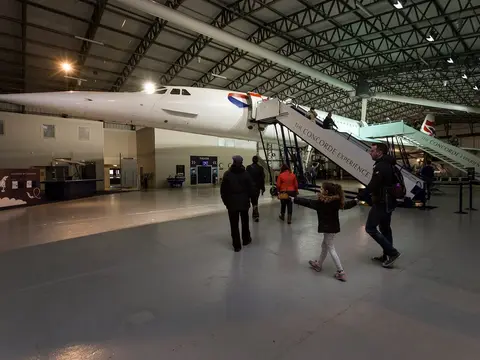
| National Museum Of FlightNorth Berwick, East Lothian | £15 | 47 | Concorde G-BOAA, which flew British Airways' first commercial supersonic service in 1976 and arrived here by barge and giant road-crawl… |