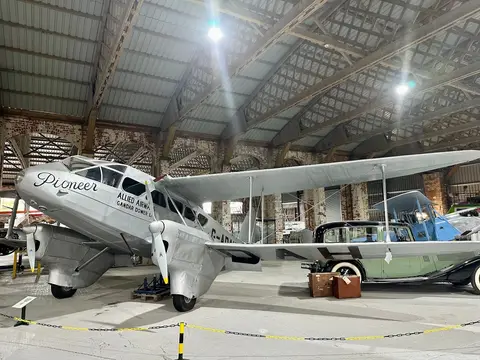
Also known as No. 4 Training Depot Station · Hooton Aerodrome
The story of RAF Hooton Park
In 1927 an air pageant led to the Liverpool and District Aero Club forming here. Nicholas Comper built his Comper Swift at Hooton, and Douglas Pobjoy made engines. No. 610 (County of Chester) Squadron formed in 1936. It left for war in 1939 and fought in the Battle of Britain from Biggin Hill. During the war Martin Hearn Ltd repaired Ansons and Mosquitos at Hooton. It also assembled US aircraft shipped into the Mersey, including Mustangs and P-38s. The RAF's first Sikorsky helicopters were assembled and tested here. A 6,000 ft concrete runway was laid in 1941.
No. 610 Squadron returned in 1946 and flew Meteors from 1951, joined by No. 611 Squadron. The airfield closed in 1957 when the Auxiliary squadrons disbanded. Vauxhall built its Ellesmere Port plant on the site. The three First World War hangars survived and were listed Grade II in 1985. The Hooton Park Trust has owned them since 2000.
Flying units
| Unit | Years | Aircraft |
|---|---|---|
| No. 4 Training Depot Station | 1917–1918 | Sopwith Dolphin, Avro 504 |
| No. 610 (County of Chester) Squadron, Auxiliary Air Force | 1936–1957 | Fairey Battle, Spitfire I, Gloster Meteor |
| No. 7 Aircraft Assembly Unit (Martin Hearn Ltd) | ||
| No. 663 (AOP) Squadron | 1949 | Auster |
| No. 611 (West Lancashire) Squadron | 1951 | Gloster Meteor |
What survives
- Three double-bay 1917 Belfast truss hangars, listed Grade II in 1985
- Owned since 2000 by the Hooton Park Trust
The museum on the airfield
| Museum | Adult entry | Airframes | Headline exhibit |
|---|---|---|---|
| Hooton Park HangarsEllesmere Port, Cheshire | £9 | 45 | Hooton Park's 1917 Belfast-truss hangars — among the finest WWI aviation buildings surviving — hold aircraft, buses and a printing museum… |