Also known as Station 131
The story of RAF Nuthampstead
Though built for bombers, it first housed the 55th Fighter Group, from September 1943 to April 1944. Its P-38H Lightnings carried green and yellow chequers. The group began operations on 15 October 1943 and was the first to fly long-range P-38 escort missions from Britain. British fuel additives caused engine trouble and icing at altitude. In April 1944 the group moved to Wormingford.
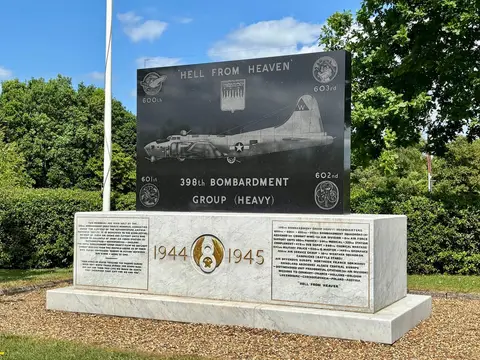
The 398th Bombardment Group replaced it, flying B-17Gs with a 'Triangle-W' tail code. It entered combat in May 1944 and bombed Berlin, Munich, Kiel and Merseburg. It supported Normandy, the Netherlands landings and the Battle of the Bulge. Its last mission hit an airfield at Pilsen on 25 April 1945. In 195 missions it lost 58 B-17s. The RAF used the base as an ordnance store, and it closed on 1 March 1959. Much of the concrete went into building the M1.
Flying units
| Unit | Years | Aircraft |
|---|---|---|
| 55th Fighter Group, USAAF | 1943–1944 | Lockheed P-38H Lightning |
| 398th Bombardment Group (Heavy), USAAF | 1944–1945 | Boeing B-17G Flying Fortress |
What survives
- Single-lane farm roads on the line of the perimeter track
- Former technical site buildings used by private companies
- A grass strip on the north-east end of the main runway
The museum on the airfield
| Museum | Adult entry | Airframes | Headline exhibit |
|---|---|---|---|
| Nuthampstead Airfield MuseumRoyston, Hertfordshire | Free | 1 | The 398th Bomb Group's Nuthampstead story — plus the 55th Fighter Group — in a smart little museum behind the Woodman Inn, which handles… |