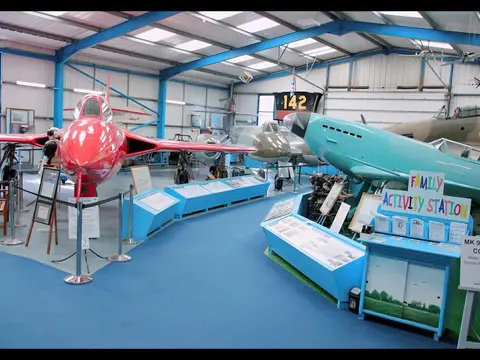
Also known as CFE Tangmere
The story of RAF Tangmere
The airfield was enlarged in 1939 to defend the south coast. On 16 August 1940 Ju 87 dive bombers attacked it, killing 14 ground staff and six civilians. The station stayed in action. Throughout the war, No. 161 (Special Duty) Squadron's Lysanders used it for flights into occupied France. SOE agents waited at Tangmere Cottage, opposite the main gate. In 1941 Douglas Bader led the Tangmere wing, and No. 616 Squadron brought Johnnie Johnson.
The Central Fighter Establishment arrived in 1945. In September 1946 Teddy Donaldson set a world air speed record of 616 mph in a Meteor from here. Neville Duke raised it to 727.63 mph in a Hunter in 1953. The last flying units left in 1963–64. Prince Charles took his first flying lesson here in 1968. The station closed on 16 October 1970. Most of the airfield is now farmland and housing.
Flying units
| Unit | Years | Aircraft |
|---|---|---|
| No. 43 Squadron | 1926–1939 | Gloster Gamecock, Armstrong Whitworth Siskin, Hawker Fury, Hawker Hurricane |
| No. 1 Squadron | 1927–1939 | Armstrong Whitworth Siskin, Hawker Fury, Hawker Hurricane |
| No. 616 Squadron | 1941–1941 | Supermarine Spitfire |
| No. 1 Squadron | 1946 | Spitfire F.21, Gloster Meteor, Hawker Hunter |
| No. 29 Squadron | 1950–1957 | de Havilland Mosquito, Gloster Meteor NF.11 |
What survives
- Grade II listed control tower, on the Heritage at Risk Register
- One 'H Block' barrack building and the former officers' quarters
- Graves of airmen from both sides at St Andrew's Church
The museum on the airfield
| Museum | Adult entry | Airframes | Headline exhibit |
|---|---|---|---|
| Tangmere Military Aviation MuseumChichester, West Sussex | £15 | 23 | Hawker Hunter WB188 in one-off scarlet, in which Neville Duke took the world air speed record to 727.63 mph off this coast in 1953;… |