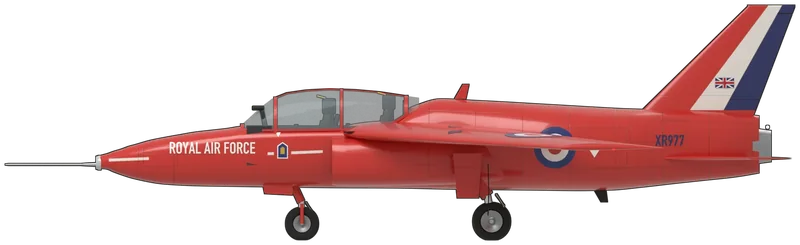
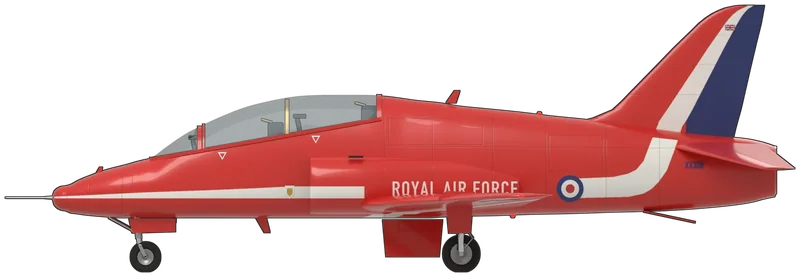
Specifications compared


| Variant compared | Gnat T.1 | Hawk T1 |
|---|---|---|
| First flight | 18 Jul 1955 (type) | 21 Aug 1974 |
| Entered service | 1959 (RAF) | 1976 (RAF) |
| Max speed | 636 mph (1,024 km/h) at 31,000 ft | Mach 0.88 in level flight; Mach 1.15 in a dive |
| Engine | Bristol Siddeley Orpheus 100, 4,270 lbf (19.0 kN) | Rolls-Royce Turbomeca Adour turbofan |
| Armament | None in RAF trainer service (F.1 fighter: 2 × 30 mm ADEN) | Centreline 30 mm ADEN pod; T1A: 2 × Sidewinder |
| Number built | 449 (all versions, including Ajeet) | 1,000+ (all versions) |
| Crew | 2 (tandem) | 2 (tandem) |
A lightweight fighter turned trainer
Teddy Petter designed the Gnat at Folland as a cheap, light fighter. He believed modern fighters had grown too costly in man-hours and materials. The Gnat flew on 18 July 1955.
The RAF never used it as a fighter. It ordered the two-seat Gnat T.1 as an advanced trainer, which entered service in 1959. The last was delivered in May 1965.
Abroad it did fight. Indian Gnats were credited with seven Pakistani Sabres in 1965, and India built the improved Ajeet.
It needed no specialist tools to build or maintain, which suited less industrialised countries. Finland and Yugoslavia bought the fighter version too.
A trainer designed as one
The Hawk's prototype, XX154, flew from Dunsfold on 21 August 1974. It was designed from the start as a trainer, with the instructor's rear seat raised for a good view forward.
It entered RAF service in 1976, replacing the Gnat and the Hunter for advanced and weapons training. It can reach Mach 0.88 in level flight and Mach 1.15 in a dive.
From 1983, 88 Hawk T1s were modified as T1As to carry two Sidewinder missiles and a 30 mm gun pod. They were to serve as short-range interceptors in wartime.
In 2017 the RAF and Navy still flew 75 Hawk T1s, with a planned retirement date of 2030.
The Red Arrows
The Red Arrows began in 1965 with seven Gnats inherited from the Yellowjacks display team. The Gnat was chosen because it was cheaper to run than a front-line fighter.
In late 1979 the team switched to the Hawk T1. It has flown Hawks ever since, from RAF Waddington.
In 1966 the team grew to nine aircraft, creating its Diamond Nine formation.
The record
449 Gnats were built, including India's Ajeet. More than 1,000 Hawks have been sold, to air forces worldwide. A naval derivative, the T-45 Goshawk, trains United States Navy pilots.
British Hawk production at Brough ended in 2020.
Where to see a Gnat and a Hawk
South Wales Aviation Museum is the one gazetteer museum with both, a Gnat T.1 and a Hawk T1A. For the full Hawk story, Boscombe Down Aviation Collection keeps the prototype XX154, and the National Museum Of Flight shows ex-Red Arrows Hawk XX308.
| Museum | Adult entry | Airframes | Headline exhibit |
|---|---|---|---|
| South Wales Aviation MuseumBarry, Vale of Glamorgan | £10 | 73 | The resident Harrier and a growing VC10/Tornado-era collection, most with steps and open canopies. Kids exit wearing thousand-yard grins. |
Frequently asked
When did the Red Arrows change from the Gnat to the Hawk?
In late 1979. The team had flown Gnats since its formation in 1965.
Was the Gnat faster than the Hawk?
On paper, yes: the Gnat T.1 was listed at 636 mph at height, while the Hawk reaches Mach 0.88 in level flight. The Hawk is the sturdier and more capable trainer.
Where can I see a Gnat and a Hawk together?
At South Wales Aviation Museum, St Athan. The Royal Air Force Museum London, Newark Air Museum and Midland Air Museum hold Gnats; Hawks are at a dozen gazetteer museums.