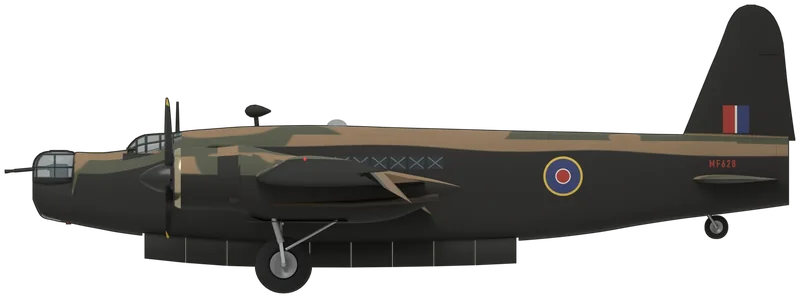
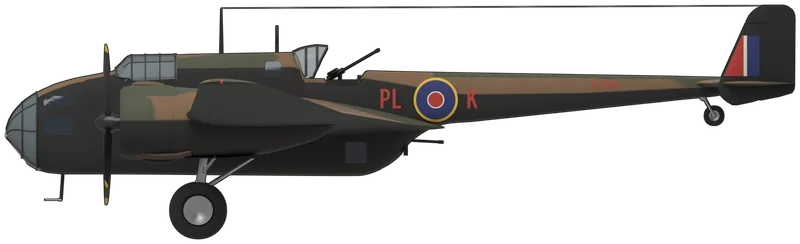
Specifications compared


| Variant compared | Wellington Mk IC | Hampden Mk I |
|---|---|---|
| First flight | 15 Jun 1936 | 21 Jun 1936 |
| Entered service | Oct 1938 | 1938 |
| Max speed | 235 mph (378 km/h) at 15,500 ft | 247 mph (398 km/h) at 13,800 ft |
| Engine | 2 × Bristol Pegasus XVIII, 1,050 hp each | 2 × Bristol Pegasus XVIII, 1,000 hp each |
| Armament | 6–8 × .303 in Browning MG in turrets; 4,500 lb bombs | 1 fixed .303 in Browning and hand-held Vickers K MGs; 4,000 lb bombs or one 18 in torpedo |
| Number built | 11,461 | 1,430 |
| Crew | 5–6 | 4 |
Two designs of 1936
The Hampden flew on 21 June 1936, and the Wellington six days earlier. Both entered service in 1938, joining the Whitley as Bomber Command's medium bombers.
Vickers's chief designer Rex Pierson led the Wellington team at Brooklands. Its geodetic airframe, a lattice of light members, came from Barnes Wallis. In tests it reached a strength factor of 11 without failing, against the six required.
Gustav Lachmann's Hampden was slim and deep, only three feet wide. C. G. Grey said it looked like a flying suitcase, and the name stuck.
Performance and defence
The Hampden was faster, at 247 mph, and climbed better than its contemporaries. To save the weight of powered turrets, it relied on hand-held Vickers K guns and one fixed Browning.
The Wellington had powered turrets and carried 4,500 lb of bombs to the Hampden's 4,000 lb. Its geodetic structure took longer to build than a conventional one, which drew criticism.
The Hampden's crew of four had almost no room to move. Its pilots found it a fine aircraft to fly and a poor one to fly in.
The record
Both types joined the first RAF raid on Berlin on 25 August 1940. Hampden crews won two Victoria Crosses that summer, Rod Learoyd and John Hannah.
From April 1942 Hampden squadrons moved to Coastal Command as torpedo bombers, some flying from north Russia to guard Arctic convoys. The last gave up the type in December 1943. Of 1,430 built, 714 were lost on operations.
The Wellington was the only British bomber built throughout the war, 11,461 in all. It flew 47,409 Bomber Command operations. On the first 1,000-bomber raid, on Cologne in May 1942, 599 of the 1,046 aircraft were Wellingtons. It retired in 1953.
Later Wellingtons hunted submarines and trained bomber crews. The T.10 at the Royal Air Force Museum Midlands is one of those trainers.
Where to see a Wellington and a Hampden
The Lincolnshire Aviation Heritage Centre at East Kirkby holds remains of a Wellington and a Hampden under restoration. For complete aircraft, Brooklands Museum shows Wellington N2980, raised from Loch Ness, and the Royal Air Force Museum London a Hampden fuselage.
| Museum | Adult entry | Airframes | Headline exhibit |
|---|---|---|---|
| Lincolnshire Aviation Heritage CentreSpilsby, Lincolnshire | £13.50 | 11 | Lancaster NX611 (taxiing now, returning to flight one day, they swear) and Mosquito NF.II HJ711 — the only running Mosquito in Europe.… |
Frequently asked
Which was the better bomber, the Wellington or the Hampden?
The Wellington. It carried more, was better defended and stayed useful throughout the war. The Hampden was faster but cramped and lightly armed.
Why was the Hampden called the flying suitcase?
Its fuselage was only three feet wide, deep and slab-sided. The editor C. G. Grey said it looked like a flying suitcase.
Where can I see a Wellington and a Hampden together?
The Lincolnshire Aviation Heritage Centre holds both, as remains and a restoration. Brooklands Museum and the Royal Air Force Museum Midlands have complete Wellingtons.