3D model
Turn it over
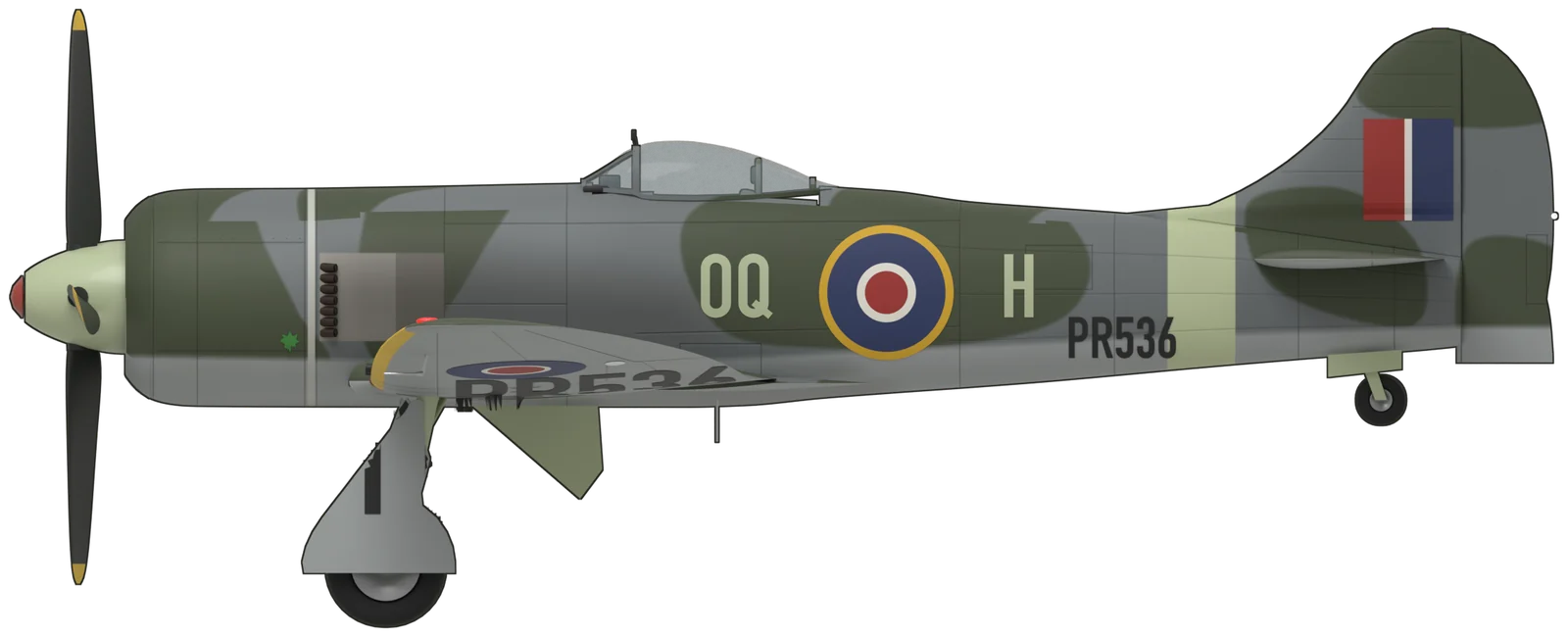
A procedural model built in Blender from published dimensions, drawings and photographs, painted as PR536, a Centaurus-engined Tempest II built by Bristol and later flown by the Indian Air Force, restored as ‘OQ-H’ of No. 5 Squadron: Ocean Grey and Dark Green upper surfaces over Medium Sea Grey, a Sky band round the rear fuselage, Sky codes beside Type C1 roundels, a Sky spinner with a red tip, yellow wing leading edges and a four-blade propeller with yellow tips, as it is displayed at RAF Museum Midlands, Cosford. Drag to orbit, scroll or pinch to zoom · download .glb (1.2 MB)
History
The Tempest II
Sydney Camm’s Hawker Typhoon, built round the 24-cylinder Napier Sabre, first flew in February 1940. It was fast low down but its thick wing held it back higher up, so Camm gave it a new, much thinner wing of almost elliptical plan, with the fuel moved into a longer fuselage. Called the Typhoon II at first and then the Tempest, the first prototype, HM595, flew on 2 September 1942. The Sabre-engined Tempest V reached the squadrons in April 1944 and was one of the fastest fighters at low level, shooting down 638 of the 1,846 V-1 flying bombs destroyed by aircraft before going on to hunt trains, transport and jet fighters over Germany.
The Tempest II was the same airframe with an 18-cylinder Bristol Centaurus radial in a tight, close-fitting cowling, the oil coolers and carburettor intake moved into the wing roots. The prototype, LA602, flew on 28 June 1943, but vibration from the big radial and the move of production from Gloster to Bristol and then back to Hawker held it up, and the installation that was finally adopted owed much to a study of a captured Focke-Wulf Fw 190. The first production aircraft came off the line on 4 October 1944. Bristol built 50 at Banwell and Hawker 402 at Langley, but none reached the squadrons before the war ended; they had been meant for Tiger Force, the planned British air contribution to the invasion of Japan.
After the war the Tempest II served with the RAF in Germany, India, Hong Kong and Malaya, where No. 33 Squadron flew strikes against communist guerrillas in the first years of the Malayan Emergency, the only time RAF Tempest IIs fought. When India became independent in 1947, Tempest IIs in India were handed over to the Royal Indian Air Force, which also bought further aircraft from Britain, and Pakistan took a smaller number. The RAF replaced its last Tempest IIs with jets and de Havilland Hornets by 1951, and India withdrew the type in 1953.
This airframe
Tempest II PR536 (‘OQ-H’)
PR536 was built by Hawker at Langley in 1945 and went out to India, where it flew with No. 5 Squadron from Peshawar and other bases in 1946 and 1947. On 20 September 1947 it was one of 124 RAF Tempest IIs handed over to the Royal Indian Air Force, becoming HA457, and after the type was withdrawn in 1953 it was left in store. Warbirds of Great Britain brought it back to Britain in 1979, and the RAF Museum acquired the fuselage in 1987 in exchange for parts of a Tempest V. The Fighter Collection restored it at Duxford in 1990–91 as a composite: the forward fuselage is PR536’s own, the rear fuselage came from Manadon and the wings from Kanpur, and it was fitted with a Vickers Varsity propeller, a Sea Fury canopy and Hurricane undercarriage legs. It was finished in the No. 5 Squadron markings it wore in a 1946 photograph and displayed at Hendon from 1991 until it moved to RAF Museum Midlands, Cosford, in January 2020. The model shows it in those markings: Ocean Grey and Dark Green over Medium Sea Grey, a Sky band round the rear fuselage, Sky codes ‘OQ-H’ beside Type C1 roundels, a Sky spinner with a red tip, yellow leading edges, a four-blade propeller with yellow tips and large black serials under the wings.
Where to see one
In the gazetteer
The gazetteer records the Tempest II in 4 UK collections. The airframe modelled here is marked.