Types you’ll see alongside
Avro Vulcan, de Havilland Vampire, Folland Gnat, Gloster Gamecock & Fairey Flycatcher, Gloster Gladiator.
Aircraft hub · 1941 · Second World War
Britain’s first jet, flown from Cranwell in May 1941 with Whittle’s engine in the back. The gazetteer currently lists it at 1 UK museum.
Last verified 2026-10-11 against the gazetteer Compendium. Airframes move — confirm on museum pages before travel.
On charge
The gazetteer records 1 Gloster E.28/39 airframe (including cockpit sections and replicas where noted) across 1 UK collection, in one region: South West England.
| Museum | City | Region | Airframes recorded |
|---|---|---|---|
| Jet Age MuseumChecked 2026-10-08 | Gloucester | South West England | Gloster E.28/39 Pioneer reproduction W4041 Replica |
3D model
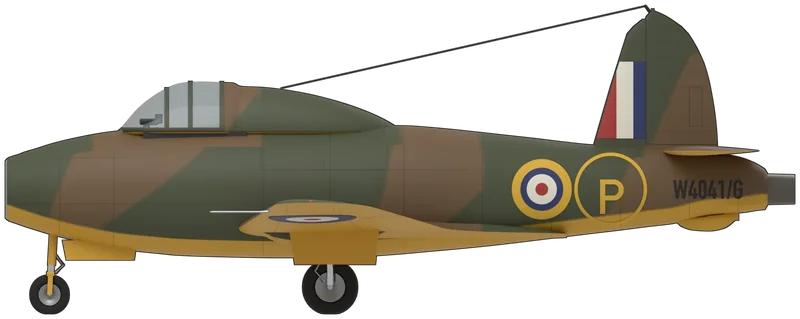
A procedural model built in Blender from the type’s published dimensions, painted as W4041/G, the first of two Gloster E.28/39 jet research aircraft built to Air Ministry specification E.28/39 and flown by Flight Lieutenant P. E. G. ‘Gerry’ Sayer from RAF Cranwell on 15 May 1941, the first flight of a British jet aeroplane, preserved in the Science Museum, London, since 1946 and represented at the Jet Age Museum, Gloucestershire, by a full-size replica: the small single-seat low-wing monoplane George Carter designed around Frank Whittle’s W.1 centrifugal turbojet, with a round nose intake feeding ducts either side of the cockpit, the engine behind the pilot exhausting through a short jet pipe in the tail, a straight tapered wing with rounded tips, a conventional tail with a tall rounded fin, a sliding canopy and a retractable tricycle undercarriage, shown standing on its wheels with the nose-wheel doors open: Dark Earth and Dark Green upper surfaces over prototype yellow undersides, Type A1 roundels on the fuselage followed by the yellow ringed prototype ‘P’ and black ‘W4041/G’, a red, white and blue fin flash, Type B roundels above the wings and Type A below, as flown in 1941 and preserved (shape from a published three-view, checked against photographs of the original and of the Jet Age Museum replica; the drawing’s side view and the replica set its height on the ground, a little taller than the 9 ft 3 in usually quoted, and the camouflage over the wings, which no photograph shows from above, is a representative pattern). Drag to orbit, scroll or pinch to zoom · all 547 models · download .glb (912 KB) · Plate 229 in The Hangar
Computed from the survey
Avro Vulcan, de Havilland Vampire, Folland Gnat, Gloster Gamecock & Fairey Flycatcher, Gloster Gladiator.
One of only 1 in UK public collections.
South West England has 1 collection recording the type.
Gloster E.28/39 Pioneer reproduction.
Type notes
| Type | Gloster E.28/39 (reproduction) |
|---|---|
| UK museums holding one | 1 |
| Airframes recorded in this survey | 1 |
Serials are the gazetteer's survey snapshot of what each collection records on charge — restorations move between workshops and reserve hangars, so check the museum page for opening times and current display status before travelling. Every type across 119 museums is indexed in the Compendium.
Aircraft questions
The Aviation Gazetteer records 1 Gloster E.28/39 airframe in UK collections.
Jet Age Museum has the most in this survey, with 1 recorded airframe.