Last verified 2026-11-21 against the gazetteer Compendium. Service bases and fleets change: check before travelling.
Not on charge
Where to see the Kawasaki Ki-48 in the UK
No complete example survives in a UK museum.
3D model
The Ki-48-II, Victory Park, Moscow in 3D
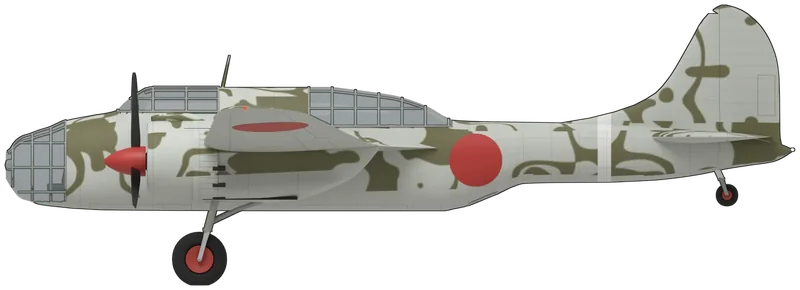
A procedural model built in Blender from the type’s published dimensions, painted as Kawasaki Ki-48-II ‘Lily’ displayed at the Museum of the Great Patriotic War in Victory Park, Moscow, a full-size reconstruction built round original parts recovered in 2011 from Shumshu in the northern Kurils: a four-seat twin-engined light bomber of the Japanese Army with two Nakajima Ha-115 fourteen-cylinder radials driving three-bladed propellers, a mid-set wing spanning 17.47 m, a heavily framed glazed nose, a stepped pilot’s canopy, a long glazed canopy over the rear gunner and a tall fin with a long dorsal fillet, shown tail down on its wheels as displayed: light grey overall with an olive-green blotch-and-squiggle mottle over the fuselage, fin, nacelles and the upper surfaces of the wings and tailplane, plain grey undersides, red hinomaru without a white surround on the fuselage sides and above and below the wings, a narrow white band round the rear fuselage, red spinners and wheel hubs and black propellers; no guns, unit markings or yellow leading-edge strips, which the display aircraft does not carry (shape from a Ki-48-II three-view scaled to the published span and length, checked against a wartime US recognition silhouette and photographs of this aircraft; the fuselage mottle mirrors from side to side). Drag to orbit, scroll or pinch to zoom · all 520 models · download .glb (1.1 MB) · Plate 183 in The Hangar
Type notes
The Kawasaki Ki-48 in brief
| Type | Kawasaki Ki-48 (Ki-48-II (Allied name ‘Lily’)) |
|---|---|
| UK museums holding one | None |