Last verified 2026-10-18 against the gazetteer Compendium. Service bases and fleets change: check before travelling.
Not on charge
Where to see the Mitsubishi Ki-67 Hiryu in the UK
No complete Ki-67 survives.
3D model
The Ki-67-I manufacture number 177, 98th Sentai in 3D
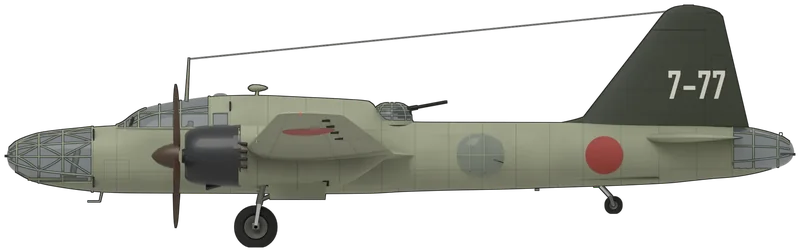
A procedural model built in Blender from the type’s published dimensions, painted as Mitsubishi Ki-67-I Hiryu ‘Peggy’ manufacture number 177, tail code ‘7-77’, of the 98th Sentai, Imperial Japanese Army Air Service, completed in the summer of 1944 and abandoned at Clark Field on Luzon in the Philippines, where US forces captured it in January 1945: a twin-engined heavy bomber with two Mitsubishi Ha-104 eighteen-cylinder radials driving four-bladed propellers, a glazed nose, a stepped cockpit, a dorsal gun turret, waist blisters and a tail gun position, a mid-mounted wing spanning 22.5 m and a single tall fin and rudder, shown tail down on its wheels: light grey-green overall, a dark green fin and rudder with ‘7-77’ in white, a red hinomaru on the fuselage and wings, yellow identification strips on the inner wing leading edges, blue-black cowlings and brown propellers (shape from a Ki-67-I three-view scaled to the published span and length, checked against wartime photographs; the finish, fin colour, tail code and fuselage hinomaru follow two black-and-white photographs of this aircraft after its capture, and the wing hinomaru, leading-edge strips, cowling and propeller colours follow standard practice). Drag to orbit, scroll or pinch to zoom · all 370 models · download .glb (1.3 MB) · Plate 194 in The Hangar
Type notes
The Mitsubishi Ki-67 Hiryu in brief
| Type | Mitsubishi Ki-67 Hiryu (Ki-67-I (Allied name ‘Peggy’)) |
|---|---|
| UK museums holding one | None |