Last verified 2026-10-18 against the gazetteer Compendium. Service bases and fleets change: check before travelling.
Not on charge
Where to see the Zeppelin-Staaken R.VI in the UK
No complete example survives.
3D model
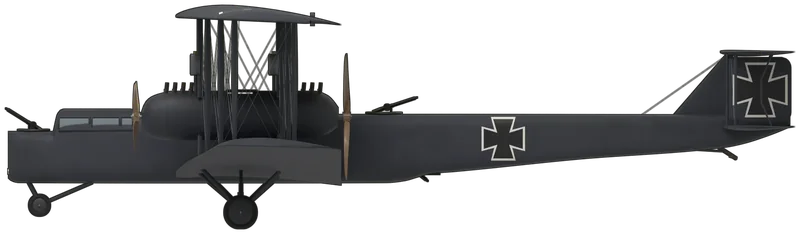
The Zeppelin-Staaken R.VI R.39/16, Rfa 501, early 1918 in 3D
A procedural model built in Blender from the type’s published dimensions, painted as Zeppelin-Staaken R.VI R.39/16, the Staaken-built giant bomber of Riesenflugzeug-Abteilung 501 that dropped the first 1,000 kg bomb on Britain, on the Royal Hospital, Chelsea, on the night of 16–17 February 1918 (no R.VI survives): a 42.2 m four-bay biplane wing with upper-wing ailerons, four 260 hp Mercedes D.IVa engines in tandem tractor-and-pusher pairs in two nacelles midway between the wings with their radiators on struts above, a long box fuselage with a nose gunner's position and a glazed cabin for the two pilots, a biplane tail with twin rudders and a small central fin, sixteen main wheels in four groups of four and twin nose wheels, shown resting tail-down on its skid; shape from a published three-view drawing and the 1918 'Typ R VI' general arrangement, scaled to the 42.2 m span and 22.1 m length and checked against photographs of R.39/16, with the finish those photographs show: a dark blue-black night finish overall and black-and-white Iron Crosses on the fuselage sides and the outer faces of the rudders, none beneath the wings; the shade follows a published colour profile because every photograph is black and white, the upper-wing crosses follow period practice, and no serial can be read. Drag to orbit, scroll or pinch to zoom · all 520 models · download .glb (1.5 MB) · Plate 33 in The Hangar
Type notes
The Zeppelin-Staaken R.VI in brief
| Type | Zeppelin-Staaken R.VI (R.VI) |
|---|---|
| UK museums holding one | None |