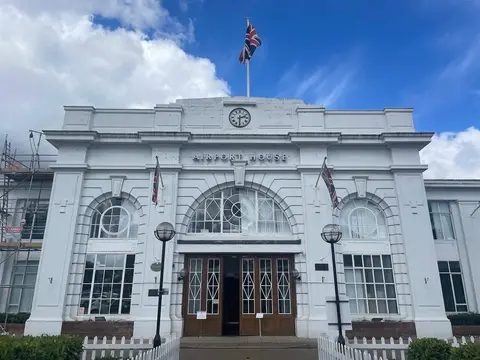
Also known as RAF Croydon · Beddington Aerodrome · Waddon Aerodrome
The story of Croydon Airport
Croydon was the first airport in the world with air traffic control and a control tower, commissioned in February 1920. The 'Mayday' call was developed here. Imperial Airways made it its base from 1924 and opened routes to India, Africa and the Far East. The airport was enlarged in 1926–28 with the first purpose-designed terminal and the world's first airport hotel. Amy Johnson left from here for Australia on 5 May 1930.
In September 1939 Croydon closed to civil flying and became a fighter station. No. 92 Squadron flew Spitfires from it early in the war. On 15 August 1940 German fighter-bombers aiming for Kenley hit Croydon instead, in the first major raid on the London area. Civil flying returned in 1946, but the airport had no room to grow. Heathrow became London's airport. The last flight left on 30 September 1959.
Flying units
| Unit | Years | Aircraft |
|---|---|---|
| No. 29 Training Squadron | 1919–1919 | |
| Imperial Airways | 1924–1939 | Handley Page HP42, Armstrong Whitworth Atalanta |
| No. 92 Squadron | Supermarine Spitfire |
What survives
- The 1928 terminal, Airport House, listed Grade II*, with the visitor centre in the old control tower
- A de Havilland Heron on struts outside the terminal
- A short stretch of runway tarmac in Roundshaw Park
The museum on the airfield
| Museum | Adult entry | Airframes | Headline exhibit |
|---|---|---|---|
| Croydon Airport Visitor CentreCroydon, Greater London | £10 | 1 | Airport House at Croydon was the world's first purpose-built airport terminal with the world's first air traffic control tower; the… |