Also known as Station 357 · Duxford Aerodrome
The story of RAF Duxford
In 1940 Duxford was the southernmost station of No. 12 Group. Czechoslovak pilots of No. 310 Squadron arrived with Hurricanes in July. Douglas Bader led the 'Big Wing' of three, then five, squadrons from here and Fowlmere. On 15 September 1940 the wing went up twice against raids on London. From December 1940 the Air Fighting Development Unit tested Typhoons, Mustangs and captured German aircraft.
The USAAF took over in 1943 as Station 357. The 78th Fighter Group flew P-47s and then P-51s, with black-and-white chequerboard markings. It escorted bombers and won two Distinguished Unit Citations. The RAF returned in December 1945 and laid a concrete runway in 1949–51. Javelins of No. 64 Squadron and Hunters of No. 65 Squadron were the last operational units. The last RAF flight left in 1961. The Imperial War Museum moved in during the 1970s.
Flying units
| Unit | Years | Aircraft |
|---|---|---|
| No. 8 Squadron | 1919–1920 | Bristol Fighter |
| No. 19 Squadron | 1923–1940 | Sopwith Snipe, Bristol Bulldog, Gloster Gauntlet, Supermarine Spitfire |
| No. 310 (Czechoslovak) Squadron | 1940–1940 | Hawker Hurricane |
| Air Fighting Development Unit | 1940 | |
| 78th Fighter Group, USAAF | 1943–1945 | Republic P-47 Thunderbolt, North American P-51 Mustang |
| No. 64 Squadron | 1961 | Gloster Javelin |
| No. 65 Squadron | 1961 | Hawker Hunter |
What survives
- First World War hangars and inter-war station buildings, now part of IWM Duxford
- The 1951 concrete runway, shortened in 1977 when the M11 was built
The museum on the airfield
| Museum | Adult entry | Airframes | Headline exhibit |
|---|---|---|---|
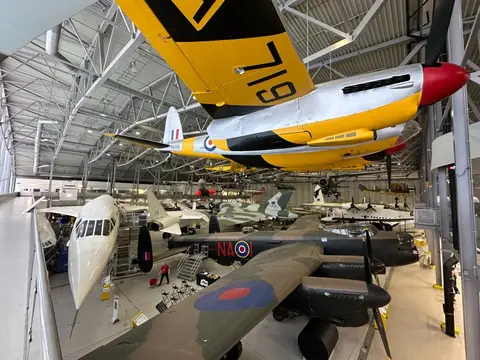
| IWM DuxfordCambridge, Cambridgeshire | £29 | 146 | Concorde 101 (G-AXDN), the pre-production development aircraft and the fastest Concorde of them all at Mach 2.23 — plus an SR-71A… |