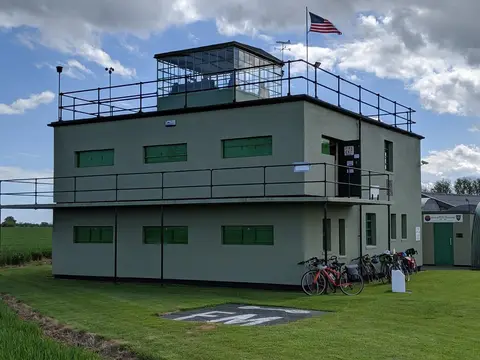
Also known as Station 153 · Parham Airfield
The story of RAF Framlingham
The 95th Bombardment Group arrived first, on 12 May 1943, and flew its first mission the next day. After heavy losses it moved to Horham in June. The 390th Bombardment Group arrived on 4 July 1943 with B-17s, marked with a 'Square-J' tail code. It began combat on 12 August 1943. Five days later it bombed the Messerschmitt works at Regensburg and won a Distinguished Unit Citation. A second followed for Schweinfurt on 14 October 1943. On D-Day it bombed the coast near Caen fifteen minutes before the landings. In over 300 missions it lost 181 aircraft, and 714 of its airmen were killed. Its last mission was on 20 April 1945, followed by food drops to the Dutch.
After the war the base became a clearing station for Polish nationals. It closed in late 1948. The runways were ground into aggregate. Restoration of the derelict control tower began in 1976. It was dedicated as the 390th Bomb Group Memorial Air Museum on 13 May 1981.
Flying units
| Unit | Years | Aircraft |
|---|---|---|
| 95th Bombardment Group (Heavy), USAAF | 1943–1943 | Boeing B-17 Flying Fortress |
| 390th Bombardment Group (Heavy), USAAF | 1943–1945 | Boeing B-17 Flying Fortress |
What survives
- The control tower, now the 390th Bomb Group Memorial Air Museum
- Most of the perimeter track, as farm roads
- Wartime Nissen huts on the technical site industrial estate
The museum on the airfield
| Museum | Adult entry | Airframes | Headline exhibit |
|---|---|---|---|
| Parham Airfield MuseumWoodbridge, Suffolk | Free | — | Parham hosts two museums in one: the 390th Bomb Group Memorial in the control tower, and the Museum of the British Resistance… |