Also known as Hendon Aerodrome · London Aerodrome
The story of RAF Hendon
The War Office took over the schools in November 1916, and 490 pilots trained here. The first RAF Pageant was held at Hendon in 1920. It became the Royal Air Force Display, drawing 100,000 people a year by 1925. Auxiliary Air Force squadrons and communications units used the field between the wars. In the Second World War it was briefly active in the Battle of Britain. Mostly it carried transport flights and dignitaries.
The three short runways and the spread of housing made Hendon unsuitable after the war. Late in 1968 a Blackburn Beverley flew in for the new RAF Museum, the last aircraft to land here. The museum opened on 15 November 1972. The rest of the site became the Grahame Park estate and Hendon Police College.
Flying units
| Unit | Years | Aircraft |
|---|---|---|
| No. 24 Squadron | ||
| No. 600 (City of London) Squadron, Auxiliary Air Force | ||
| No. 601 (County of London) Squadron, Auxiliary Air Force | ||
| No. 604 (County of Middlesex) Squadron, Auxiliary Air Force |
What survives
- Part of the Grahame-White Factory, now a gallery of early aircraft at the RAF Museum
- The museum occupies the south-east side of the old aerodrome
The museum on the airfield
| Museum | Adult entry | Airframes | Headline exhibit |
|---|---|---|---|
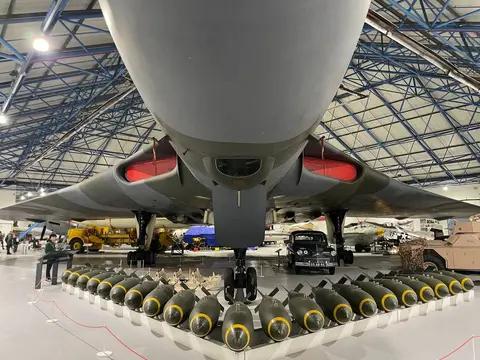
| Royal Air Force Museum LondonLondon, Greater London | Free | 88 | Avro Lancaster R5868 'S-Sugar' — 137 operations, the RAF's highest-scoring surviving heavy — under the same roof as a Vulcan, a… |