History
The story of RAF Langham
Coastal Command used it for the rest of the war. Its best-known units were the Beaufighters of the Anzac Strike Wing, Nos. 455 Squadron RAAF and 489 Squadron RNZAF. On 2 October 1944 six Beaufighters left Langham to hunt shipping off the Frisian Islands. Warrant Officer Douglas Mann and Flight Sergeant Donald Kennedy were shot down near Borkum. They spent eight days in their dinghy before a launch from Gorleston rescued them. Both recovered, and Mann won the DFC.
The station went to care and maintenance in 1947. It reopened during the Korean War and later served as an emergency strip for RAF Sculthorpe. It closed for good in 1961. Bernard Matthews bought the site and built turkey sheds on the runways, which preserved much of them.
Order of battle
Flying units
| Unit | Years | Aircraft |
|---|---|---|
| No. 455 Squadron RAAF (Anzac Strike Wing) | Bristol Beaufighter | |
| No. 489 Squadron RNZAF (Anzac Strike Wing) | Bristol Beaufighter | |
| No. 612 Squadron | ||
| No. 254 Squadron |
Today
What survives
- The wartime control tower
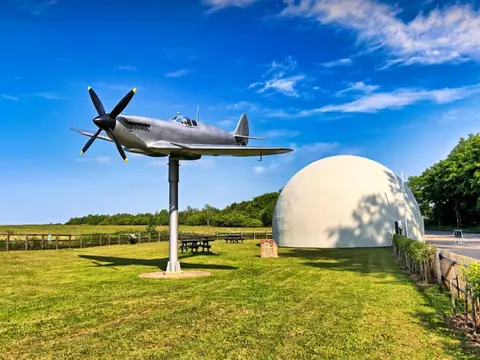
- Langham Dome, a 1942 anti-aircraft gunnery trainer, one of about six left in the UK
- Large sections of runway under the poultry sheds
Visit
The museum on the airfield
| Museum | Adult entry | Airframes | Headline exhibit |
|---|---|---|---|
| Langham DomeHolt, Norfolk | £7 | 1 | Langham Dome is a one-building wonder: a 1942 concrete gunnery-training dome where projected aircraft taught AA gunners to shoot —… |