Also known as Station 369 · Aeroplane and Armament Experimental Establishment
The story of RAF Martlesham Heath
The establishment left for Boscombe Down on 9 September 1939. Martlesham became the most northerly station of No. 11 Group. Blenheims, Hurricanes, Spitfires and Typhoons flew from here, and Robert Stanford Tuck was among its pilots. On 15 August 1940 Erprobungsgruppe 210 bombed the airfield while No. 17 Squadron's Hurricanes searched out to sea. The American volunteers of No. 71 (Eagle) Squadron flew from here in 1941.
In October 1943 the USAAF 356th Fighter Group arrived, as Station 369. It flew P-47s and then P-51s, marked with a magenta and blue diamond pattern, until May 1945. Post-war, nearby Ipswich limited jet flying. The Battle of Britain Memorial Flight was based here from 1958 to 1961. The Air Ministry closed the station in 1963. The site is now a business and housing area.
Flying units
| Unit | Years | Aircraft |
|---|---|---|
| Aeroplane and Armament Experimental Establishment | 1924–1939 | |
| No. 17 Squadron | 1940–1940 | Hawker Hurricane |
| No. 71 (Eagle) Squadron | 1941–1941 | |
| 356th Fighter Group, USAAF | 1943–1945 | Republic P-47 Thunderbolt, North American P-51 Mustang |
| Battle of Britain Memorial Flight | 1958–1961 |
What survives
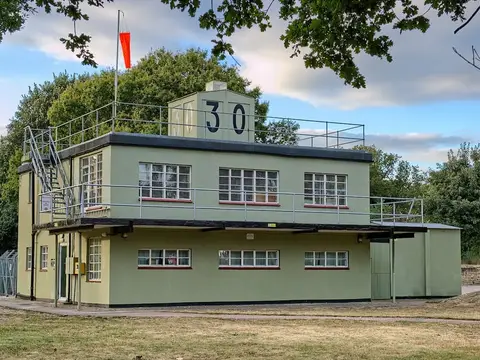
- The control tower, kept as a museum by the Martlesham Heath Aviation Society
- Four pre-war hangars and technical buildings, now used by light industry
- Memorial to the 356th Fighter Group on the old parade ground
The museum on the airfield
| Museum | Adult entry | Airframes | Headline exhibit |
|---|---|---|---|
| Martlesham Heath Aviation SocietyIpswich, Suffolk | Donation | — | The restored Martlesham Heath control tower museum covers the experimental establishment where every new RAF type from 1917–1939 was… |