Also known as Middle Wallop Flying Station · RNAS Middle Wallop (HMS Flycatcher) · Station 449 · Army Aviation Centre
The story of RAF Middle Wallop
From September 1940 No. 604 Squadron flew radar-equipped Beaufighters from here. It helped defend Britain at night during the Blitz, claiming 50 victories by May 1941. One pilot recalled the bumpy grass runways as a hazard for ten-ton Beaufighters. In November 1943 the US Ninth Air Force put IX Fighter Command headquarters here as Station 449. The 67th Reconnaissance Group followed, and both left for France in June 1944. The Royal Navy held the airfield briefly in 1945 as HMS Flycatcher.
After the war Middle Wallop trained air observation post pilots. It became the Light Aircraft School in 1952. Helicopter development work began in 1954. When Army aviation became independent in 1957, the school became the Army Air Corps Centre. The airfield passed fully to the Army in October 1958. It is still the home of the Army Air Corps and of Army flying training.
Flying units
| Unit | Years | Aircraft |
|---|---|---|
| No. 609 (West Riding) Squadron | 1940–1940 | Supermarine Spitfire I |
| No. 238 Squadron | 1940–1941 | Hawker Hurricane I |
| No. 604 (County of Middlesex) Squadron | 1940–1943 | Bristol Blenheim I, Bristol Beaufighter IF |
| 67th Reconnaissance Group, USAAF | 1943–1944 | |
| Army Air Corps Centre / Army Aviation Centre | 1957 |
What survives
- An active Army airfield, headquarters of the Army Air Corps
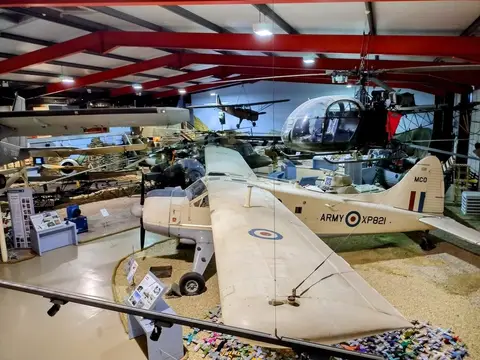
- The Historic Army Aircraft Flight and the Army Flying Museum on site
The museum on the airfield
| Museum | Adult entry | Airframes | Headline exhibit |
|---|---|---|---|
| Army Flying MuseumStockbridge, Hampshire | £18 | 43 | Middle Wallop's Army Flying Museum covers everything the Army has flown from observation balloons to Apaches, with superb dioramas and a… |