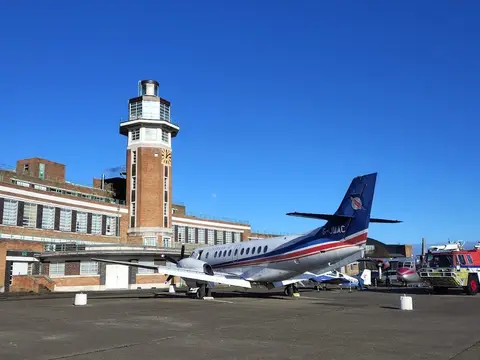
Also known as Liverpool (Speke) Airport · Liverpool John Lennon Airport
The story of RAF Speke
In the Second World War the airport was requisitioned as RAF Speke. The Rootes shadow factory built Bristol Blenheims and 1,070 Handley Page Halifax bombers. Lockheed assembled Hudsons and Mustangs shipped in parts from America to Liverpool Docks. The airport was also home to the Merchant Ship Fighter Unit. On 8 October 1940 Flight Lieutenant Denys Gillam took off in a Hurricane and met a Ju 88 crossing the field. He shot it down with his undercarriage still retracting. He shared the kill with Alois Vašátko and Josef Stehlík of No. 312 Squadron. It is thought to be the fastest victory of the Battle of Britain.
Civil flying resumed after VE Day. The city took control again in 1961, and a new 7,500 ft runway opened to the south-east in 1966. The original 1930s terminal closed when a new one opened in 1986. It is now a hotel, listed Grade II. The airport was renamed after John Lennon in 2001.
Flying units
| Unit | Years | Aircraft |
|---|---|---|
| No. 312 (Czechoslovak) Squadron | 1940 | Hawker Hurricane |
| Merchant Ship Fighter Unit | ||
| Rootes shadow factory | Bristol Blenheim, Handley Page Halifax | |
| Lockheed assembly | Lockheed Hudson, North American Mustang |
What survives
- The Grade II listed 1930s Art Deco terminal, now a hotel
- The original airfield area beside the old terminal, now largely redeveloped
The museum on the airfield
| Museum | Adult entry | Airframes | Headline exhibit |
|---|---|---|---|
| Speke Aerodrome Heritage GroupLiverpool, Merseyside | Free | 7 | Speke Airport Museum — Speke Aerodrome Heritage Group keeps airliners, including a Dan-Air 748 under restoration, on Liverpool's gorgeous… |