Also known as Station 111 · RAE Bedford
The story of RAF Thurleigh
The 306th Bombardment Group arrived on 7 September 1942 with B-17s and a 'Triangle H' tail code. It stayed until 1 December 1945, the longest stay of any US air group at a British base. On 27 January 1943 it led the Eighth Air Force's first raid on Germany, against U-boat yards at Wilhelmshaven. It suffered heavily over Bremen and on the Schweinfurt–Regensburg mission. It won two Distinguished Unit Citations in 1944. By 19 April 1945 it had flown 342 missions, and 171 of its B-17s had failed to return. The film Twelve O'Clock High drew on the group and its commander Frank Armstrong.
From 1946 the airfield became the Royal Aircraft Establishment, Bedford. Its runway was lengthened for the Bristol Brabazon. Experimental flying moved to Boscombe Down, and the airfield closed in 1997. The site is now a business park, the Bedford Autodrome and Bedford Aerodrome.
Flying units
| Unit | Years | Aircraft |
|---|---|---|
| No. 160 Squadron | 1942–1942 | |
| No. 18 Operational Training Unit | ||
| 306th Bombardment Group (Heavy), USAAF | 1942–1945 | Boeing B-17 Flying Fortress |
| Royal Aircraft Establishment Bedford | 1946–1994 |
What survives
- The main runway, kept intact on Thurleigh Business Park
- Bedford Aerodrome at the eastern end, still in aviation use
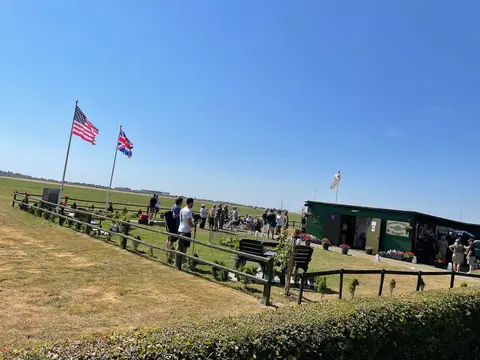
The museum on the airfield
| Museum | Adult entry | Airframes | Headline exhibit |
|---|---|---|---|
| 306th Bombardment Group MuseumBedford, Bedfordshire | Free | — | Thurleigh's 306th BG museum — the group that flew the first US heavy-bomber raid from England and inspired 'Twelve O'Clock High' — free… |