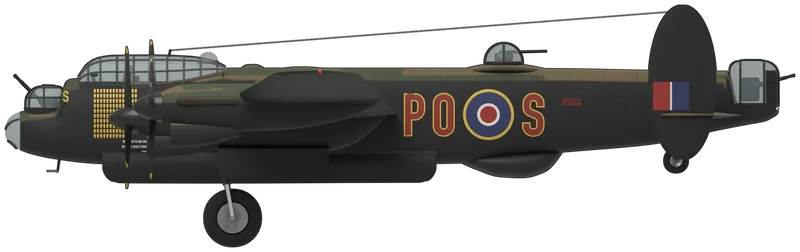
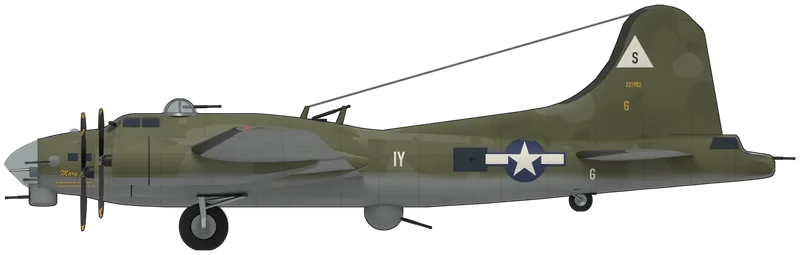
Specifications compared


| Variant compared | Lancaster B.I | B-17G Flying Fortress |
|---|---|---|
| First flight | 9 Jan 1941 | 28 Jul 1935 |
| Entered service | Feb 1942 | Apr 1938 (type) |
| Max speed | 282 mph (454 km/h) at 13,000 ft | 295 mph (472 km/h) at 25,000 ft |
| Engine | 4 × Rolls-Royce Merlin XX, 1,280 hp each | 4 × Wright R-1820-97 Cyclone, 1,200 hp each, turbosupercharged |
| Armament | 8 × .303 in MG; up to 18,000 lb bombs (22,000 lb Grand Slam on modified aircraft) | 13 × .50 in MG; 4,500–8,000 lb bombs internally |
| Number built | 7,377 | 12,731 |
| Crew | 7 | 10 |
Different ideas
The B-17 flew on 28 July 1935, years before the Lancaster. It was built for high-altitude daylight bombing with the Norden sight, defended by its own guns.
The Lancaster flew on 9 January 1941. It was Bomber Command's night bomber, relying on darkness more than firepower. Its long, unobstructed bomb bay was the key to its success.
Both were four-engined, but the B-17 carried a crew of ten to the Lancaster's seven. Most of the extra men were gunners.
Performance and loads
The B-17G was faster and flew higher, at 295 mph at 25,000 ft. It carried thirteen .50 in machine guns. On long missions it typically carried about 4,500 lb of bombs internally.
The Lancaster had eight .303 in guns and carried up to 18,000 lb. Modified aircraft dropped the 22,000 lb Grand Slam, the largest load of any bomber in the war.
Numbers were on the B-17's side. In August 1944 the USAAF had 4,574 in service, equipping 32 overseas combat groups.
The B-17 in RAF hands
The RAF flew the B-17 first, as the Fortress I, in 1941. Daylight raids went badly, with eight aircraft lost by September. Bomber Command gave up and passed its Fortresses to Coastal Command for maritime patrol.
The USAAF's later, better-armed B-17Fs and Gs flew alongside Bomber Command's night offensive from 1942.
With Coastal Command, the Fortress flew long-range patrols over the Atlantic. Later B-17E, F and G models joined it there.
The record and a myth
12,731 B-17s and 7,377 Lancasters were built. The B-17 is often said to have dropped more bombs than any other aircraft, over 640,000 tons in Europe.
Lancasters dropped 608,612 long tons in 156,000 sorties. A long ton is about 12% heavier than a short ton, so the totals are closer than they look.
The Lancaster's last wartime task was humanitarian. In Operation Manna, in spring 1945, 3,156 Lancasters and 145 Mosquitos dropped food to the starving Dutch in 3,298 sorties.
Where to see a Lancaster and a B-17
IWM Duxford shows Lancaster X KB889 and two B-17Gs, one of them the airworthy Sally B. The Royal Air Force Museum London pairs Lancaster R5868 with a B-17G.
| Museum | Adult entry | Airframes | Headline exhibit |
|---|---|---|---|
| IWM DuxfordCambridge, Cambridgeshire | £29 | 146 | Concorde 101 (G-AXDN), the pre-production development aircraft and the fastest Concorde of them all at Mach 2.23 — plus an SR-71A… |
| Royal Air Force Museum LondonLondon, Greater London | Free | 88 | Avro Lancaster R5868 'S-Sugar' — 137 operations, the RAF's highest-scoring surviving heavy — under the same roof as a Vulcan, a… |
Frequently asked
Which carried more bombs, the Lancaster or the B-17?
The Lancaster, by a wide margin. It could lift up to 18,000 lb, against roughly 4,500 lb for a B-17 on a long mission.
Did the RAF fly the B-17?
Yes. Its Fortress Is flew daylight raids in 1941 with poor results. Bomber Command passed them to Coastal Command, which used later B-17s for maritime patrol.
Where can I see a Lancaster and a B-17 together?
IWM Duxford and the Royal Air Force Museum London both hold a complete example of each.