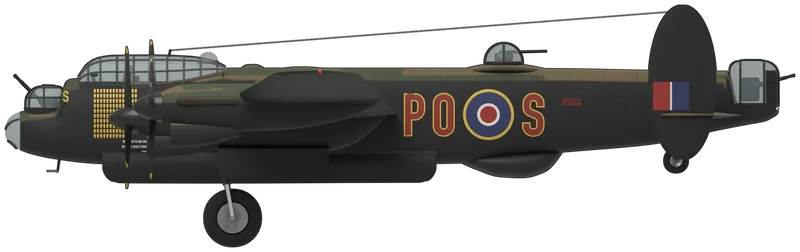
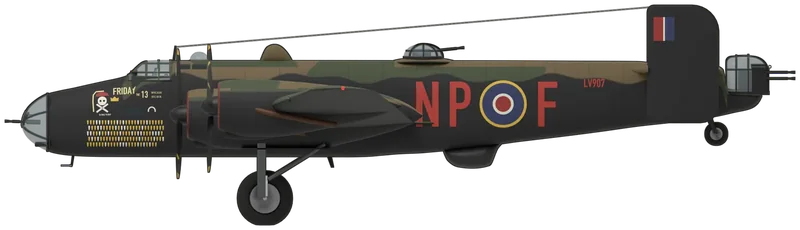
Specifications compared

| Variant compared | Lancaster B.I | Halifax B.III |
|---|---|---|
| First flight | 9 Jan 1941 | 25 Oct 1939 |
| Entered service | Feb 1942 | 13 Nov 1940 (type) |
| Max speed | 282 mph (454 km/h) at 13,000 ft | 282 mph (454 km/h) at 13,500 ft |
| Engine | 4 × Rolls-Royce Merlin XX, 1,280 hp each | 4 × Bristol Hercules XVI, 1,615 hp each |
| Armament | 8 × .303 in Browning MG in three turrets; up to 18,000 lb bombs (22,000 lb Grand Slam on modified aircraft) | 8 × .303 in Browning MG in two turrets, 1 × Vickers K; 13,000 lb bombs |
| Number built | 7,377 | 6,178 |
| Crew | 7 | 7 |
Common roots
Both came from the same 1936 Air Ministry requirement for a twin-engined bomber. Handley Page switched to four engines early. Avro built the twin-engined Manchester, whose Vulture engines failed it.
The Halifax flew first, on 25 October 1939, and entered service in November 1940. The four-Merlin Lancaster flew on 9 January 1941 and reached squadrons in early 1942.
The early Halifax needed many changes. A larger, D-shaped fin finally cured a dangerous rudder problem when engines failed.
Performance and use
Top speeds were similar, at about 282 mph. The difference was in the bomb bay. The Lancaster could carry the 12,000 lb Tallboy and, modified, the 22,000 lb Grand Slam.
On night raids on Germany in 1943, Halifaxes dropped an average of 5,635 lb of bombs and lost 5.5%. Lancasters averaged 9,070 lb and lost 3.7%. The Hercules-engined Halifax III cut its group's loss rate from 4.2% to 1.6% in 1944.
Only the Lancaster's bay could take the largest bombs without major change. Its versatility also led to its choice for 617 Squadron's Dams raid.
The record
7,377 Lancasters and 6,178 Halifaxes were built. Lancasters flew 156,000 sorties and dropped 608,612 long tons of bombs. Halifaxes flew 83,138 sorties, including mining and radio countermeasures work, and dropped 224,207 long tons.
The Halifax also served with Coastal Command, as a transport and as a glider tug. Halifax freighters flew in the Berlin Airlift.
In the Battle of Berlin, Lancasters flew 7,256 of the 9,111 sorties. After the war the RAF retired the Halifax quickly. The Lincoln, developed from the Lancaster, replaced both.
The myth: the Halifax was a failure
Sir Arthur Harris rated the Halifax below the Lancaster, partly for its smaller load. Many of its crews disagreed. The early marks had real problems, but the Halifax III was a capable aircraft that stayed in production until April 1945.
The Halifax was flown in numbers by Canadian, Australian and Free French squadrons. Pakistan kept it until 1961, its last military user.
Where to see a Lancaster and a Halifax
The Royal Air Force Museum London shows Lancaster R5868 near the recovered wreck of Halifax W1048. IWM Duxford has a Lancaster X and a Halifax nose section; the Yorkshire Air Museum's rebuilt Halifax is the best complete example.
| Museum | Adult entry | Airframes | Headline exhibit |
|---|---|---|---|
| IWM DuxfordCambridge, Cambridgeshire | £29 | 146 | Concorde 101 (G-AXDN), the pre-production development aircraft and the fastest Concorde of them all at Mach 2.23 — plus an SR-71A… |
| Royal Air Force Museum LondonLondon, Greater London | Free | 88 | Avro Lancaster R5868 'S-Sugar' — 137 operations, the RAF's highest-scoring surviving heavy — under the same roof as a Vulcan, a… |
Frequently asked
Was the Lancaster better than the Halifax?
As a night bomber over Germany, yes: in 1943 it carried more and lost fewer aircraft. The Halifax III narrowed the gap and did more varied roles.
How many Lancasters and Halifaxes were built?
7,377 Lancasters and 6,178 Halifaxes, including two Halifax prototypes.
Where can I see a Lancaster and a Halifax together?
The Royal Air Force Museum London holds a complete Lancaster and the recovered Halifax W1048. IWM Duxford has a Lancaster and a Halifax nose section.