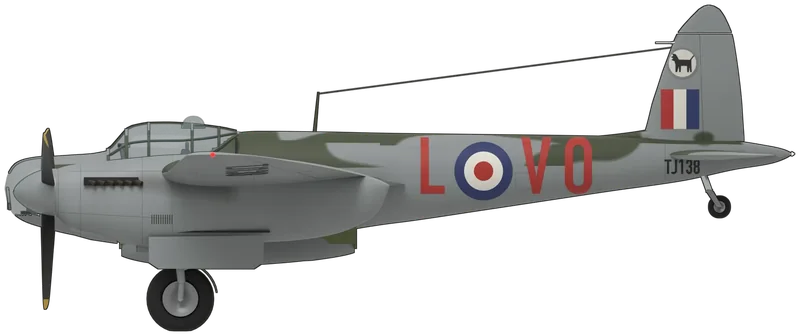
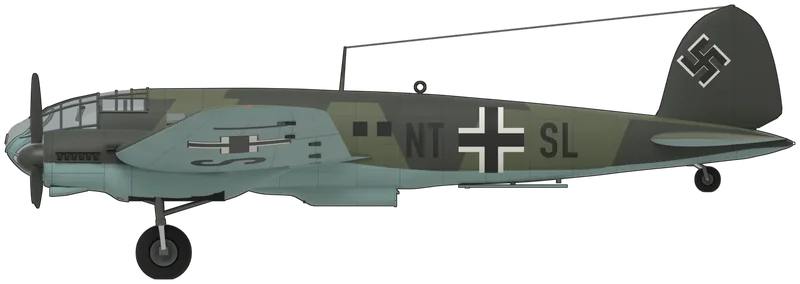
Specifications compared

| Variant compared | Mosquito B Mk XVI | Ju 88 A-4 |
|---|---|---|
| First flight | 25 Nov 1940 | 21 Dec 1936 |
| Entered service | Nov 1941 (type) | 1939 (type) |
| Max speed | 415 mph (668 km/h) at 28,000 ft | 292 mph (470 km/h) at 17,390 ft (5,300 m) |
| Engine | 2 × Rolls-Royce Merlin 76/77, 1,710 hp each | 2 × Junkers Jumo 211J, 1,340 PS each |
| Armament | No defensive guns; 4,000 lb bombs (FB.VI fighter-bomber: 4 × .303 in MG and 4 × 20 mm cannon) | Several 7.92 mm and 13 mm defensive MGs; 1,400 kg bombs internally, up to 3,000 kg externally |
| Number built | 7,781 (all versions) | 15,183 (all versions) |
| Crew | 2 | 4 |
Two fast bombers
Both began with the same idea: a bomber fast enough to outrun fighters. Junkers designed the Ju 88 as a Schnellbomber, or fast bomber, and it flew on 21 December 1936.
The Luftwaffe then asked for dive bombing, extra crew and defensive guns. Each change added weight. Junkers even tried a heavy dive-bomber version, but the airframe could not take the strain.
De Havilland kept to the original idea. The Mosquito flew on 25 November 1940 as an unarmed bomber, built mostly of wood. Birch plywood skins around a balsa core gave a light, stiff and smooth airframe.
Performance and roles
The Mosquito B Mk XVI reached 415 mph at 28,000 ft with a crew of two. It could carry a single 4,000 lb Cookie blast bomb. The Ju 88 A-4 managed about 292 mph with a crew of four.
The Ju 88 carried up to 1,400 kg in its bomb bays and more outside, at a cost in speed. In return it had the bigger load and the longer development life.
Both types spread far beyond bombing. The Ju 88 served as a dive bomber, night fighter, torpedo bomber, reconnaissance aircraft and heavy fighter. The Mosquito became a fighter-bomber, night fighter, pathfinder and photo-reconnaissance aircraft.
The record
Junkers built 15,183 Ju 88s, making it one of the most heavily used German aircraft of the war. De Havilland and its partners built 7,781 Mosquitos between 1940 and 1950.
On 30 January 1943 a Mosquito raid on Berlin took Hermann Göring's anniversary speech off the air. The RAF kept Mosquitos until 1963.
Göring later told German aircraft makers that the Mosquito made him furious with envy.
The myth: nothing could catch a Mosquito
Speed protected the Mosquito, but not completely. By 1945 German jets could catch it. One Me 262 pilot, Kurt Welter, claimed 25 Mosquitos at night. Even so, Mosquito bombers ended the war with the lowest losses of any aircraft in Bomber Command.
Where to see a Mosquito and a Ju 88
The Royal Air Force Museum Midlands is the place: it shows Mosquito TT.35 TA639 and Ju 88R-1 night fighter 360043 in the same collection. For a fuller Mosquito story, the De Havilland Aircraft Museum keeps the prototype W4050.
| Museum | Adult entry | Airframes | Headline exhibit |
|---|---|---|---|
| Royal Air Force Museum LondonLondon, Greater London | Free | 88 | Avro Lancaster R5868 'S-Sugar' — 137 operations, the RAF's highest-scoring surviving heavy — under the same roof as a Vulcan, a… |
| Royal Air Force Museum MidlandsShifnal, Shropshire | Free | 78 | TSR-2 XR220, one of two survivors of the most gifted aircraft Britain ever cancelled, sharing floor space with the stainless-steel… |
Frequently asked
Was the Mosquito faster than the Ju 88?
Yes, by more than 100 mph. The Mosquito B Mk XVI reached 415 mph; the Ju 88 A-4 about 292 mph.
Why was the Mosquito made of wood?
De Havilland argued that aluminium and steel would run short in war, while wood would not. Furniture makers already had the skills. The ply-balsa-ply skin also gave a light, smooth and stiff structure.
Where can I see a Mosquito and a Ju 88 together?
At the Royal Air Force Museum Midlands at Cosford, which holds Mosquito TA639 and Ju 88R-1 360043. It is the only complete Ju 88 in the gazetteer.