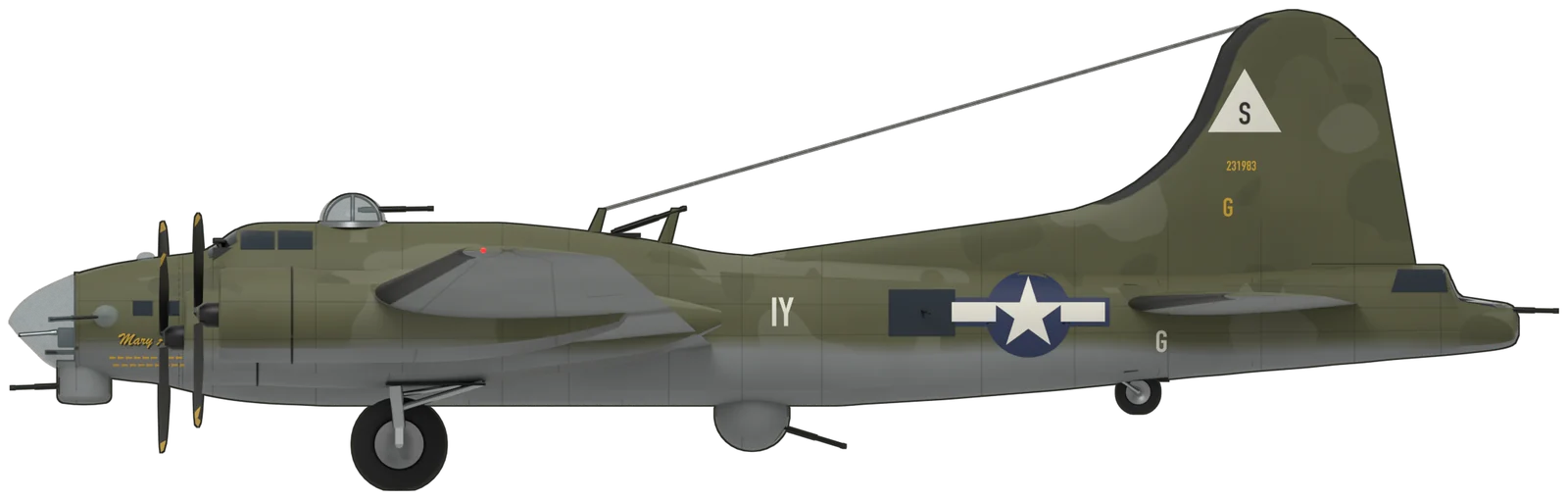
3D model
Turn it over
A procedural model built in Blender from published dimensions, drawings and photographs, painted as 42-31983 “Mary Alice”, IY-G of the 401st Bomb Group in 1944. Drag to orbit, scroll or pinch to zoom · download .glb (1.4 MB)
History
The Flying Fortress
Boeing’s Model 299 first flew in July 1935, and a reporter’s description of the heavily armed prototype as a “flying fortress” stuck. The B-17 became the bomber with which the US Eighth Air Force set out to bomb Germany by day, in tight formations meant to protect each other with their guns.
The cost was terrible until long-range escort fighters arrived in 1944. The B-17G, the most numerous version, added a chin turret under the nose to meet head-on fighter attacks. Boeing, Douglas and Lockheed Vega built 12,731 B-17s in all.
Many survived the war as survey aircraft, airliners and water bombers, which is why a few dozen still exist. Duxford’s came to Britain after decades of photographic survey work in France.
This airframe
B-17G 44-83735, as “Mary Alice”
IWM Duxford’s B-17G was built by Douglas at Long Beach and delivered in May 1945, too late for the war. It flew for decades as a survey aircraft with France’s Institut Géographique National before IWM bought it in 1978. The model shows the markings it wore for many years at Duxford, representing “Mary Alice”, IY-G of the 401st Bomb Group.
Where to see one
In the gazetteer
The gazetteer records the Flying Fortress in 2 UK collections. The airframe modelled here is marked.