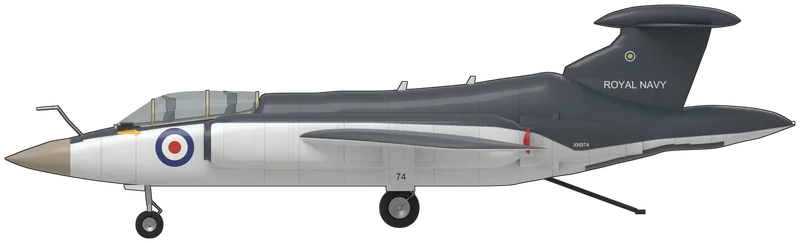
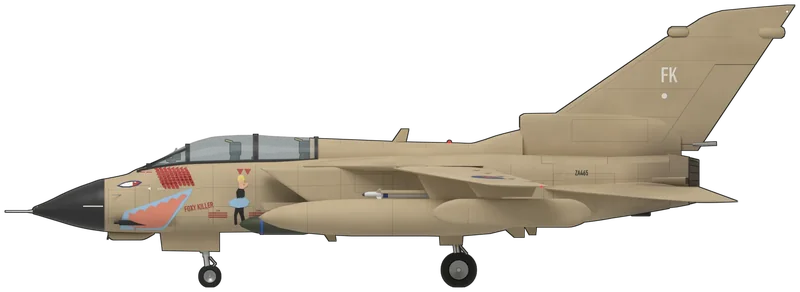
Specifications compared


| Variant compared | Buccaneer S.2B | Tornado GR1/GR4 (IDS) |
|---|---|---|
| First flight | 30 Apr 1958 (type) | 14 Aug 1974 (type) |
| Entered service | 17 Jul 1962 (Navy); Oct 1969 (RAF) | 1979–80 (type) |
| Max speed | 580 kn (667 mph, Mach 0.95) at 200 ft | Mach 2.2 at 9,000 m with working intake ramps; lower on most IDS |
| Engine | 2 × Rolls-Royce Spey Mk 101, 11,000 lbf each | 2 × Turbo-Union RB199-34R Mk 103, 43.8 kN dry / 76.8 kN reheat |
| Armament | Rotating internal bomb bay plus 4 pylons, up to 12,000 lb; Martel, Sea Eagle, Sidewinder | 2 × 27 mm Mauser BK-27 (GR1; 1 in GR4); 9,000 kg on 7 pylons |
| Number built | 211 (including 2 prototypes) | 990 (all versions) |
| Crew | 2 | 2 |
A naval strike jet
The Buccaneer began with Naval Staff Requirement NA.39 of 1952. The Navy wanted a two-seat jet to attack Soviet cruisers at high speed and very low level.
It flew on 30 April 1958 and joined the Navy in 1962. Blackburn blew engine air over the wings and tail, which greatly improved control at slow carrier-landing speeds.
From Navy to RAF
The RAF lost both the TSR-2 and the F-111K, and bought Buccaneers as a substitute. They entered RAF service in October 1969.
When the Navy retired its last large carrier in 1979, its Buccaneers passed to the RAF. A crash in 1980 revealed fatigue problems, and the fleet was cut to 60.
The Tornado flew on 14 August 1974 and entered service from 1979. It was meant to take over the Vulcan's and the Buccaneer's strike roles. After 1983 the Tornado took most land strike work, and the Buccaneer moved to maritime strike with Sea Eagle missiles.
At sea, the Buccaneer's strike role passed to the Sea Harrier. The Buccaneer stood down from its reserve nuclear role in 1991.
The Gulf War partnership
From 1979 the RAF's Buccaneers carried the Pave Spike laser designator. In January 1991 the first six deployed from Lossiemouth at short notice.
A typical formation was four Tornados and two Buccaneers, each Buccaneer with one designator pod. They flew by day, as the pod could not work at night. Around 20 road bridges were destroyed in Buccaneer-supported missions.
In 218 missions the Buccaneers designated targets for other aircraft and dropped 48 laser-guided bombs of their own.
The record
211 Buccaneers were built, including two prototypes. The RAF retired the last in March 1994, in favour of the Tornado. Panavia built 990 Tornados, and the RAF flew its last on 1 April 2019.
Crews nicknamed the Buccaneer the Banana Jet. South Africa was its only export customer and flew it through the long Border War.
Where to see a Buccaneer and a Tornado
Nine gazetteer museums hold both, including the Royal Air Force Museum London, IWM Duxford and the National Museum Of Flight. Yorkshire Air Museum shows three Buccaneers with two Tornados, and South Wales Aviation Museum pairs Buccaneer XX889 with a GR1 and a GR4.
| Museum | Adult entry | Airframes | Headline exhibit |
|---|---|---|---|
| IWM DuxfordCambridge, Cambridgeshire | £29 | 146 | Concorde 101 (G-AXDN), the pre-production development aircraft and the fastest Concorde of them all at Mach 2.23 — plus an SR-71A… |
| National Museum Of FlightNorth Berwick, East Lothian | £15 | 47 | Concorde G-BOAA, which flew British Airways' first commercial supersonic service in 1976 and arrived here by barge and giant road-crawl… |
| RAF Manston History MuseumRamsgate, Kent | £7 | 22 | RAF Manston's history museum spans 1916 RNAS days to Cold War Meteors, with strong 1940s room-sets — and it sits next door to the… |
| Royal Air Force Museum LondonLondon, Greater London | Free | 88 | Avro Lancaster R5868 'S-Sugar' — 137 operations, the RAF's highest-scoring surviving heavy — under the same roof as a Vulcan, a… |
| Royal Air Force Museum MidlandsShifnal, Shropshire | Free | 78 | TSR-2 XR220, one of two survivors of the most gifted aircraft Britain ever cancelled, sharing floor space with the stainless-steel… |
| South Wales Aviation MuseumBarry, Vale of Glamorgan | £10 | 73 | The resident Harrier and a growing VC10/Tornado-era collection, most with steps and open canopies. Kids exit wearing thousand-yard grins. |
| South Yorkshire Aircraft MuseumDoncaster, South Yorkshire | £7.50 | 109 | Doncaster's South Yorkshire Aircraft Museum sprawls across the old RAF Doncaster site: dozens of airframes and helicopters, strong… |
| Ulster Aviation Society (Maze Long Kesh)Lisburn, County Antrim | By appointment | 63 | The Shorts family — SC.1 vertical take-off research aircraft included — plus a Buccaneer, Phantom, Wildcat, and a newly arrived AV-8… |
| Yorkshire Air MuseumYork, North Yorkshire | £17 | 54 | Halifax 'Friday the 13th' — the world's only complete Halifax reconstruction, honouring the type that flew from this very field —… |
Frequently asked
What replaced the Buccaneer in the RAF?
The Panavia Tornado. The last RAF Buccaneers retired in March 1994.
What did the Buccaneer do in the Gulf War?
It marked targets with Pave Spike laser designators for Tornados carrying laser-guided bombs. Buccaneers flew 218 missions and dropped 48 such bombs themselves.
Where can I see a Buccaneer and a Tornado together?
Nine gazetteer museums hold both, including the Royal Air Force Museum London, IWM Duxford, Yorkshire Air Museum and South Wales Aviation Museum.