Specifications compared

| Variant compared | DHC-1 Chipmunk | DH.82A Tiger Moth |
|---|---|---|
| First flight | 22 May 1946 | 26 Oct 1931 |
| Entered service | 1946 (type); RAF early 1950s | Feb 1932 |
| Max speed | 138 mph (222 km/h) at sea level | 109 mph (175 km/h) |
| Engine | de Havilland Gipsy Major, 145 hp | de Havilland Gipsy Major I, 130 hp |
| Armament | None | None as a trainer; up to 8 × 20 lb bombs on wartime conversions |
| Number built | 1,284 (Canada, Britain and Portugal) | 8,868 |
| Crew | 2 (tandem, enclosed) | 2 (tandem, open) |
The Tiger Moth
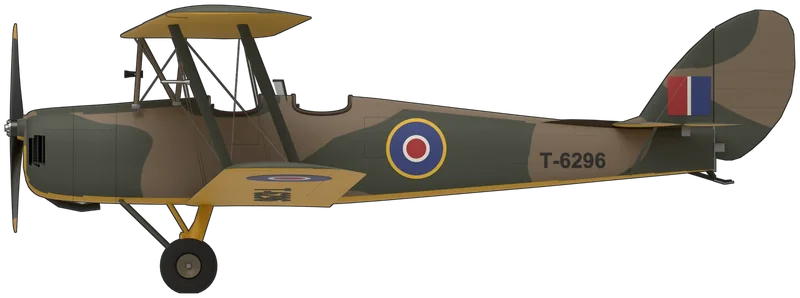
The Tiger Moth flew on 26 October 1931 and entered RAF service in 1932. It was a biplane with open tandem cockpits and a Gipsy Major engine.
It became the primary trainer across the Commonwealth and the main type of the British Commonwealth Air Training Plan. 8,868 were built, and Canada, Australia and New Zealand all flew it in large numbers.
A radio-controlled version, the Queen Bee, served as a target for anti-aircraft gunners. Its name is the likely origin of the word drone for a pilotless aircraft.
The Chipmunk
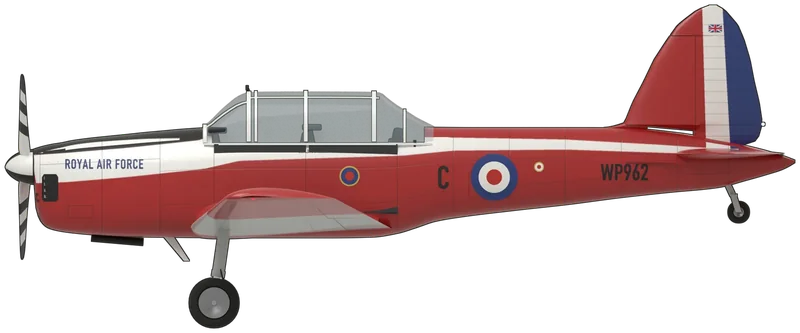
De Havilland Canada designed the Chipmunk as a successor to the Tiger Moth. Its principal designer was the Polish engineer Wsiewołod Jakimiuk. It flew on 22 May 1946.
The Air Ministry wrote Specification T.8/48 around it, to replace the Tiger Moth. The Chipmunk beat the Fairey Primer and was built in Britain as the T.10. It was a low-wing monoplane with tandem seats under a canopy.
Chipmunks were built in Canada, Britain and Portugal, 1,284 in all. British production supplied the RAF's T.10s.
In service
Chipmunks replaced Tiger Moths in the RAF in the early 1950s. The Army Air Corps and Fleet Air Arm also used them for primary training.
Prince Philip had his first flying lesson in a Chipmunk in 1952 and called it his favourite aircraft. Chipmunks also flew discreet reconnaissance over Berlin for the British military mission, BRIXMIS.
The RAF kept Chipmunks for elementary training until 1996, when the Bulldog replaced them. Cadets flew them on Air Experience Flights until the same year.
The myth: the Tiger Moth was an easy aeroplane
The Tiger Moth is gentle in normal flight, but it was never a toy. Aerobatics and formation flying demanded skill, and a botched manoeuvre could end in a spin. From 1941 military Tiger Moths were fitted with anti-spin strakes.
After the war many surplus Tiger Moths moved into civil flying, and a good number still fly today.
Where to see a Chipmunk and a Tiger Moth
The De Havilland Aircraft Museum shows a Chipmunk T.10 and a Tiger Moth, plus the fuselage of a Queen Bee target drone. The Shuttleworth Collection, Solent Sky, Newark Air Museum and Hooton Park Hangars also hold both.
| Museum | Adult entry | Airframes | Headline exhibit |
|---|---|---|---|
| Boscombe Down Aviation CollectionSalisbury, Wiltshire | £13.50 | 49 | The Lancaster cockpit reproduction tour, and a test-and-evaluation pedigree collection you can physically inhabit rather than admire… |
| De Havilland Aircraft MuseumSt Albans, Hertfordshire | £12 | 35 | Mosquito prototype W4050, the original 1940 aircraft, in the place it was designed and first assembled. No other British museum has… |
| Hooton Park HangarsEllesmere Port, Cheshire | £9 | 45 | Hooton Park's 1917 Belfast-truss hangars — among the finest WWI aviation buildings surviving — hold aircraft, buses and a printing museum… |
| Newark Air MuseumNewark, Nottinghamshire | £12.50 | 95 | Vulcan XM594, with cockpit tours occasionally given by former Vulcan aircrew, which reviewers describe with the reverence normally… |
| Solent SkySouthampton, Hampshire | £14 | 23 | Supermarine S.6A N248, the 1929 Schneider Trophy racer from the bloodline that begat the Spitfire — parked beneath its descendant for… |
| South Yorkshire Aircraft MuseumDoncaster, South Yorkshire | £7.50 | 109 | Doncaster's South Yorkshire Aircraft Museum sprawls across the old RAF Doncaster site: dozens of airframes and helicopters, strong… |
| The Shuttleworth CollectionBiggleswade, Bedfordshire | £19.50 | 55 | The 1934 DH.88 Comet 'Grosvenor House', winner of the MacRobertson England–Australia air race, restored to fly; and the Edwardians —… |
Frequently asked
What replaced the Tiger Moth in the RAF?
The de Havilland Canada Chipmunk, from the early 1950s. The Air Ministry's Specification T.8/48 was written around it.
When did the RAF stop using the Chipmunk?
In 1996, when the Scottish Aviation Bulldog took over elementary training and cadet air experience flying.
Where can I see a Chipmunk and a Tiger Moth together?
The De Havilland Aircraft Museum, The Shuttleworth Collection, Solent Sky, Boscombe Down Aviation Collection, Newark Air Museum and others.