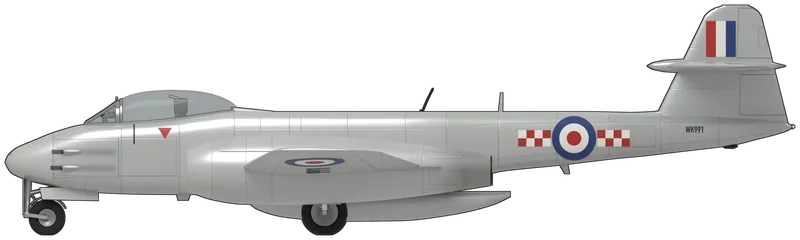
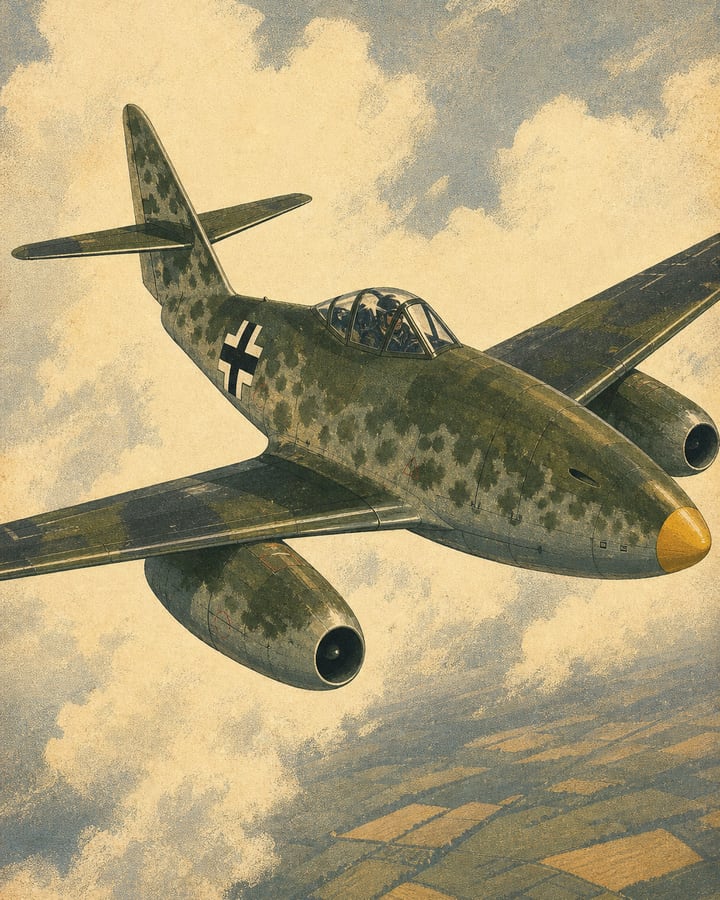
Specifications compared


| Variant compared | Meteor F.1 | Me 262 A-1a |
|---|---|---|
| First flight | 5 Mar 1943 | 18 Jul 1942 (on jet power) |
| Entered service | 27 Jul 1944 | Apr 1944 |
| Max speed | c. 417 mph (671 km/h) at 10,000 ft | 559 mph (900 km/h) |
| Engine | 2 × Rolls-Royce Welland, c. 1,700 lbf each | 2 × Junkers Jumo 004B-1, 1,980 lbf each |
| Armament | 4 × 20 mm Hispano cannon | 4 × 30 mm MK 108 cannon; R4M rockets or 2 × 250 kg bombs |
| Number built | 3,947 (all marks, 1943–55) | 1,430 |
| Crew | 1 | 1 |
Two first jets
The Me 262 first flew on 18 April 1941, on a piston engine, because its jets were not ready. Its first flight on jet power alone came on 18 July 1942.
The Meteor flew on 5 March 1943. Its Rolls-Royce Welland engines, Britain's first production jets, were built from Frank Whittle's centrifugal designs. The Me 262 used axial-flow Junkers Jumo 004s.
Both were twin-engined, single-seat fighters. Both entered service in mid-1944, the Me 262 a few months ahead.
The Meteor's Wellands gave about 1,700 lbf each. The Derwents of later marks roughly doubled that.
Performance and use
The Me 262 could exceed 850 km/h, about 150 km/h faster than any Allied fighter in Europe. It carried four 30 mm cannon, and later R4M rockets. The first Meteors managed about 417 mph and carried four 20 mm cannon.
No. 616 Squadron took the Meteor into action from Manston on 27 July 1944, against V-1 flying bombs. Its pilots claimed 14 by the war's end.
At first Meteors were barred from flying over German-held territory, for fear one would be captured. In 1945 the squadron moved to the continent and flew ground attack, without meeting German jets.
The record
Messerschmitt built 1,430 Me 262s. Allied fighters countered them by attacking their airfields and catching them on take-off and landing.
Gloster and its partners built 3,947 Meteors between 1943 and 1955. A Meteor F.3 set the first official jet air speed record, 606 mph, on 7 November 1945. The RAF flew Meteor target tugs until 1982.
The Hawker Tempest proved a dangerous opponent, fast at low altitude where the jets were vulnerable. One Me 262 pilot called it his aircraft's most dangerous enemy.
The myth: Hitler alone delayed the Me 262
Albert Speer and Adolf Galland both blamed Hitler's demand for a bomber version for the delay. That interference was real, but it was not the only cause. Engine vibration, materials shortages and metallurgy problems also held the jet back.
Where to see a Meteor and a Me 262
The Royal Air Force Museum Midlands holds the only Me 262 in the gazetteer, A-2a VK893, alongside a Meteor NF.14. For a wartime Meteor nearby, Jet Age Museum keeps the cockpit of F.3 EE425.
| Museum | Adult entry | Airframes | Headline exhibit |
|---|---|---|---|
| Royal Air Force Museum MidlandsShifnal, Shropshire | Free | 78 | TSR-2 XR220, one of two survivors of the most gifted aircraft Britain ever cancelled, sharing floor space with the stainless-steel… |
Frequently asked
Which was the first operational jet fighter?
The Me 262, which entered Luftwaffe service in spring 1944. The Meteor followed in July 1944 and was the first Allied jet fighter in action.
Did the Meteor ever fight the Me 262?
No. Meteors in Europe flew armed reconnaissance and ground attack in 1945 without meeting German jets. Allied anti-aircraft gunners sometimes mistook Meteors for Me 262s.
Where can I see a Meteor and an Me 262 together?
At the Royal Air Force Museum Midlands at Cosford, which holds Me 262 VK893 and a Meteor NF.14.