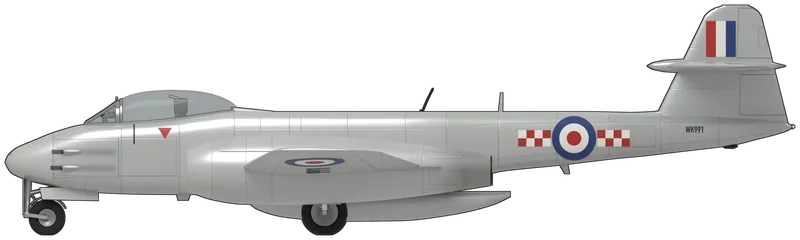
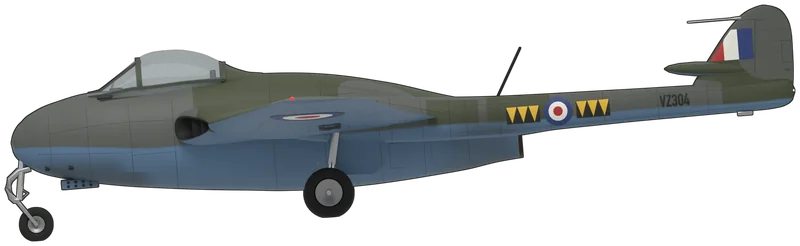
Specifications compared

| Variant compared | Meteor F.8 | Vampire FB.5 |
|---|---|---|
| First flight | 5 Mar 1943 (type) | 20 Sep 1943 (type) |
| Entered service | 27 Jul 1944 (type) | 1946 (type) |
| Max speed | 600 mph (966 km/h, Mach 0.82) at 10,000 ft | 548 mph (882 km/h) |
| Engine | 2 × Rolls-Royce Derwent 8, 3,600 lbf each | 1 × de Havilland Goblin 3, 3,350 lbf |
| Armament | 4 × 20 mm Hispano cannon; rockets or 2 × 1,000 lb bombs | 4 × 20 mm Hispano cannon; 8 rockets or 2 × 500 lb bombs |
| Number built | 3,947 | 4,780 (3,268 in Britain, 1,512 abroad) |
| Crew | 1 | 1 |
Two ways to build a jet
Gloster's Meteor flew on 5 March 1943, with one engine in each wing. It was a straightforward design rather than an aerodynamically advanced one.
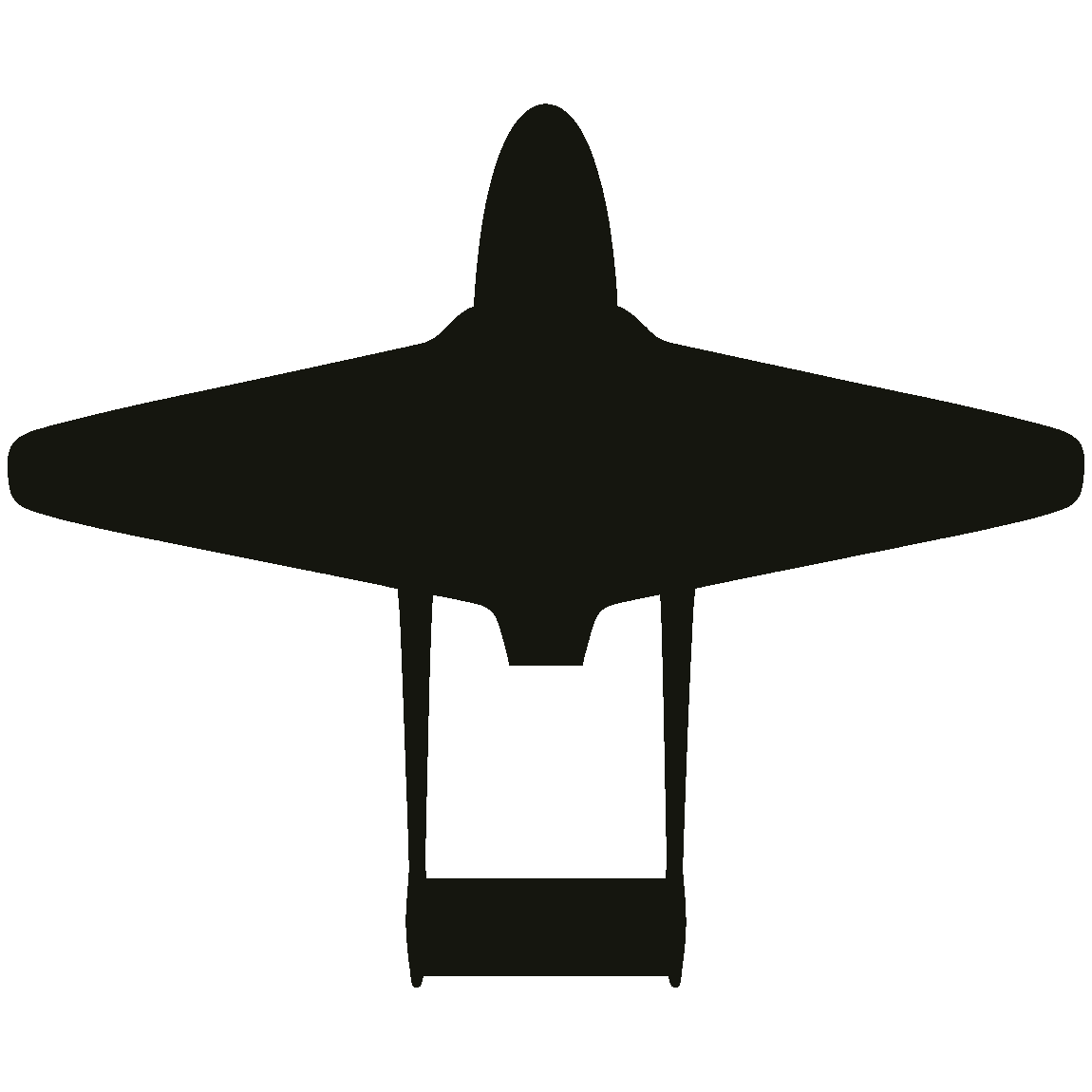
De Havilland's Vampire flew on 20 September 1943. It used a single Halford H.1 engine, later the Goblin, in a short nacelle with twin booms carrying the tail. Apart from the engine and booms, it was a fairly conventional aircraft.
The Meteor was in action by July 1944. The Vampire entered service in 1946, the first single-engined jet in the RAF.
Performance and firsts
Both carried four 20 mm Hispano cannon. The Meteor F.8, with two Derwent 8s, reached 600 mph at 10,000 ft. The Vampire FB.5 reached about 548 mph on one Goblin.
Each set records. A Meteor F.3 set the first official jet air speed record, 606 mph, in November 1945. In 1945 a Sea Vampire flown by Eric Brown made the first jet landing and take-off on an aircraft carrier, HMS Ocean.
A Vampire was also the first jet aircraft to cross the Atlantic.
The record
Gloster and its partners built 3,947 Meteors. De Havilland and English Electric built 3,268 Vampires in Britain, with 1,512 more abroad.
The Vampire left front-line RAF service in 1953 for ground attack and training. The two-seat T.11 trained many RAF jet pilots, and 31 air forces used the type. Switzerland kept Vampires until 1990.
Meteors became trainers, night fighters and target tugs, serving the RAF until 1982. Australian Meteors fought in Korea.
Both had two-seat trainers. The Vampire T.11 came from a two-seat night fighter with the radar removed; the Meteor T.7 did the same job for the twin.
The myth: the Meteor was the main early jet
As Britain's first jet fighter, the Meteor gets most of the attention. The Vampire was built in greater numbers and sold more widely. Most museums with one also hold the other.
The Royal Navy also took the Vampire to sea as its first jet fighter.
Where to see a Meteor and a Vampire
Twenty gazetteer museums hold both, and Midland Air Museum is a good start, with an early Meteor F.4 and Vampire F.1 VF301. The Royal Air Force Museum London, IWM Duxford and Newark Air Museum also show complete examples of each.
| Museum | Adult entry | Airframes | Headline exhibit |
|---|---|---|---|
| Bournemouth Aviation MuseumChristchurch, Dorset | £10 | 29 | The sit-anywhere policy itself — one entry fee, no per-cockpit charges, a full BAC 1-11 flight-deck sim in a shed, and thousands… |
| City of Norwich Aviation MuseumNorwich, Norfolk | £9 | 33 | City of Norwich Aviation Museum at Horsham St Faith: Norfolk's largest, ~30 airframes including a Vulcan and Nimrod with bookable… |
| East Midlands AeroparkDerby, Leicestershire | £5 | 35 | East Midlands Aeropark: a Vulcan, Nimrod R1 and Buccaneer parked on grassy mounds overlooking EMA's runway — half museum, half premier… |
| Fleet Air Arm MuseumYeovil, Somerset | £21 | 97 | Concorde 002 (G-BSST), the first British-assembled Concorde, which made her maiden flight from Filton in 1969 and now headlines a hall of… |
| Hooton Park HangarsEllesmere Port, Cheshire | £9 | 45 | Hooton Park's 1917 Belfast-truss hangars — among the finest WWI aviation buildings surviving — hold aircraft, buses and a printing museum… |
| IWM DuxfordCambridge, Cambridgeshire | £29 | 146 | Concorde 101 (G-AXDN), the pre-production development aircraft and the fastest Concorde of them all at Mach 2.23 — plus an SR-71A… |
| Jet Age MuseumGloucester, Gloucestershire | Donation | 15 | Gloucestershire's jet-age shrine (free!) beside Staverton airport: Gloster heritage from the E.28/39 replica to Javelins, with… |
| Midland Air MuseumCoventry, Warwickshire | £11 | 66 | Vulcan XL360 with cockpit access and volunteer-led tours (ask for the instrumentation talk), plus the Whittle jet heritage collection a… |
| Montrose Air Station MuseumMontrose, Angus | £10 | 14 | The 1913 fabric itself, plus the resident ghost stories (Montrose is Britain's most famously haunted airfield, a claim the volunteers… |
| MorayviaForres, Moray | £8 | 35 | Nimrod XV244 (complete, and the crew who operated her sometimes give the tours) alongside a Sea King in RAF SAR yellow — the machine that… |
| Newark Air MuseumNewark, Nottinghamshire | £12.50 | 95 | Vulcan XM594, with cockpit tours occasionally given by former Vulcan aircrew, which reviewers describe with the reverence normally… |
| Norfolk and Suffolk Aviation MuseumBungay, Suffolk | £10 | 65 | Depends who you ask — the joy is the oddities. Come for the Bloodhound missiles and decoy rarities; stay for volunteer flight-simulator… |
| North East Land, Sea and Air MuseumsSunderland, Tyne and Wear | £7.50 | 46 | NELSAM in Sunderland mixes Vulcan XL319 (flew in when the airport still existed), a Pucará from the Falklands, trams, buses and a… |
| Royal Air Force Museum LondonLondon, Greater London | Free | 88 | Avro Lancaster R5868 'S-Sugar' — 137 operations, the RAF's highest-scoring surviving heavy — under the same roof as a Vulcan, a… |
| Solway Aviation MuseumCrosby on Eden, Cumbria | £8 | 21 | Vulcan XJ823 with pre-bookable crew-compartment visits; a Phantom, Lightning and Canberra (whose three-crew cockpit reviewers describe as… |
| South Wales Aviation MuseumBarry, Vale of Glamorgan | £10 | 73 | The resident Harrier and a growing VC10/Tornado-era collection, most with steps and open canopies. Kids exit wearing thousand-yard grins. |
| South Yorkshire Aircraft MuseumDoncaster, South Yorkshire | £7.50 | 109 | Doncaster's South Yorkshire Aircraft Museum sprawls across the old RAF Doncaster site: dozens of airframes and helicopters, strong… |
| Tangmere Military Aviation MuseumChichester, West Sussex | £15 | 23 | Hawker Hunter WB188 in one-off scarlet, in which Neville Duke took the world air speed record to 727.63 mph off this coast in 1953;… |
| Ulster Aviation Society (Maze Long Kesh)Lisburn, County Antrim | By appointment | 63 | The Shorts family — SC.1 vertical take-off research aircraft included — plus a Buccaneer, Phantom, Wildcat, and a newly arrived AV-8… |
| Yorkshire Air MuseumYork, North Yorkshire | £17 | 54 | Halifax 'Friday the 13th' — the world's only complete Halifax reconstruction, honouring the type that flew from this very field —… |
Frequently asked
Which came first, the Meteor or the Vampire?
The Meteor, which flew in March 1943 and saw action in 1944. The Vampire flew in September 1943 and entered service in 1946.
Were more Meteors or Vampires built?
More Vampires: 3,268 in Britain and 1,512 abroad, against 3,947 Meteors.
Where can I see a Meteor and a Vampire together?
Almost any large collection. Midland Air Museum, Newark Air Museum, IWM Duxford and the Royal Air Force Museum London all have both.