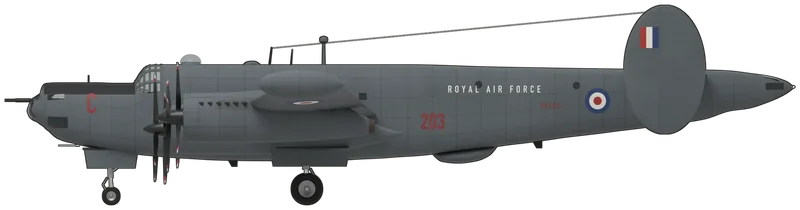
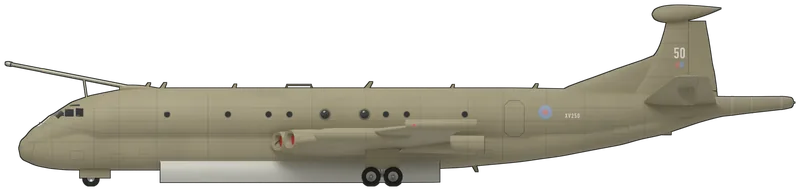
Specifications compared


| Variant compared | Shackleton (early MR figures) | Nimrod MR2 |
|---|---|---|
| First flight | 9 Mar 1949 | 23 May 1967 |
| Entered service | Apr 1951 | 2 Oct 1969 (type) |
| Max speed | 260 kn (299 mph) | 500 kn (575 mph) |
| Engine | 4 × Rolls-Royce Griffon 57, 1,960 hp each | 4 × Rolls-Royce Spey turbofans, 12,160 lbf each |
| Armament | 2 × 20 mm cannon; 10,000 lb of bombs, torpedoes or depth charges | Up to 20,000 lb in bomb bay and on 2 pylons: torpedoes, depth charges, missiles |
| Number built | 185 | 49 (plus 2 prototypes) |
| Crew | 10 | 13 |
The Shackleton
Avro developed the Shackleton from the Lincoln bomber, itself a development of the Lancaster. It also borrowed from the Tudor airliner. It flew on 9 March 1949 and joined Coastal Command in 1951.
Its job was hunting the growing Soviet submarine fleet. Four Rolls-Royce Griffons gave it long endurance, and a crew of ten worked a large electronics suite. Avro built 185 between 1951 and 1958.
The heavier MR.3 needed help from Viper jet engines on take-off. The long hours at high power took a toll on its airframe.
South Africa also flew Shackletons.
The Nimrod
The Nimrod was an extensive rebuild of the de Havilland Comet, the world's first jet airliner. It was designed to replace the ageing Shackletons. It flew on 23 May 1967 and entered service on 2 October 1969.
Its four Rolls-Royce Speys gave a top speed of about 500 knots. On low-level patrol the crew could shut down two engines to save fuel. The RAF also flew three Nimrod R1s for electronic intelligence.
It could reach a patrol area at jet speed and then loiter on two engines. That combined much of the Shackleton's endurance with far quicker transits.
Early warning
In the 1970s a few Shackletons were converted to the airborne early warning role. The Nimrod AEW3 was meant to replace them, but it ran into severe problems.
It was cancelled in 1986 in favour of the Boeing E-3 Sentry. The Shackleton AEW2s flew on until the Sentry arrived in 1991.
The ageing Shackletons thus outlived the jet meant to replace them.
The record and a myth
The Nimrod MR2 served until March 2010. Its rebuilt successor, the MRA4, was abandoned in 2010 after delays and cost overruns, and the R1s retired in June 2011.
The Shackleton is often described as a converted Lancaster. It was a new aircraft, though it drew heavily on the Lincoln bomber and the Tudor airliner.
Where to see a Shackleton and a Nimrod
The Yorkshire Air Museum shows a complete Shackleton AEW.2, WR963, beside Nimrod MR.2 XV250. South Wales Aviation Museum, Morayvia and the Avro Heritage Museum also hold both types, the Nimrods as forward fuselages except at Morayvia.
| Museum | Adult entry | Airframes | Headline exhibit |
|---|---|---|---|
| Avro Heritage MuseumStockport, Greater Manchester | £9 | 14 | Vulcan XM603 — the only all-white Vulcan on display anywhere, in original anti-flash nuclear livery — plus walk-in Lancaster and Nimrod… |
| MorayviaForres, Moray | £8 | 35 | Nimrod XV244 (complete, and the crew who operated her sometimes give the tours) alongside a Sea King in RAF SAR yellow — the machine that… |
| South Wales Aviation MuseumBarry, Vale of Glamorgan | £10 | 73 | The resident Harrier and a growing VC10/Tornado-era collection, most with steps and open canopies. Kids exit wearing thousand-yard grins. |
| Yorkshire Air MuseumYork, North Yorkshire | £17 | 54 | Halifax 'Friday the 13th' — the world's only complete Halifax reconstruction, honouring the type that flew from this very field —… |
Frequently asked
What replaced the Shackleton?
The Nimrod replaced it on maritime patrol from 1969. In the early-warning role it was replaced by the Boeing E-3 Sentry in 1991.
Was the Nimrod based on the Comet airliner?
Yes. It was an extensive modification of the de Havilland Comet, re-engined with Rolls-Royce Speys and rebuilt for maritime patrol.
Where can I see a Shackleton and a Nimrod together?
The Yorkshire Air Museum has complete examples of both. South Wales Aviation Museum, Morayvia and the Avro Heritage Museum also hold the pair.