3D model
Turn it over
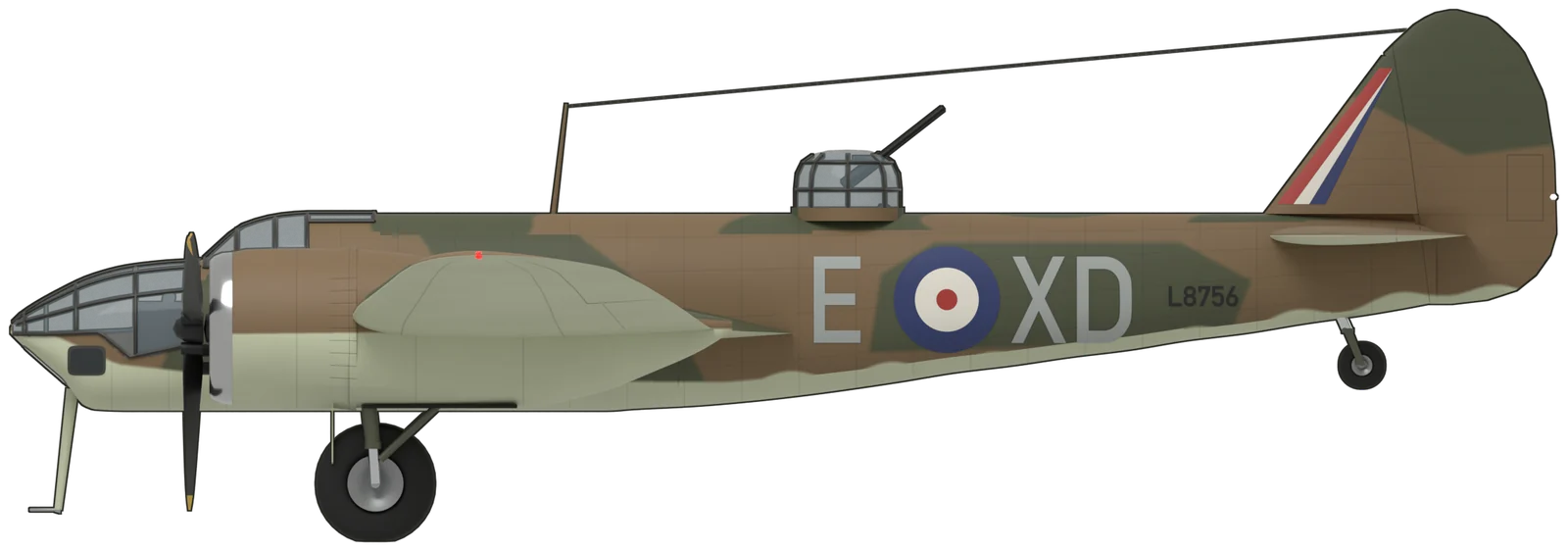
A procedural model built in Blender from published dimensions, drawings and photographs, painted as L8756, a long-nosed Blenheim IV of No. 139 Squadron coded XD-E, as finished on the RAF Museum’s Canadian-built Bolingbroke IV-T RCAF 10001: Dark Earth and Dark Green upper surfaces over Sky, polished cowling rings round its two Mercury radials, Type A roundels beside Medium Sea Grey codes, a fin flash, black propellers with yellow tips and a single Vickers K gun in the dorsal turret, as it is displayed at RAF Museum Midlands, Cosford. Drag to orbit, scroll or pinch to zoom · download .glb (1.2 MB)
History
The Blenheim Mk IV
The Blenheim began as a private venture. In 1934 the newspaper owner Lord Rothermere asked Bristol for a fast executive aircraft, and the all-metal Type 142 that resulted, which he named ‘Britain First’, flew in April 1935 and proved faster than any fighter the RAF then had. Rothermere gave it to the nation, and the Air Ministry ordered a bomber version straight off the drawing board. The first Blenheim I, K7033, flew at Filton on 25 June 1936, and No. 114 Squadron at Wyton received the first in March 1937.
The short nose of the Mk I left the navigator little room to work, so Bristol lengthened it by about three feet, with a scalloped port side so that the pilot could still see forward. The long-nosed Mk IV reached the squadrons in 1939. On 3 September 1939 a Blenheim IV of No. 139 Squadron flew the RAF’s first operational sortie of the war, photographing the German fleet at Wilhelmshaven. By 1940 the type was outclassed, yet No. 2 Group sent it on costly low-level daylight raids against shipping, ports and power stations, and Wing Commander Hughie Edwards won the Victoria Cross leading Blenheims over Bremen in July 1941.
Blenheims also flew as night fighters, some carrying the first airborne radar, and fought in Greece, North Africa and the Far East. Finland built them under licence and flew them until 1958. About 4,400 were built in all, most of them in Britain by Bristol, Avro and Rootes; in Canada, Fairchild at Longueuil built 676 as the Bolingbroke for the RCAF, which flew them on coastal patrols and as trainers. Nearly every Blenheim in a museum today began life as a Bolingbroke.
This airframe
Blenheim IV ‘L8756’
This aircraft is really Bolingbroke IV-T 10001, built by Fairchild at Longueuil, Quebec, and taken on RCAF charge in October 1942 as a gunnery and navigation trainer at the Bombing and Gunnery Schools in Manitoba and Saskatchewan. Struck off in 1946 after 905 flying hours, it was sold to a farmer for $200 and stood on his farm at Portage la Prairie for twenty years. The RAF Museum bought it in 1966 for the same price, and volunteers at Boscombe Down rebuilt it as a Blenheim IV between 1972 and 1978, over more than 8,000 hours. They chose to paint it as L8756 ‘XD-E’ of No. 139 Squadron, the unit that flew the RAF’s first sortie of the war. It stood at Hendon for many years and is now displayed at RAF Museum Midlands, Cosford. The model shows it in Dark Earth and Dark Green over Sky, with polished cowling rings, Type A roundels beside grey codes, a fin flash, black propellers with yellow tips and a single Vickers K gun in the dorsal turret.
Where to see one
In the gazetteer
The gazetteer records the Blenheim Mk IV in 4 UK collections. The airframe modelled here is marked.