AP 118 · No. 10 Section II · Aircraft Collection 03 / 12

Aircraft/Collections/Battle of Britain

Fighter station · summer 1940

Aircraft of the Battle of Britain

Hurricanes and Spitfires scramble from a grass fighter station while German bombers and their escorts cross overhead: the summer of 1940, to scale.

9
Aircraft
1940
Period
17
UK museums hold them

The diorama

Diorama · 1940

Loading the airfield…

A Fighter Command sector station in the summer of 1940: a grass airfield with camouflaged Bellman hangars, a watch office, a dispersal hut and earth blast pens to shelter the fighters from bombing. The RAF aircraft take off and land; the Luftwaffe’s bombers and escorts pass overhead.

Drag to look around · ctrl + scroll to zoom · pick an aircraft to follow it

The Battle of Britain was fought in the skies over southern England between July and October 1940. The Luftwaffe set out to destroy Fighter Command as a prelude to invasion; Fighter Command, directed by radar and a network of observers, operations rooms and sector stations, set out to survive and to make every raid expensive.

The Hurricane was the more numerous British fighter and claimed more German aircraft than all other defences combined; the Spitfire, faster and more agile, became the symbol of the battle. Against them came the Messerschmitt Bf 109, a match for either, the twin-engined Bf 110 escort fighter and the bomber formations of Heinkel He 111s, Junkers Ju 88s and Dornier Do 17s.

Many fighter stations were still grass fields. From August the Luftwaffe bombed them directly: Biggin Hill, Kenley, Manston and others were hit again and again. Blast pens, dispersal around the airfield edge and hard-working repair crews kept the squadrons flying, and on 15 September, now Battle of Britain Day, the RAF met two massive raids in strength.

To scale

The collection side by side

Every aircraft drawn at the same scale, so a He 111 and a Magister can be compared at a glance.

  • Supermarine Spitfire side profile, to scaleSpitfire · 9.47 m
  • Hawker Hurricane side profile, to scaleHurricane · 9.58 m
  • Bristol Blenheim side profile, to scaleBlenheim Mk IV · 12.98 m
  • Gloster Gladiator side profile, to scaleGladiator · 8.36 m
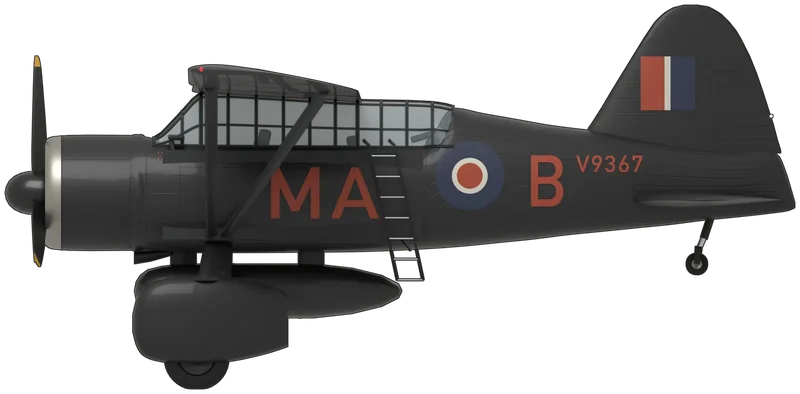
  • Westland Lysander side profile, to scaleLysander · 9.3 m
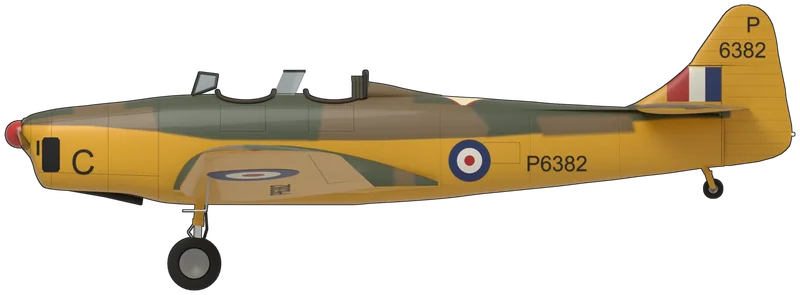
  • Miles Magister side profile, to scaleMagister · 7.51 m
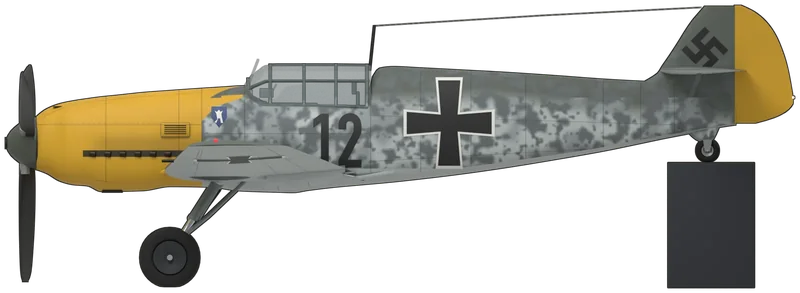
  • Messerschmitt Bf 109 side profile, to scaleBf 109E · 8.64 m
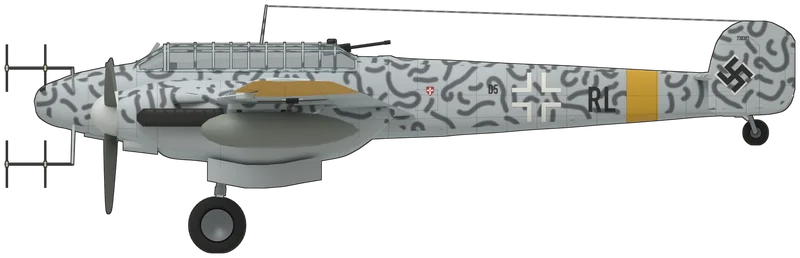
  • Messerschmitt Bf 110 side profile, to scaleBf 110 · 12.07 m
  • Heinkel He 111 side profile, to scaleHe 111 · 16.4 m

10 m

Profiles

Side, top and front

Each aircraft drawn from its 3D model, painted as one real airframe, with its specification.

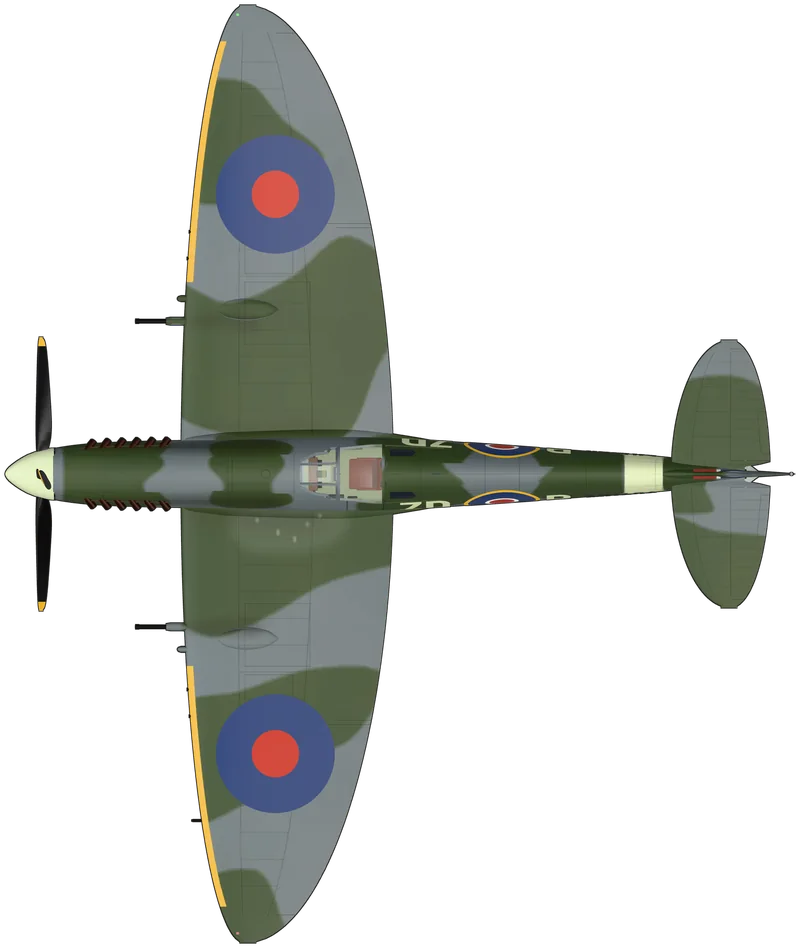
Supermarine Spitfire

01 · Fighter · LF Mk IX MH434
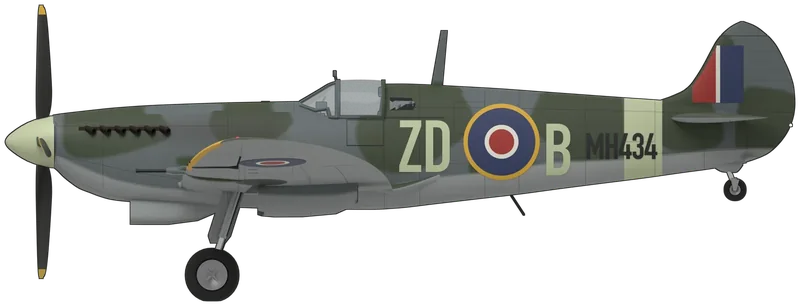
Side view of the Supermarine Spitfire, LF Mk IX MH434
Port side
Top view of the Supermarine Spitfire, LF Mk IX MH434
Plan, from above
Front view of the Supermarine Spitfire, LF Mk IX MH434
Head-on

R.J. Mitchell’s Spitfire grew out of his Schneider Trophy racers and first flew on 5 March 1936. Its thin elliptical wing gave it the speed and agility to meet the best German fighters, and Spitfires were in production from before the war until after it: more than 22,000 Spitfires and Seafires were built.

The Spitfire was built in some two dozen marks, from the 1,030 hp Mk I to the 2,000 hp-plus Griffon-engined Mk 24.

MH434 was built at Castle Bromwich in 1943 and flew as ZD-B with No. 222 (Natal) Squadron from Hornchurch, where Flt Lt Henry Lardner-Burke shot down a Focke-Wulf Fw 190 in it that August.

First flight
5 March 1936
Role
Fighter
Maker
Supermarine, Britain
Engine
Rolls-Royce Merlin 66 V-12, about 1,700 hp
Crew
1
Wingspan
11.23 m (36 ft 10 in)
Length
9.47 m (31 ft 1 in)
Height
3.86 m (12 ft 8 in)
Top speed
454 mph
Built
20,351 + 2,334
In service
1938–1957

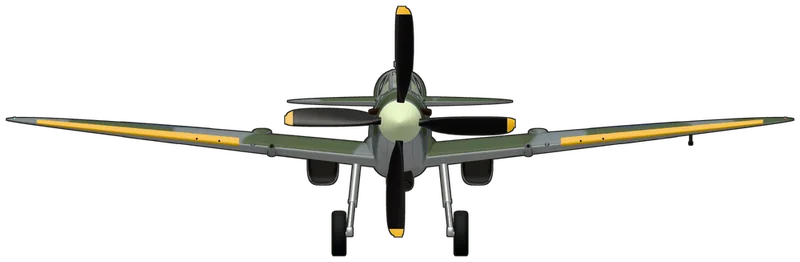
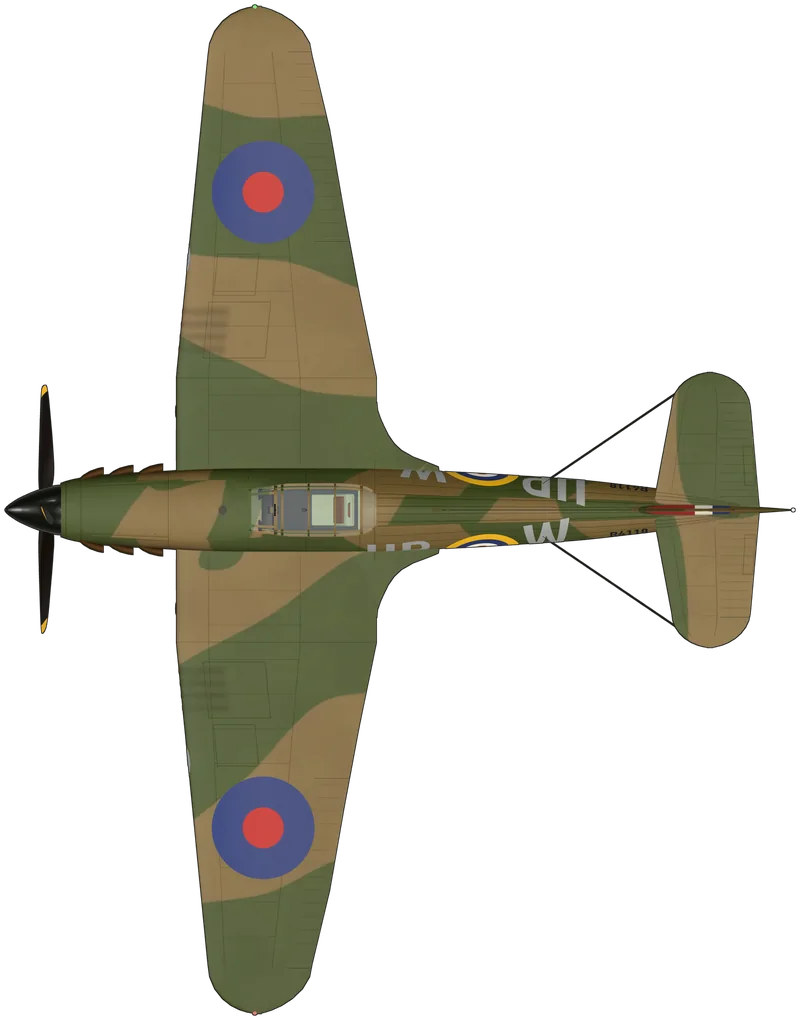
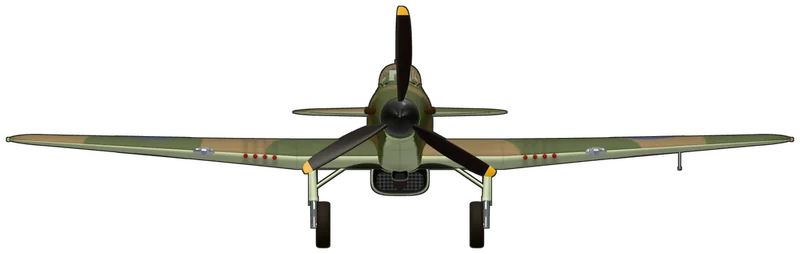
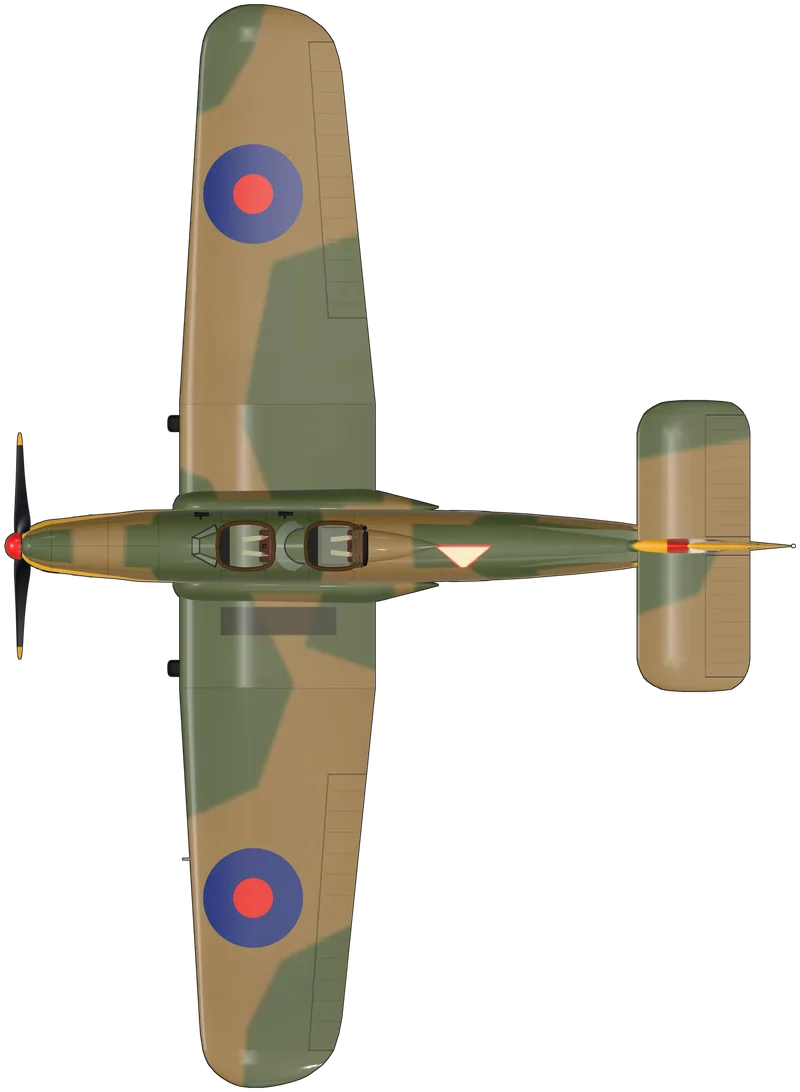
Hawker Hurricane

02 · Fighter · Mk I R4118
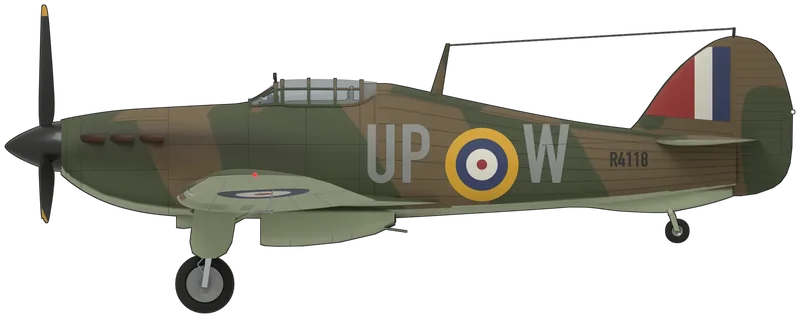
Side view of the Hawker Hurricane, Mk I R4118
Port side
Top view of the Hawker Hurricane, Mk I R4118
Plan, from above
Front view of the Hawker Hurricane, Mk I R4118
Head-on

Sydney Camm’s Hurricane was the RAF’s first monoplane fighter and its first to exceed 300 mph. It first flew in November 1935, and its steel-tube and fabric construction was familiar to the factories and could be repaired on the squadron.

Hurricane pilots were credited with about 60 per cent of the RAF’s victories in the Battle of Britain.

R4118 was built by Gloster in 1940 and flew 49 sorties as UP-W with No. 605 (County of Warwick) Squadron from Croydon during the Battle of Britain.

First flight
6 November 1935
Role
Fighter
Maker
Hawker, Britain
Engine
Rolls-Royce Merlin III V-12, 1,030 hp
Crew
1
Wingspan
12.19 m (40 ft 0 in)
Length
9.58 m (31 ft 5 in)
Height
4 m (13 ft 1 in)
Top speed
340 mph
Built
14,583
In service
1937–1947

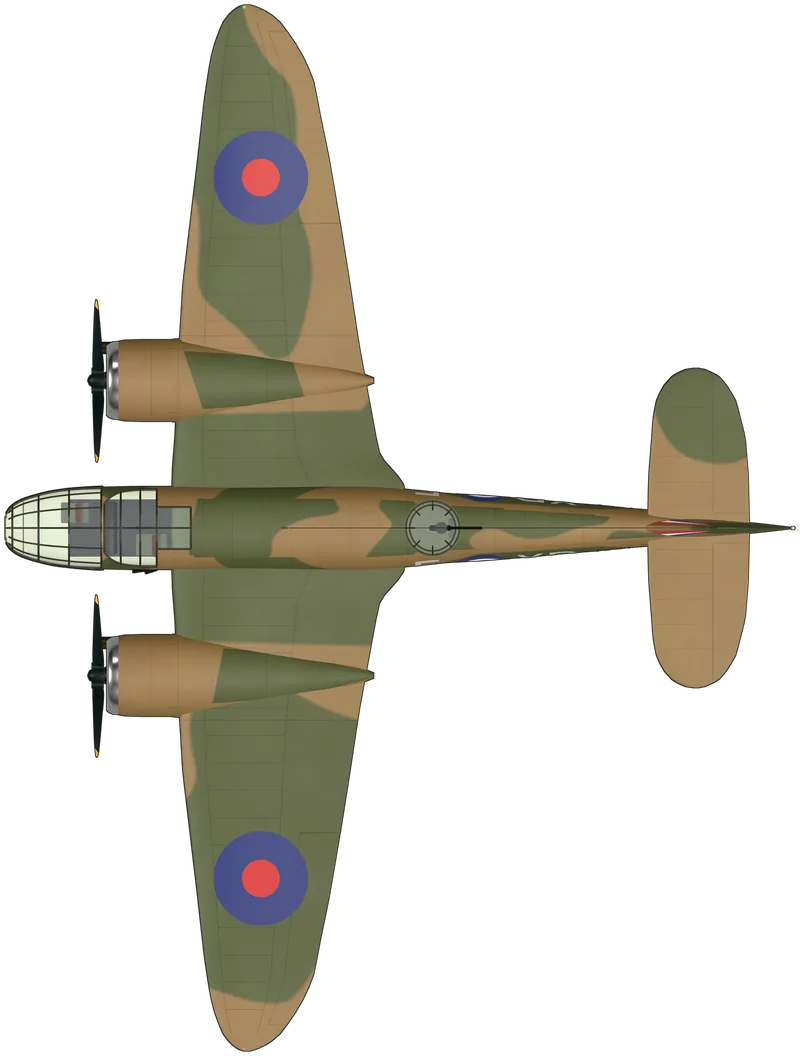
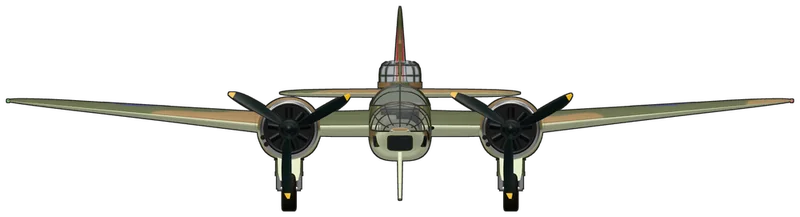
Bristol Blenheim

03 · Light bomber · Blenheim IV ‘L8756’
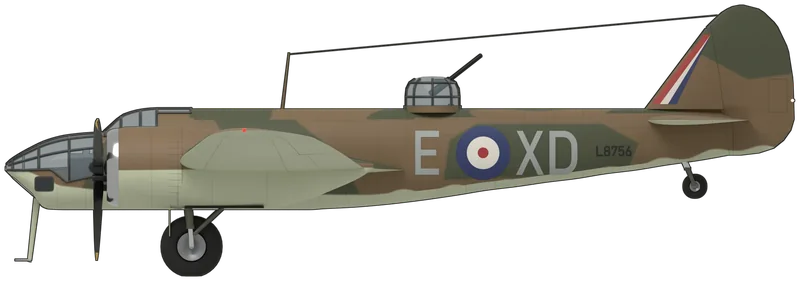
Side view of the Bristol Blenheim, Blenheim IV ‘L8756’
Port side
Top view of the Bristol Blenheim, Blenheim IV ‘L8756’
Plan, from above
Front view of the Bristol Blenheim, Blenheim IV ‘L8756’
Head-on

The Blenheim began as a private venture. In 1934 the newspaper owner Lord Rothermere asked Bristol for a fast executive aircraft, and the all-metal Type 142 that resulted, which he named ‘Britain First’, flew in April 1935 and proved faster than any fighter the RAF then had. Rothermere gave it to the nation, and the Air Ministry ordered a bomber version straight off the drawing board.

‘Britain First’, the private aircraft from which the Blenheim grew, flew at over 300 mph in 1935, some 70 mph faster than the Gloster Gauntlet the RAF was then bringing into service.

This aircraft is really Bolingbroke IV-T 10001, built by Fairchild at Longueuil, Quebec, and taken on RCAF charge in October 1942 as a gunnery and navigation trainer at the Bombing and Gunnery Schools in Manitoba and Saskatchewan.

First flight
25 June 1936
Role
Light bomber
Maker
Bristol Aeroplane Company (Fairchild in Canada as the Bolingbroke), Britain
Engine
2 × Bristol Mercury XV nine-cylinder radials, 905 hp each
Crew
3
Wingspan
17.17 m (56 ft 4 in)
Length
12.98 m (42 ft 7 in)
Height
3 m (9 ft 10 in)
Top speed
266 mph
Built
~4,400
In service
1937–1958 (RAF front line to 1944)

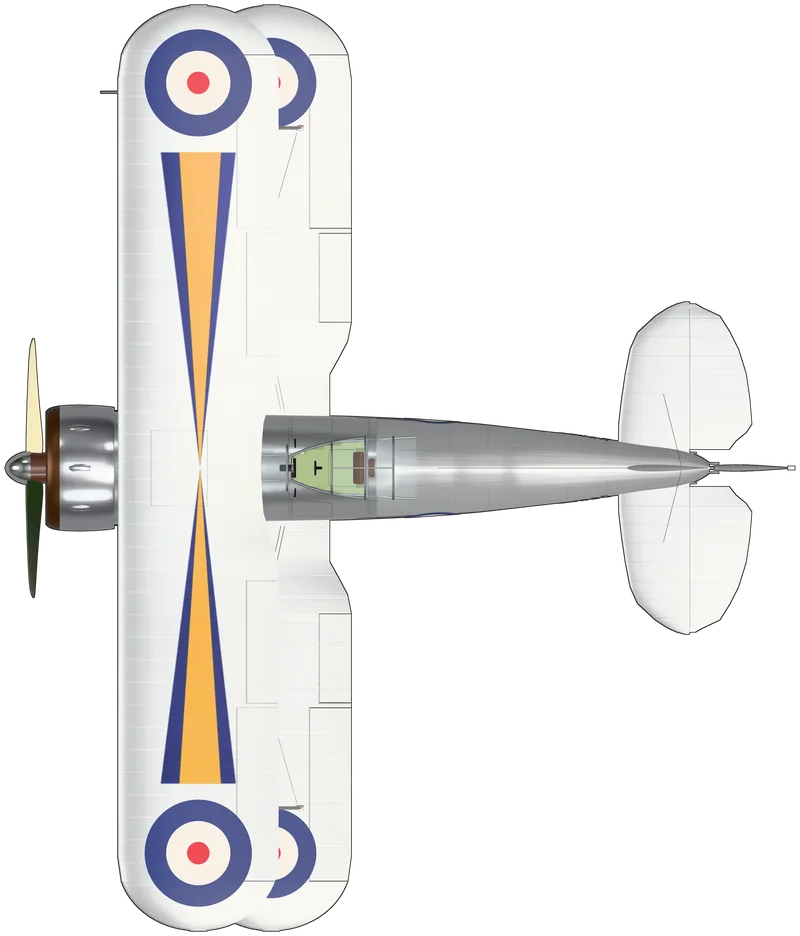
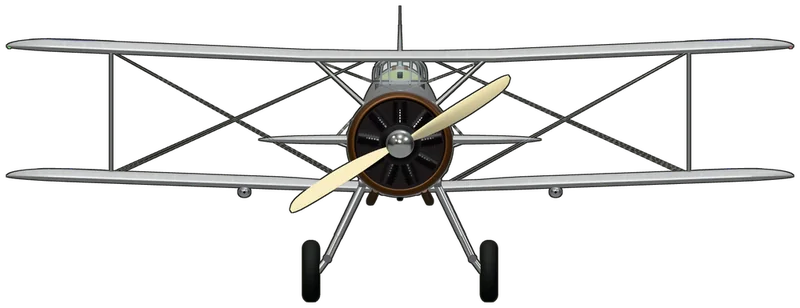
Gloster Gladiator

04 · Biplane fighter · Gladiator I L8032 (G-AMRK)
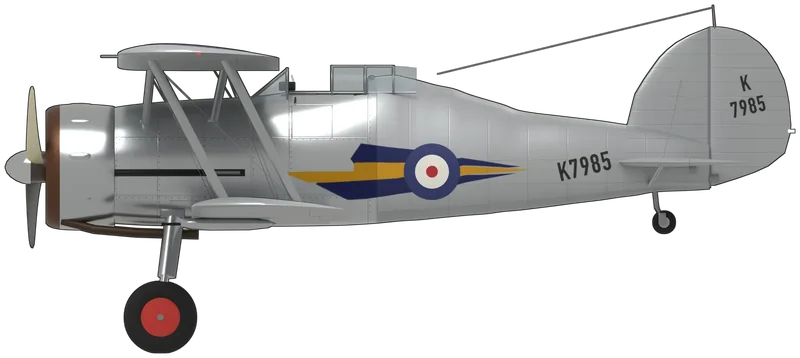
Side view of the Gloster Gladiator, Gladiator I L8032 (G-AMRK)
Port side
Top view of the Gloster Gladiator, Gladiator I L8032 (G-AMRK)
Plan, from above
Front view of the Gloster Gladiator, Gladiator I L8032 (G-AMRK)
Head-on

The Gladiator was Henry Folland’s last refinement of the open-cockpit Gauntlet. Gloster built it as a private venture, the SS.37, to meet an Air Ministry specification for a four-gun fighter, giving it single-bay wings braced by one pair of interplane struts on each side, cantilever main undercarriage legs with internal springing, flaps on both wings and a Bristol Mercury radial in a long-chord cowling. The prototype first flew on 12 September 1934 and reached about 242 mph, and the Air Ministry ordered the type in 1935 as the Gladiator, with an enclosed sliding canopy, the first on an RAF fighter, and four machine guns, two in the fuselage sides and one under each lower wing.

The Gladiator was the RAF’s last biplane fighter and also its first fighter with an enclosed cockpit: the pilot sat under a sliding canopy between wings braced with wires.

L8032 was the last Gladiator Mk I built.

First flight
12 September 1934
Role
Biplane fighter
Maker
Gloster Aircraft Company, Britain
Engine
Bristol Mercury IX nine-cylinder radial, 830 hp
Crew
1
Wingspan
9.83 m (32 ft 3 in)
Length
8.36 m (27 ft 5 in)
Height
3.58 m (11 ft 9 in)
Top speed
257 mph
Built
747
In service
1937–1945

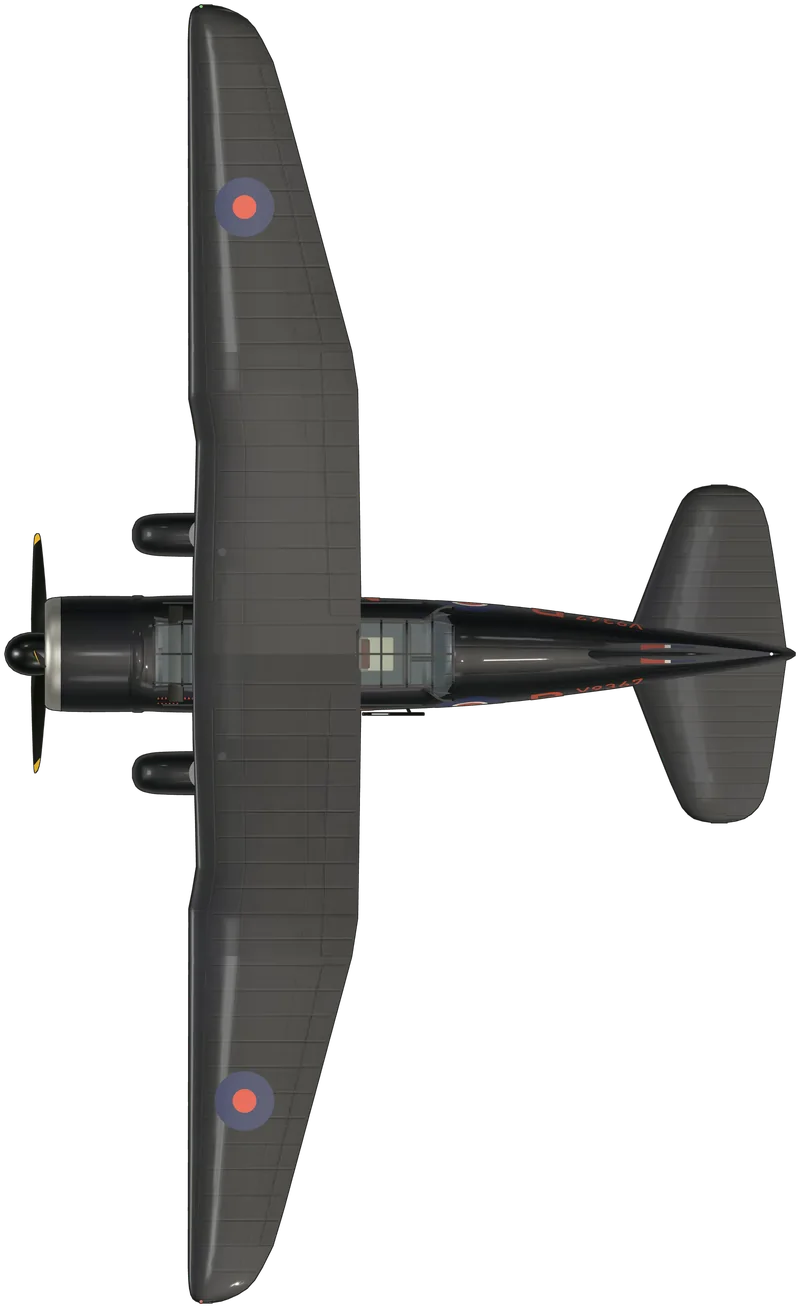
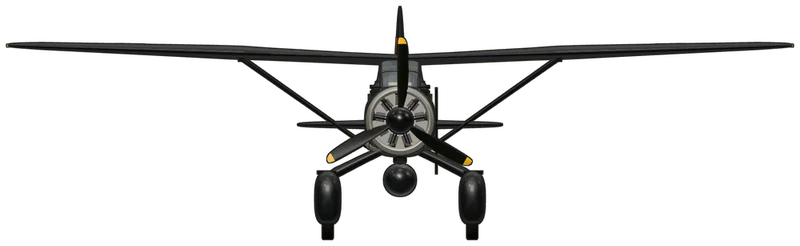
Westland Lysander

05 · Army co-operation and special duties monoplane · Lysander IIIA V9552 (G-AZWT)
Side view of the Westland Lysander, Lysander IIIA V9552 (G-AZWT)
Port side
Top view of the Westland Lysander, Lysander IIIA V9552 (G-AZWT)
Plan, from above
Front view of the Westland Lysander, Lysander IIIA V9552 (G-AZWT)
Head-on

The Lysander was Westland’s answer to Air Ministry specification A.39/34 for an army co-operation aircraft, a machine to spot for the artillery, photograph enemy positions, drop supplies and carry messages for troops in the field. Arthur Davenport and Teddy Petter designed it after asking the pilots who would fly it what they wanted, and the answer was a good view and the ability to use small, rough fields. They gave it a high wing that tapered towards the root, so the pilot could see past it, automatic leading-edge slats and slotted flaps for very low landing speeds, and a fixed undercarriage on two spatted cantilever legs.

On a pick-up the Lysander often spent only a few minutes on the ground in occupied France: agents climbed down the fixed ladder as passengers for England climbed up, and the pilot took off again without stopping the engine.

V9552 was built by Westland as a Lysander IIIA and shipped to Canada in 1942, where it served the Royal Canadian Air Force as target tug 1582 until 1946.

First flight
15 June 1936
Role
Army co-operation and special duties monoplane
Maker
Westland Aircraft, Britain
Engine
Bristol Mercury XXX nine-cylinder radial, 870 hp
Crew
2
Wingspan
15.24 m (50 ft 0 in)
Length
9.3 m (30 ft 6 in)
Height
4.42 m (14 ft 6 in)
Top speed
212 mph
Built
1,786
In service
1938–1946

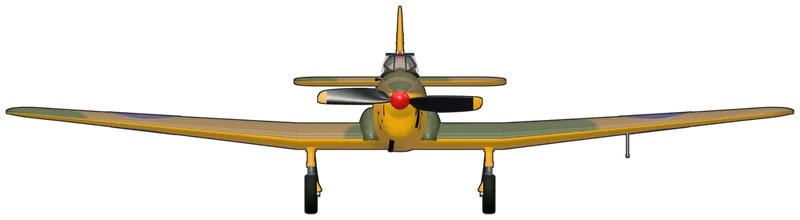
Miles Magister

06 · Elementary trainer · Magister I P6382 (G-AJRS)
Side view of the Miles Magister, Magister I P6382 (G-AJRS)
Port side
Top view of the Miles Magister, Magister I P6382 (G-AJRS)
Plan, from above
Front view of the Miles Magister, Magister I P6382 (G-AJRS)
Head-on

In the mid-1930s the RAF taught its pilots on biplanes, while the fighters they would go on to fly were becoming monoplanes. F. G. Miles of Phillips & Powis at Woodley, near Reading, had already built the Hawk Trainer, a two-seat version of his light Hawk monoplane, and the Air Ministry wrote specification T.40/36 around a militarised version of it. The prototype M.14, flown by Miles on 20 March 1937, was a low-wing monoplane built of spruce and plywood, with tandem open cockpits, flaps, a fixed undercarriage and a 130 hp de Havilland Gipsy Major I. It gave pupils the feel of a monoplane, flaps and all, before they moved on to the Harvard, the Master and then the Hurricane and Spitfire.

The Magister was the RAF’s first monoplane trainer, but it was built almost entirely of wood: a spruce and plywood airframe in an age that was turning to metal.

P6382 was built by Phillips & Powis at Woodley in 1939 and served with the RAF as an elementary trainer.

First flight
20 March 1937
Role
Elementary trainer
Maker
Phillips & Powis Aircraft (Miles), Britain
Engine
de Havilland Gipsy Major I four-cylinder inverted inline, 130 hp
Crew
2
Wingspan
10.31 m (33 ft 10 in)
Length
7.51 m (24 ft 8 in)
Height
2.03 m (6 ft 8 in)
Top speed
132 mph
Built
1,303
In service
1937–1940s

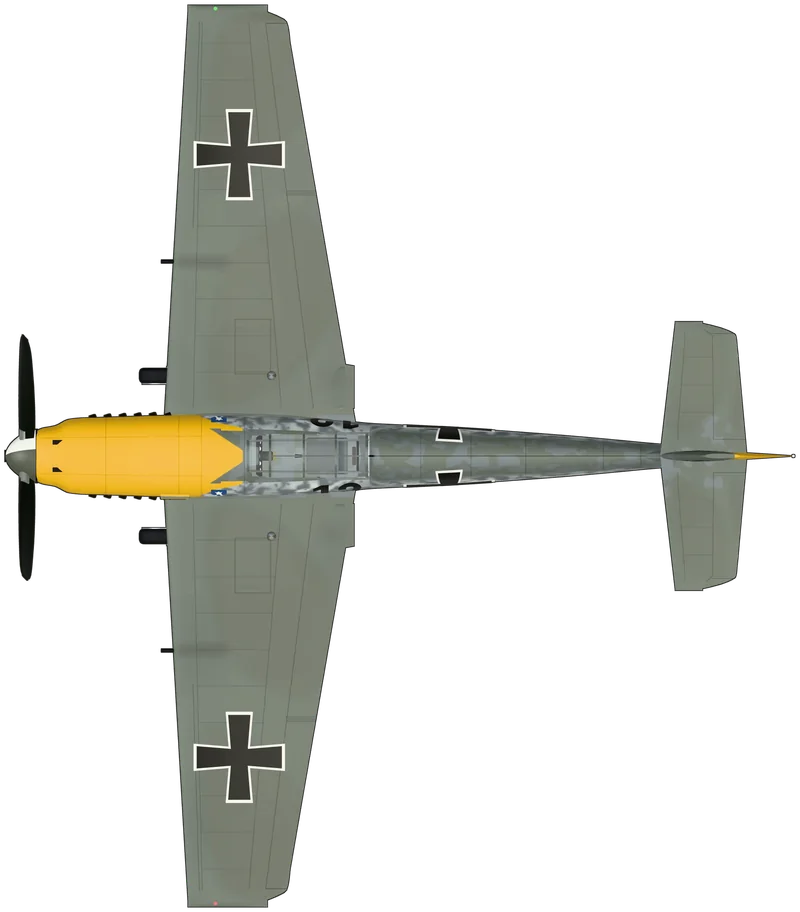
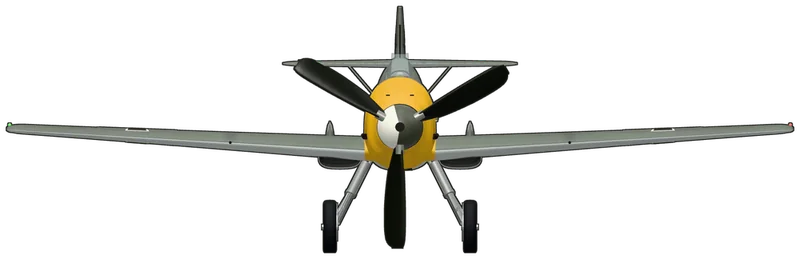
Messerschmitt Bf 109

07 · Monoplane fighter · Bf 109E-3 Werknummer 1190 (DG200)
Side view of the Messerschmitt Bf 109, Bf 109E-3 Werknummer 1190 (DG200)
Port side
Top view of the Messerschmitt Bf 109, Bf 109E-3 Werknummer 1190 (DG200)
Plan, from above
Front view of the Messerschmitt Bf 109, Bf 109E-3 Werknummer 1190 (DG200)
Head-on

Willy Messerschmitt’s design team at Bayerische Flugzeugwerke in Augsburg produced the Bf 109 to a 1934 Luftwaffe call for a modern fighter. The prototype first flew on 29 May 1935, powered by a borrowed Rolls-Royce Kestrel because the German engines were not yet ready. It was small, light and fast, with a cantilever low wing, an all-metal stressed skin and a retractable undercarriage that folded outwards.

The Bf 109’s cockpit hinges sideways rather than sliding back, and the narrow canopy leaves the pilot sitting low and cramped behind a heavy engine.

Werknummer 1190 is a Bf 109E-3 that came down in England in 1940.

First flight
29 May 1935
Role
Monoplane fighter
Maker
Bayerische Flugzeugwerke (Messerschmitt), Germany
Engine
one Daimler-Benz DB 601A inverted V-12, 1,175 hp
Crew
1
Wingspan
9.87 m (32 ft 5 in)
Length
8.64 m (28 ft 4 in)
Height
2.5 m (8 ft 2 in)
Top speed
386 mph
Built
~34,000
In service
1939–1945

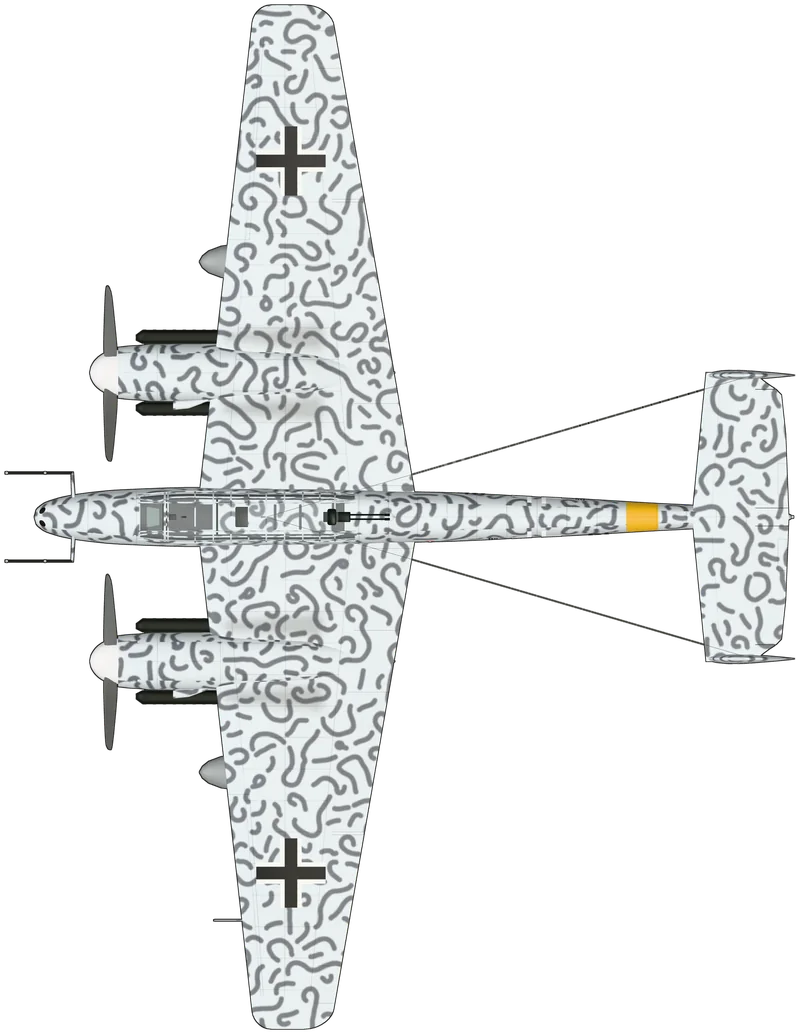
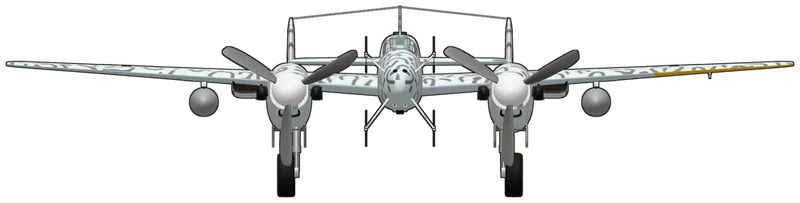
Messerschmitt Bf 110

08 · Heavy fighter and night fighter · Bf 110 G-4 Werk Nummer 730301 (D5+RL)
Side view of the Messerschmitt Bf 110, Bf 110 G-4 Werk Nummer 730301 (D5+RL)
Port side
Top view of the Messerschmitt Bf 110, Bf 110 G-4 Werk Nummer 730301 (D5+RL)
Plan, from above
Front view of the Messerschmitt Bf 110, Bf 110 G-4 Werk Nummer 730301 (D5+RL)
Head-on

The Bf 110 was Messerschmitt’s answer to a 1934 Luftwaffe requirement for a Zerstörer, or “destroyer”: a long-range, twin-engined, heavily armed fighter that could escort bombers deep into enemy territory and clear the way for them. It was a slim, all-metal monoplane with twin fins, a long glazed canopy over the pilot and a rear gunner, and cannon and machine guns grouped in the nose. The first prototype flew at Augsburg on 12 May 1936, and the Bf 110C, with Daimler-Benz DB 601 engines, entered service in numbers in time for the invasion of Poland in 1939.

On 10 May 1941 Rudolf Hess, Hitler’s deputy, flew a Bf 110 alone from Augsburg to Scotland on his bid to make peace, baled out over Renfrewshire and spent the rest of the war as a prisoner.

Werk Nummer 730301 is a Bf 110 G-4 night fighter that flew as D5+RL with 3./NJG 3, the third squadron of Nachtjagdgeschwader 3.

First flight
12 May 1936
Role
Heavy fighter and night fighter
Maker
Messerschmitt, Germany
Engine
2 × Daimler-Benz DB 605B inverted V-12s, 1,455 hp each
Crew
3
Wingspan
16.25 m (53 ft 4 in)
Length
12.07 m (39 ft 7 in)
Height
3.5 m (11 ft 6 in)
Top speed
388 mph
Built
~7,300
In service
1937–1945

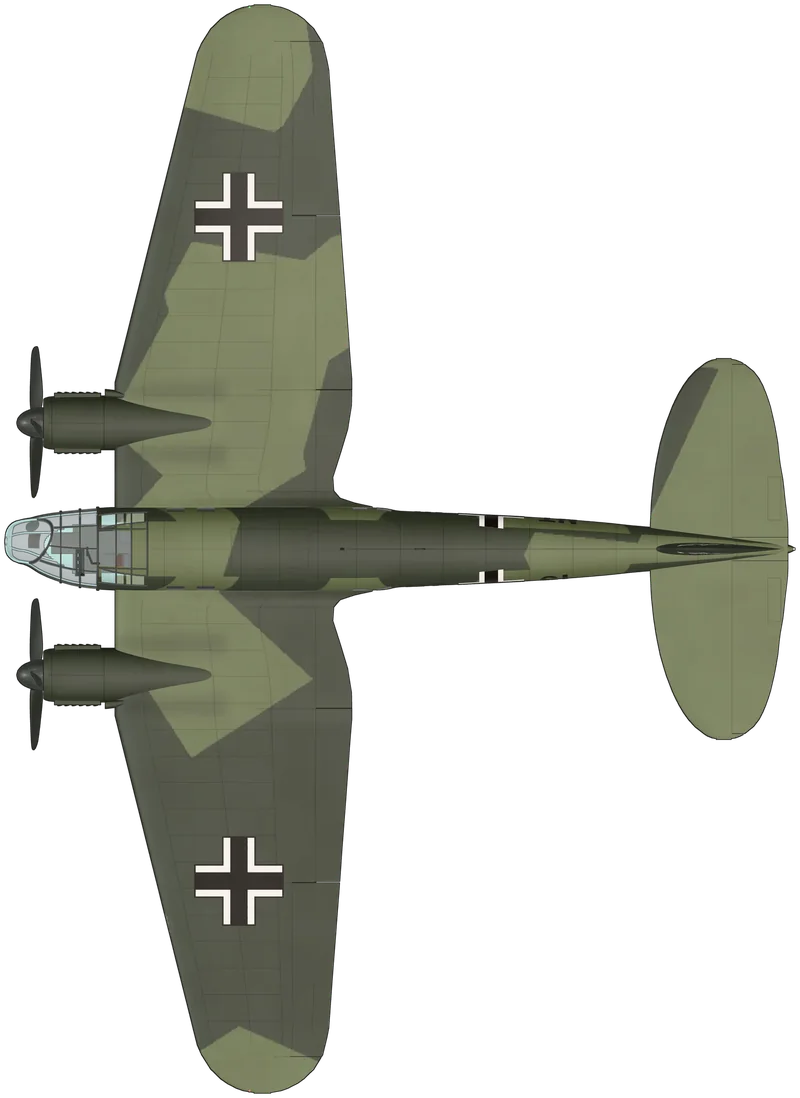
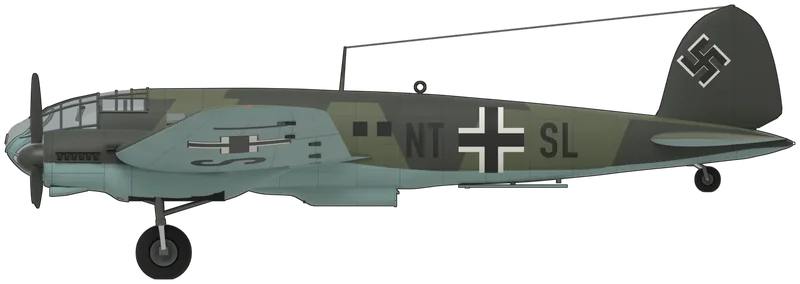
Heinkel He 111

09 · Medium bomber · He 111 H-20/R1 Werknummer 701152 (NT+SL)
Side view of the Heinkel He 111, He 111 H-20/R1 Werknummer 701152 (NT+SL)
Port side
Top view of the Heinkel He 111, He 111 H-20/R1 Werknummer 701152 (NT+SL)
Plan, from above
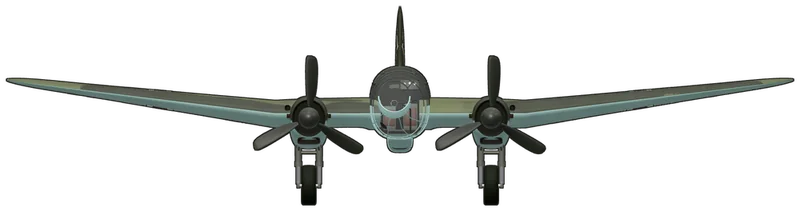
Front view of the Heinkel He 111, He 111 H-20/R1 Werknummer 701152 (NT+SL)
Head-on

The He 111 was designed at Heinkel by the twin brothers Siegfried and Walter Günter as a fast, twin-engined monoplane that could be shown off as an airliner for Lufthansa while it was really built to be a bomber for the secret new Luftwaffe. It had a smooth, all-metal fuselage and an elliptical wing like that of the smaller He 70. Gerhard Nitschke flew the first prototype at Rostock-Marienehe on 24 February 1935.

In the 1969 film Battle of Britain, the Luftwaffe’s He 111s were played by Spanish CASA 2.111s powered by Rolls-Royce Merlins, the same engines as the Spitfires and Hurricanes they were pretending to fight.

Werknummer 701152 was built in 1944 as an He 111 H-20/R1 paratroop transport, with seats for 16 paratroops in two compartments; they are still in it.

First flight
24 February 1935
Role
Medium bomber
Maker
Heinkel, Germany
Engine
2 × Junkers Jumo 211F inverted V-12s, 1,340 hp each
Crew
4–5
Wingspan
22.6 m (74 ft 2 in)
Length
16.4 m (53 ft 10 in)
Height
4 m (13 ft 1 in)
Top speed
292 mph
Built
~22,000
In service
1936–1945

Compared

Specifications at a glance

Span, length, speed and production for every aircraft on this page.

Specifications compared
AircraftFirst flewRoleSpanLengthTop speedBuiltUK museums
Supermarine Spitfire1936Fighter11.23 m9.47 m454 mph20,351 + 2,33414
Hawker Hurricane1935Fighter12.19 m9.58 m340 mph14,58310
Bristol Blenheim1936Light bomber17.17 m12.98 m266 mph~4,4005
Gloster Gladiator1934Biplane fighter9.83 m8.36 m257 mph7475
Westland Lysander1936Army co-operation and special duties monoplane15.24 m9.3 m212 mph1,7864
Miles Magister1937Elementary trainer10.31 m7.51 m132 mph1,3033
Messerschmitt Bf 1091935Monoplane fighter9.87 m8.64 m386 mph~34,0006
Messerschmitt Bf 1101936Heavy fighter and night fighter16.25 m12.07 m388 mph~7,3002
Heinkel He 1111935Medium bomber22.6 m16.4 m292 mph~22,0002

Questions

Asked and answered

Which aircraft fought in the Battle of Britain?

On the British side the Hurricane and Spitfire, with Blenheims, Defiants and a squadron of Gladiators. The Luftwaffe flew the Bf 109 and Bf 110 fighters and the He 111, Ju 88 and Do 17 bombers, with Ju 87 Stukas early in the battle.

Did the Hurricane or the Spitfire shoot down more aircraft?

The Hurricane: there were more of them, and Hurricane pilots are credited with the majority of the RAF’s victories in the battle. The Spitfire’s higher performance made it the better match for the Bf 109.

Where can I see Battle of Britain aircraft?

IWM Duxford, the RAF Museum, the Battle of Britain Memorial Flight at Coningsby and the Kent Battle of Britain Museum are good places to start. Each profile below lists the UK museums that hold one.

More dioramas

Other collections

The models and drawings are procedural interpretations built from published dimensions, three-view drawings and photographs of each airframe, and the airfield is a compressed impression of its period, not a plan of a real station. Aircraft shown overhead (Bf 109E, Bf 110, He 111) did not operate from airfields like this one. Treat the museum aircraft as the reference.