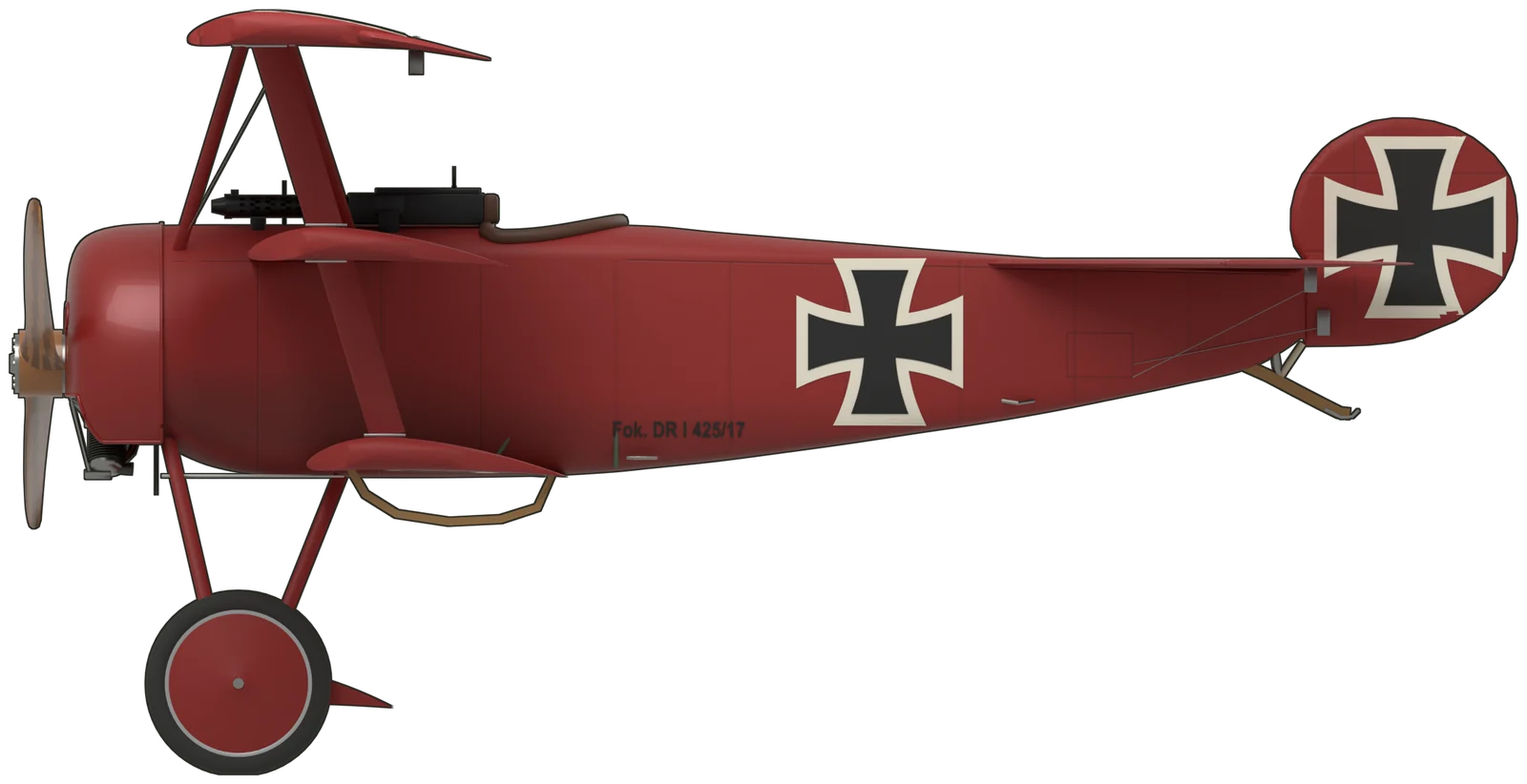
3D model
Turn it over
A procedural model built in Blender from published dimensions, drawings and photographs, painted as 425/17 in Manfred von Richthofen’s red scheme with early-April 1918 cross markings. Drag to orbit, scroll or pinch to zoom · download .glb (1.2 MB)
History
The Dr.I
Fokker’s triplane answered the British Sopwith Triplane, which had impressed German pilots in 1917. Reinhold Platz’s design used three short, deep cantilever wings with no bracing wires, giving a phenomenal rate of climb and turn at the cost of speed.
It reached the front that autumn, but early wing failures grounded it, and only 320 were built. Its fame rests largely on one man: Manfred von Richthofen, the Red Baron, who scored his last victories in Dr.I 425/17 and was killed in it on 21 April 1918.
No original Dr.I survives; the last was destroyed in Berlin during the Second World War. Every triplane on display today is a replica.
This airframe
Dr.I 425/17
Richthofen’s 425/17 left the factory in Fokker’s streaked olive and was doped red all over by Jasta 11. The model shows it in early April 1918, with the white square fields behind its crosses painted out to narrow borders, as it looked shortly before his death. A replica is recorded at IWM Duxford.
Where to see one
In the gazetteer
The gazetteer records the Dr.I in one UK collection. The airframe modelled here is marked.