AP 118 · No. 10 Section II · Aircraft Collection 01 / 12

Aircraft/Collections/First World War

Western Front aerodrome · 1917–18

Aircraft of the First World War

Canvas hangars, a mown strip and a line of poplars: the Royal Flying Corps at war, with every machine on the field built to scale from the aircraft that survive in British museums.

12
Aircraft
1914–18
Period
13
UK museums hold them

The diorama

Diorama · 1914–18

Loading the airfield…

A Royal Flying Corps aerodrome behind the lines in France, 1917–18: Bessonneau canvas hangars, bell tents for the ground crew, a white landing T and a farm at the edge of the field. There are no runways; aircraft take off into wind across the grass. A Fokker triplane crosses high overhead.

Drag to look around · ctrl + scroll to zoom · pick an aircraft to follow it

When war broke out in August 1914 the Royal Flying Corps sent four squadrons to France with about sixty aeroplanes, most of them meant for nothing more warlike than looking. Within four years aircraft had become fighters, bombers, artillery spotters and ground-attack machines, and on 1 April 1918 the RFC and the Royal Naval Air Service were merged into the Royal Air Force, the first independent air force in the world.

The aircraft on this page trace that change. The stable, docile B.E.2 was ideal for reconnaissance and easy prey for the first real fighters. The Avro 504 taught a generation to fly. Small, agile scouts from Sopwith and Bristol gave way to the S.E.5a and the Camel, and two-seaters such as the R.E.8 and the Bristol Fighter did the dangerous daily work of photography and artillery observation.

Aerodromes moved with the front. Squadrons lived in tents and huts and kept their aircraft in portable canvas Bessonneau hangars that could be struck and re-erected in a day. Fields were simply grass, chosen for size and drainage, and every take-off was made into the wind.

To scale

The collection side by side

Every aircraft drawn at the same scale, so a DH.9 and a Camel F.1 can be compared at a glance.

  • Royal Aircraft Factory B.E.2 side profile, to scaleB.E.2c · 8.31 m
  • Avro 504 side profile, to scale504K · 8.97 m
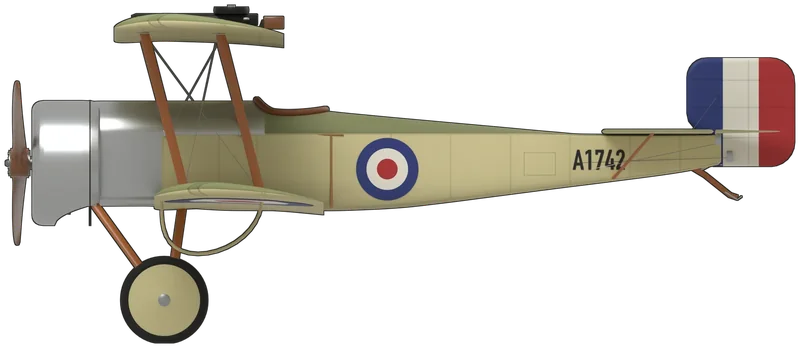
  • Bristol Scout D side profile, to scaleScout D · 6.3 m
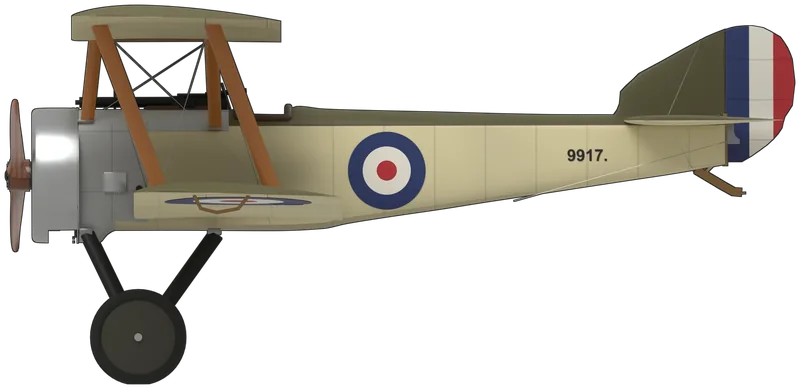
  • Sopwith Pup side profile, to scalePup · 5.89 m
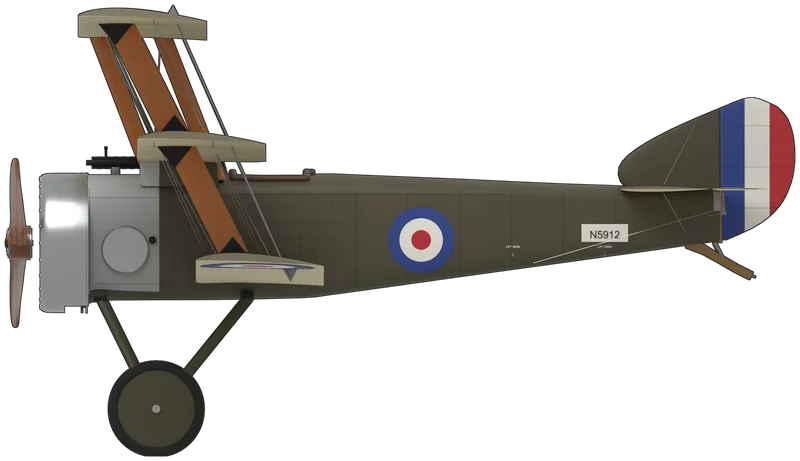
  • Sopwith Triplane side profile, to scaleTriplane · 5.74 m
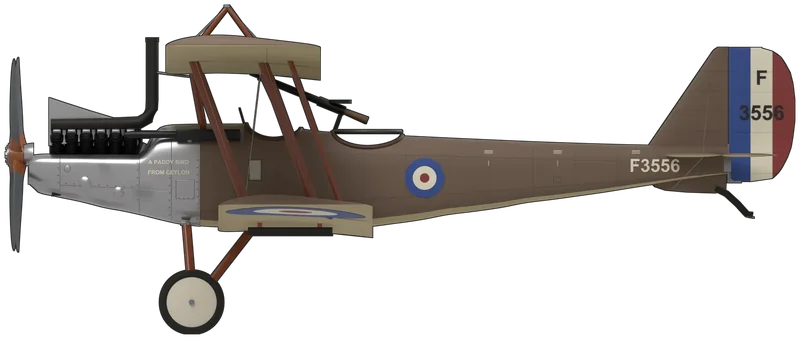
  • Royal Aircraft Factory R.E.8 side profile, to scaleR.E.8 · 8.5 m
  • Bristol M.1C side profile, to scaleM.1C · 6.22 m
  • Bristol F.2b Fighter side profile, to scaleF.2B Fighter · 7.87 m
  • Royal Aircraft Factory S.E.5a side profile, to scaleS.E.5a · 6.38 m
  • Sopwith Camel side profile, to scaleCamel F.1 · 5.72 m
  • Airco DH.9 / DH.9A side profile, to scaleDH.9 · 9.27 m
  • Fokker Dr.I side profile, to scaleDr.I · 5.77 m

10 m

Profiles

Side, top and front

Each aircraft drawn from its 3D model, painted as one real airframe, with its specification.

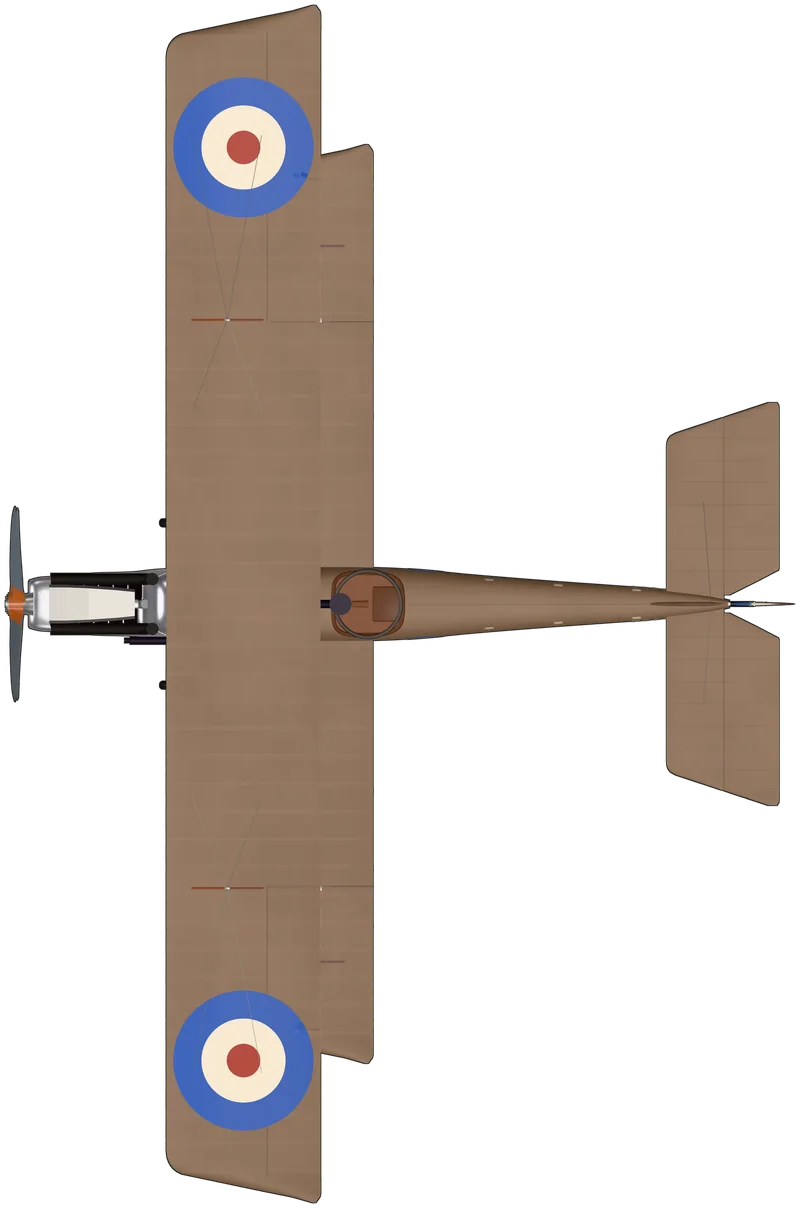
Royal Aircraft Factory B.E.2

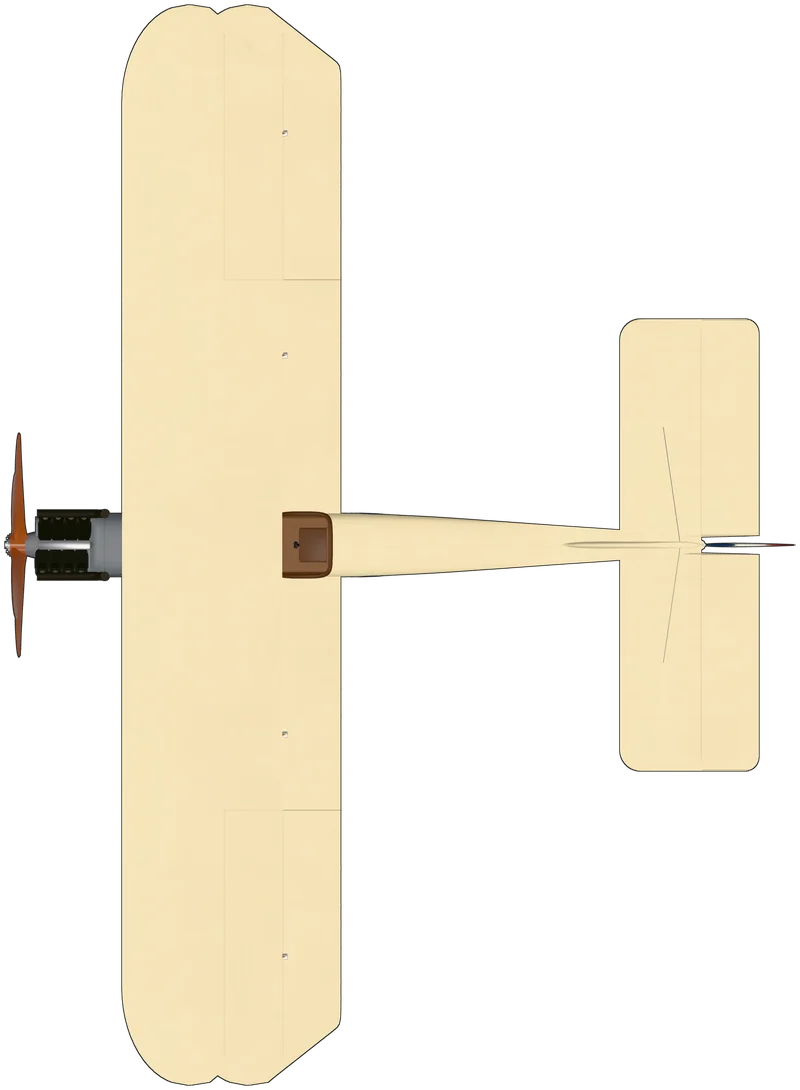
01 · Reconnaissance biplane · B.E.2c 2699
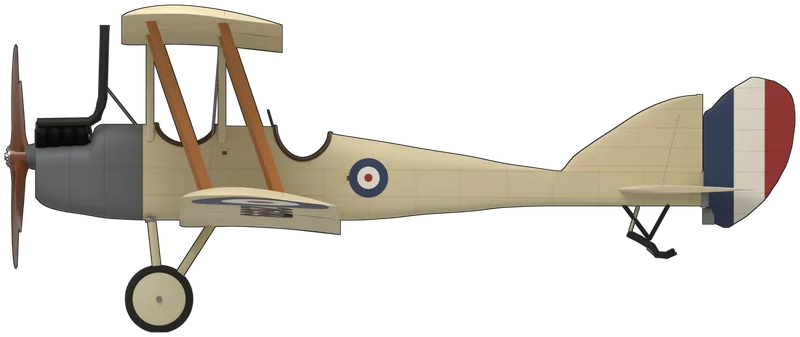
Side view of the Royal Aircraft Factory B.E.2, B.E.2c 2699
Port side
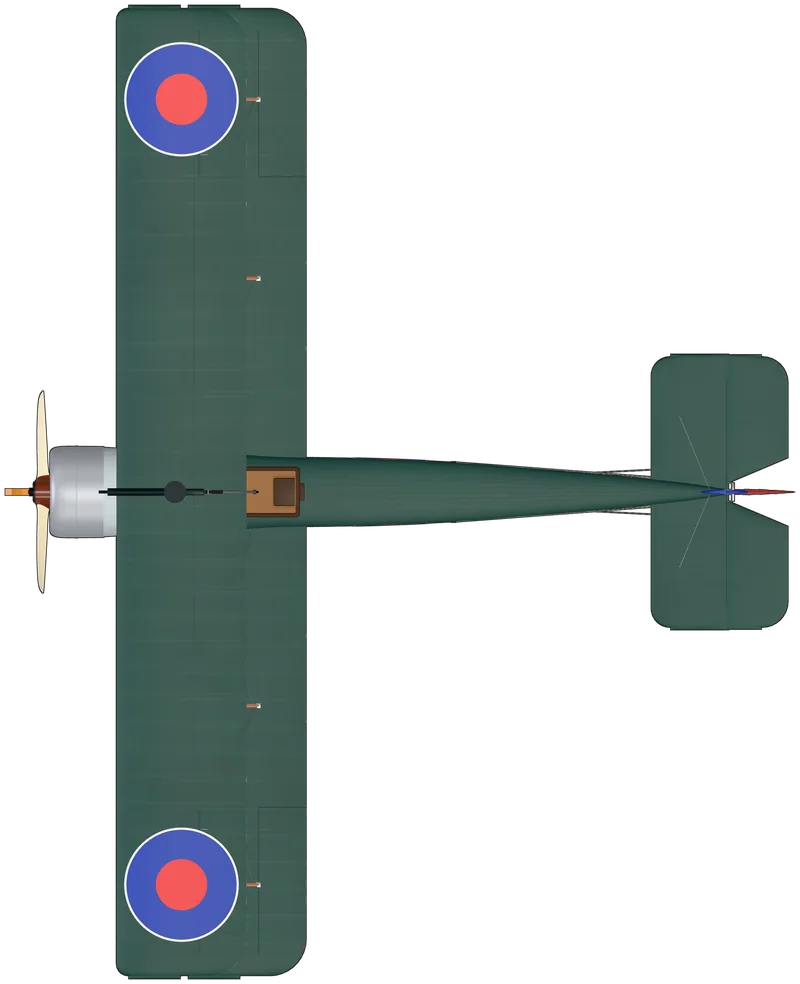
Top view of the Royal Aircraft Factory B.E.2, B.E.2c 2699
Plan, from above
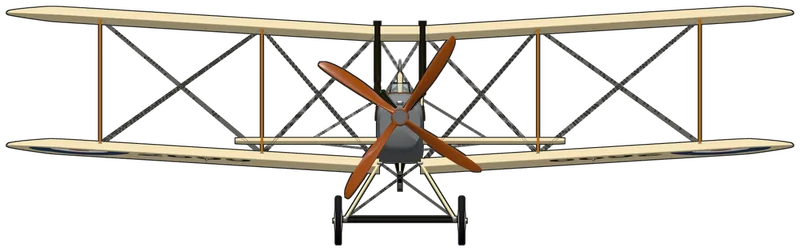
Front view of the Royal Aircraft Factory B.E.2, B.E.2c 2699
Head-on

Geoffrey de Havilland designed the B.E.2 at the Royal Aircraft Factory at Farnborough, and it first flew in 1912. ‘B.E.’ stood for Blériot Experimental, the Factory’s name for an aeroplane with its propeller at the front. That August de Havilland set a British height record in one, and B.E.2s were among the first RFC aircraft to fly to France in 1914.

The B.E.2c was so stable that crews could fly it hands-off while they took photographs or sent artillery corrections by wireless.

2699 is a genuine B.E.2c built by Ruston, Proctor & Co. of Lincoln in about 1916.

First flight
1912
Role
Reconnaissance biplane
Maker
Royal Aircraft Factory, Britain
Engine
R.A.F. 1a air-cooled V-8, 90 hp
Crew
2
Wingspan
11.28 m (37 ft 0 in)
Length
8.31 m (27 ft 3 in)
Height
3.39 m (11 ft 1 in)
Top speed
72 mph
Built
~3,500
In service
1914–1919

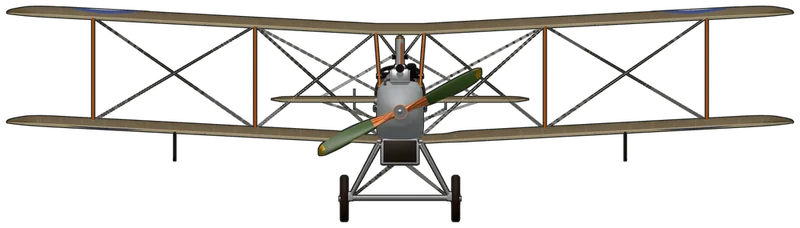
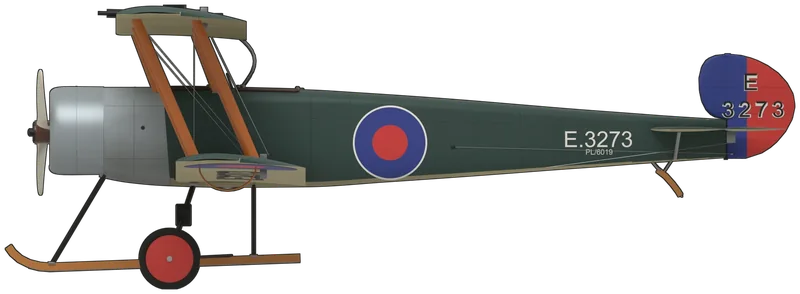
Avro 504

02 · Trainer and Home Defence biplane · 504K G-ADEV (‘E3273’)
Side view of the Avro 504, 504K G-ADEV (‘E3273’)
Port side
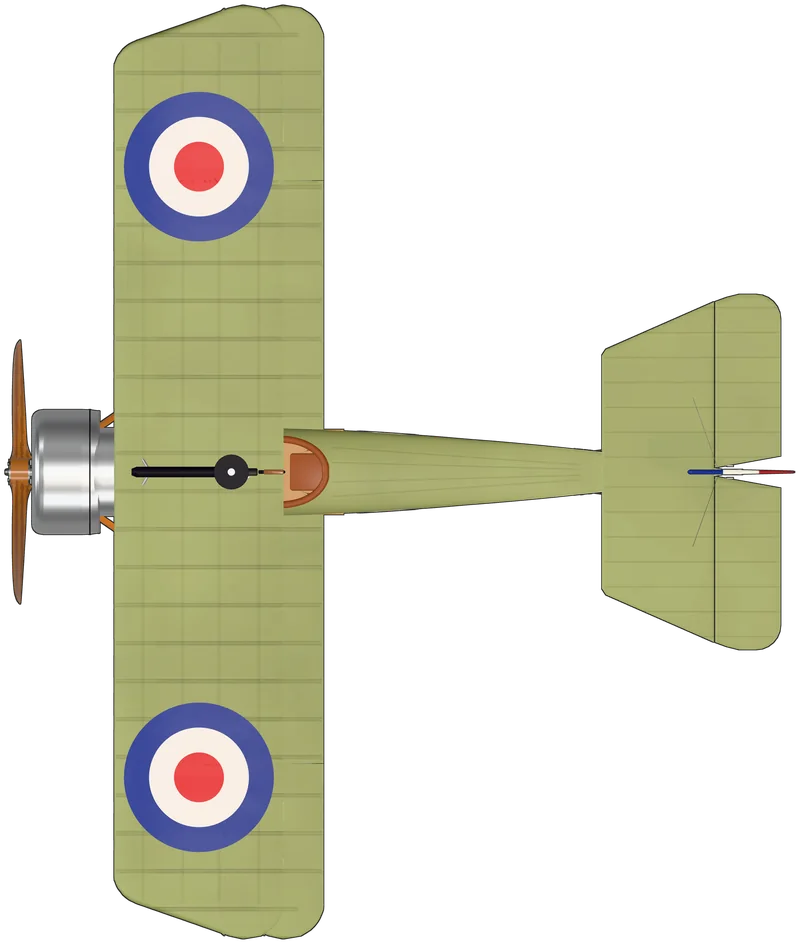
Top view of the Avro 504, 504K G-ADEV (‘E3273’)
Plan, from above
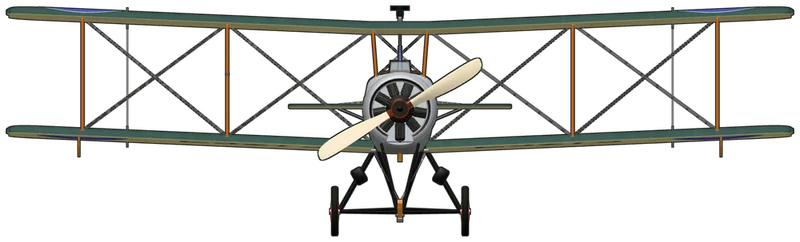
Front view of the Avro 504, 504K G-ADEV (‘E3273’)
Head-on

Alliott Verdon Roe’s company designed the 504 as a two-seat tractor biplane, and it first flew at Brooklands in July 1913. It was light, simple and easy to fly, and the Royal Flying Corps and the Royal Naval Air Service both bought it before the war. In November 1914 three RNAS 504s flew from Belfort to bomb the Zeppelin sheds at Friedrichshafen on Lake Constance, one of the first strategic bombing raids.

The long skid between the wheels, nicknamed the ‘toothpick’, stopped the 504K from tipping onto its nose when a pupil braked a landing too hard on rough grass.

G-ADEV is The Shuttleworth Collection’s airworthy 504K.

First flight
18 July 1913
Role
Trainer and Home Defence biplane
Maker
A.V. Roe and Company, Britain
Engine
Le Rhône 9J nine-cylinder rotary, 110 hp (the universal mounting also took Clerget and Gnome rotaries)
Crew
2 (1 as a night fighter)
Wingspan
10.97 m (36 ft 0 in)
Length
8.97 m (29 ft 5 in)
Height
3.17 m (10 ft 5 in)
Top speed
95 mph
Built
8,970
In service
1914–1930s

Bristol Scout D

03 · Biplane scout · Scout D ‘A1742’ (BAPC 38)
Side view of the Bristol Scout D, Scout D ‘A1742’ (BAPC 38)
Port side
Top view of the Bristol Scout D, Scout D ‘A1742’ (BAPC 38)
Plan, from above
Front view of the Bristol Scout D, Scout D ‘A1742’ (BAPC 38)
Head-on

Frank Barnwell and the company’s test pilot Harry Busteed designed the Scout at Filton in late 1913 as a small, fast single-seater for racing and sport, and Busteed first flew it at Larkhill on 23 February 1914. It was shown at the Olympia Aero Show the next month, where its neat lines and 80 hp Gnome rotary earned it the nickname “Baby”. With larger wings it reached nearly 100 mph, very fast for 1914, and it was being prepared for races when war came that August and the War Office took over both of the improved Scout Bs.

On 3 November 1915 Flight Lieutenant H. F. Towler flew a Scout C off the short deck of the seaplane carrier HMS Vindex, the first take-off by a wheeled aeroplane from a British carrier.

A1742 is a static reproduction built in the early 1960s and recorded as BAPC 38.

First flight
23 February 1914
Role
Biplane scout
Maker
British & Colonial Aeroplane Company, Britain
Engine
Le Rhône or Gnome nine-cylinder rotary, 80 hp (100 hp Gnome Monosoupape in later aircraft)
Crew
1
Wingspan
7.49 m (24 ft 7 in)
Length
6.3 m (20 ft 8 in)
Height
2.59 m (8 ft 6 in)
Top speed
94 mph
Built
374
In service
1914–1918

Sopwith Pup

04 · Biplane scout · Pup G-EBKY (‘9917’)
Side view of the Sopwith Pup, Pup G-EBKY (‘9917’)
Port side
Top view of the Sopwith Pup, Pup G-EBKY (‘9917’)
Plan, from above
Front view of the Sopwith Pup, Pup G-EBKY (‘9917’)
Head-on

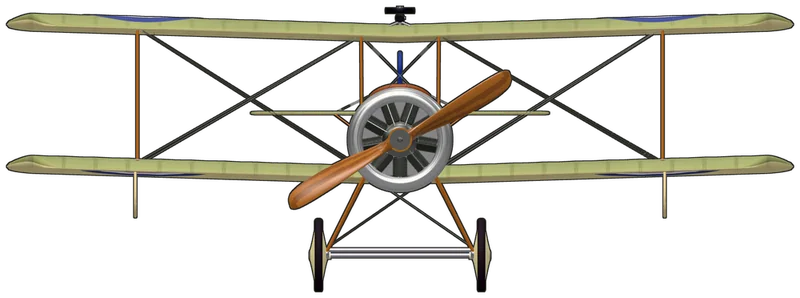
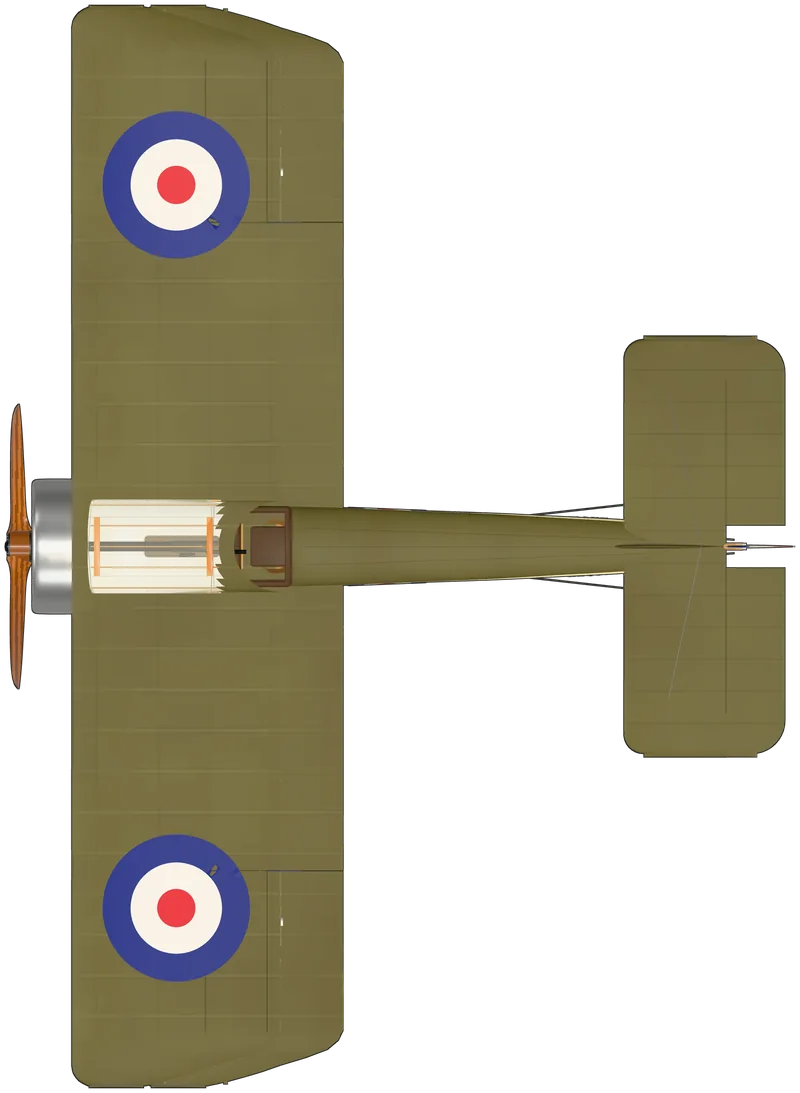
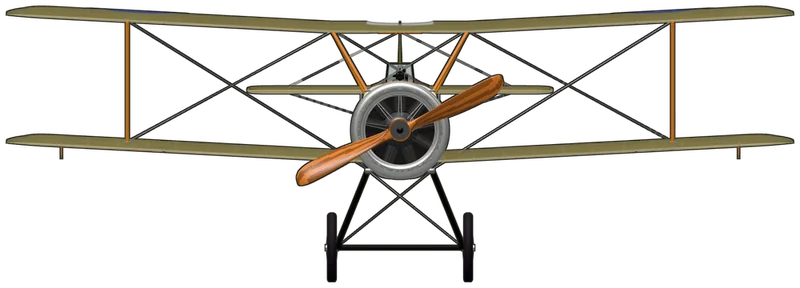
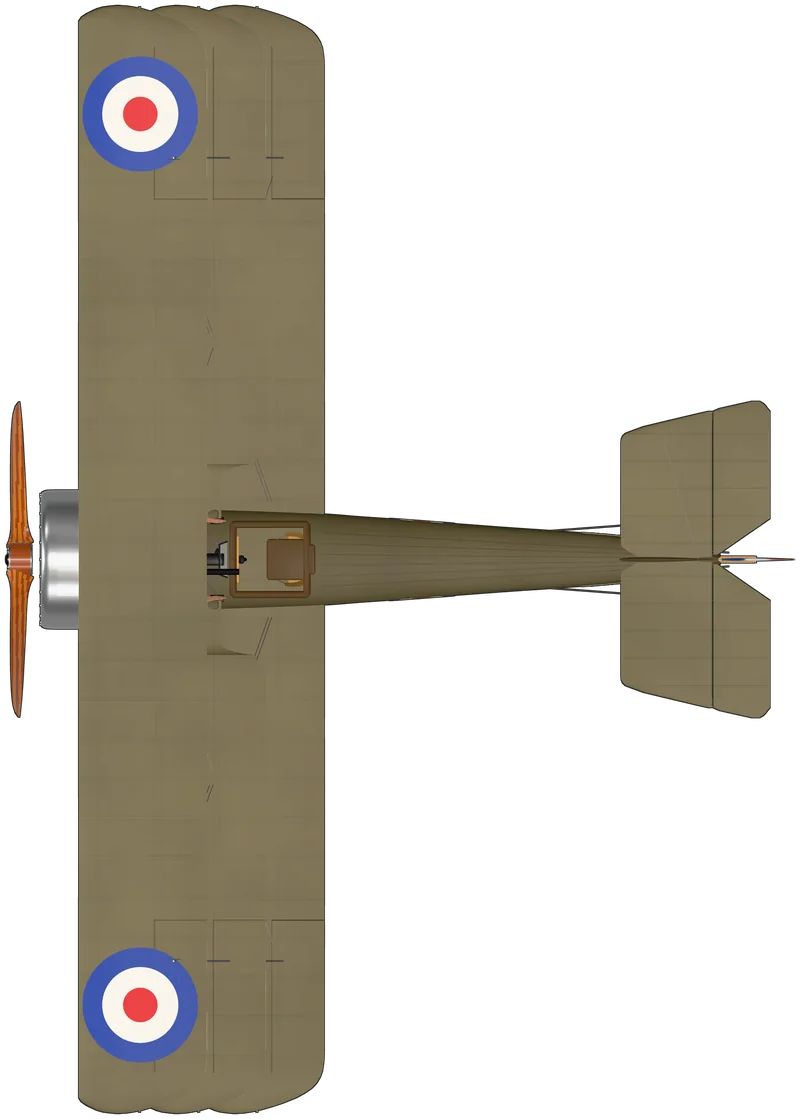
Herbert Smith designed the Pup at Sopwith’s Kingston works as a small single-seat scout, and Harry Hawker flew the prototype in February 1916. Its official name was the Sopwith Scout, but it looked so much like a smaller 1½ Strutter that the pilots called it the Pup, and the name stuck. It was a plain, well-proportioned biplane with a single Vickers gun firing through the propeller and an 80 hp Le Rhône rotary, half the power of the Camel that followed it.

Dunning’s deck landings on HMS Furious had no arrester gear: a party of officers ran out, grabbed rope toggles on the Pup’s wings and held it down on the deck.

G-EBKY is the only genuine Sopwith Pup still flying.

First flight
9 February 1916
Role
Biplane scout
Maker
Sopwith Aviation Company, Britain
Engine
Le Rhône 9C nine-cylinder rotary, 80 hp
Crew
1
Wingspan
8.08 m (26 ft 6 in)
Length
5.89 m (19 ft 4 in)
Height
2.87 m (9 ft 5 in)
Top speed
112 mph
Built
1,770
In service
1916–1918

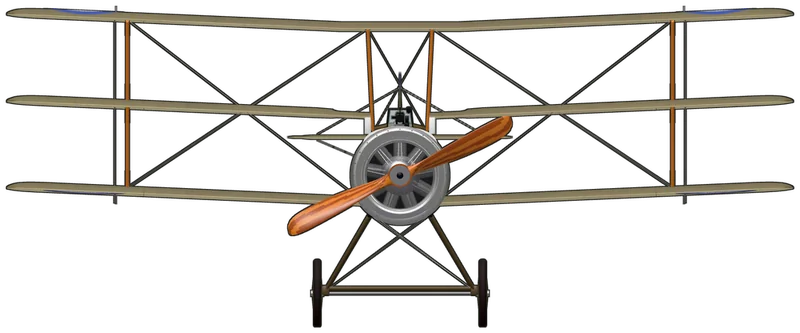
Sopwith Triplane

05 · Triplane scout · Triplane N5912
Side view of the Sopwith Triplane, Triplane N5912
Port side
Top view of the Sopwith Triplane, Triplane N5912
Plan, from above
Front view of the Sopwith Triplane, Triplane N5912
Head-on

Herbert Smith designed the Triplane at Kingston in 1916, using the fuselage, tail and engine installation of the Pup with three narrow-chord wings in place of two. The narrow wings gave the pilot a much better view than a biplane’s broad ones, and stacking three of them gave plenty of wing area in a short span, so the aircraft climbed and turned very well. Harry Hawker flew the prototype, N500, at Brooklands on 28 May 1916, and he was looping it within minutes of taking off.

The Triplane so impressed the Germans in 1917 that their aircraft makers produced a rash of triplane designs of their own; Fokker’s Dr.I was the only one built in large numbers.

N5912 is one of only three Triplanes built by Oakley & Co of Ilford, Essex, a firm with no previous aircraft experience whose contract was cancelled in October 1917.

First flight
28 May 1916
Role
Triplane scout
Maker
Sopwith Aviation Company, Britain
Engine
Clerget 9B nine-cylinder rotary, 130 hp
Crew
1
Wingspan
8.08 m (26 ft 6 in)
Length
5.74 m (18 ft 10 in)
Height
3.2 m (10 ft 6 in)
Top speed
117 mph
Built
147
In service
1916–1918

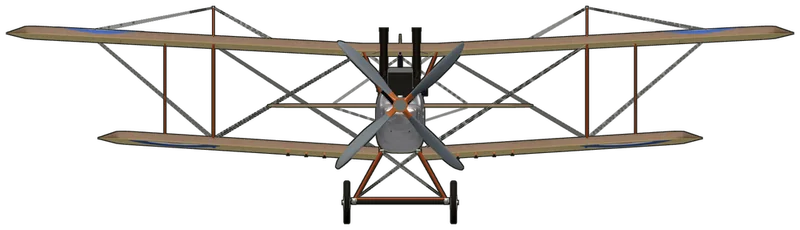
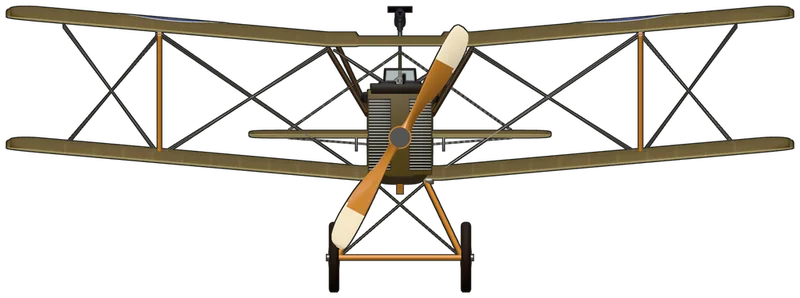
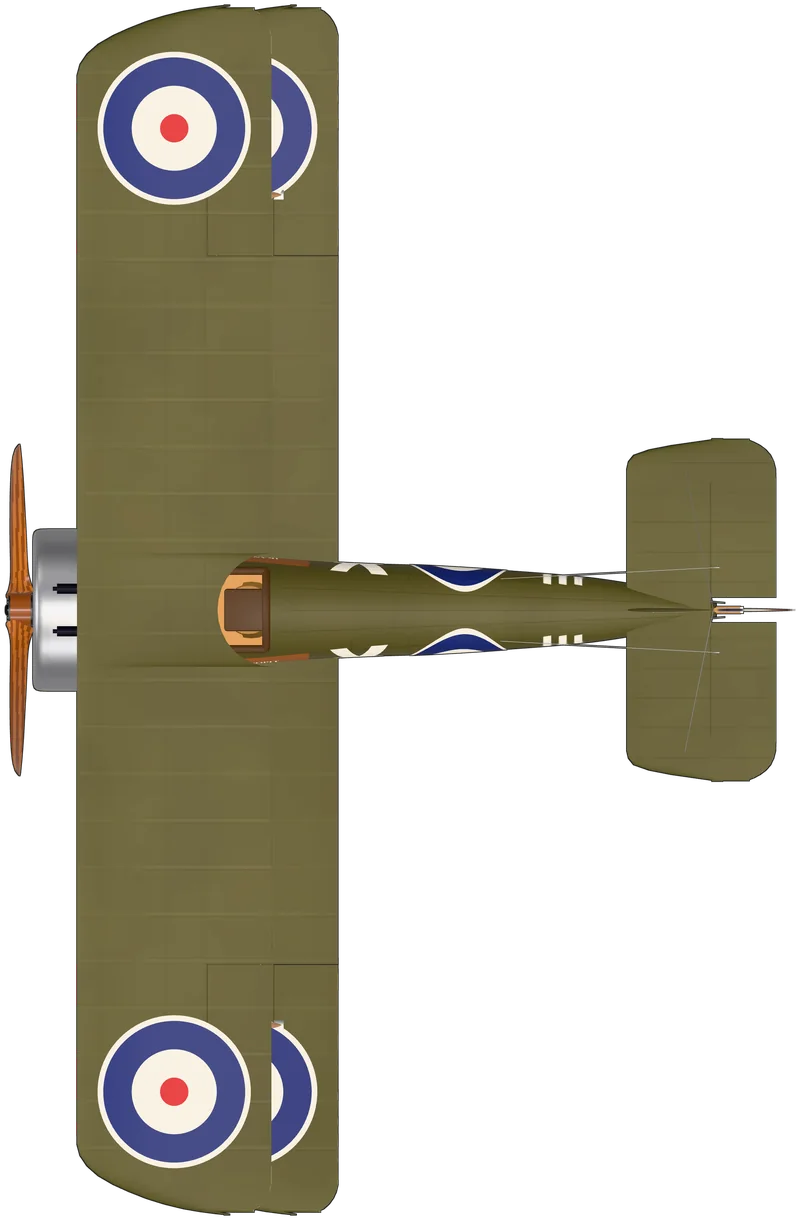
Royal Aircraft Factory R.E.8

06 · Reconnaissance and artillery-spotting biplane · R.E.8 F3556
Side view of the Royal Aircraft Factory R.E.8, R.E.8 F3556
Port side
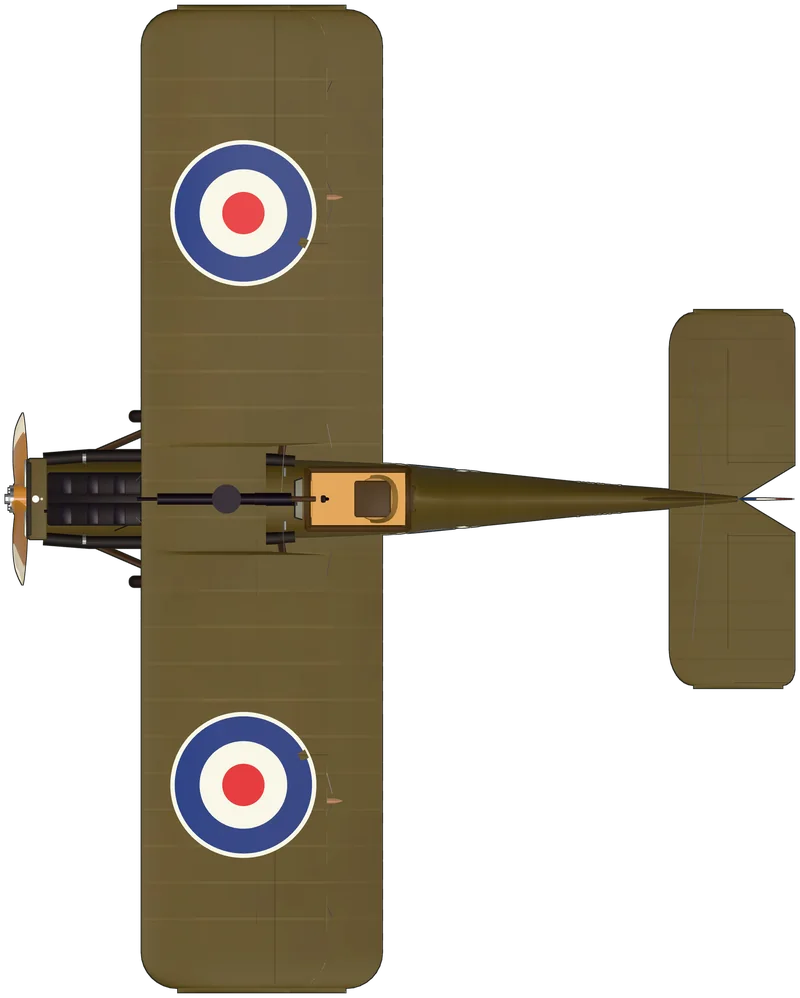
Top view of the Royal Aircraft Factory R.E.8, R.E.8 F3556
Plan, from above
Front view of the Royal Aircraft Factory R.E.8, R.E.8 F3556
Head-on

The R.E.8 was designed at the Royal Aircraft Factory at Farnborough by John Kenworthy and Walter Barling to replace the B.E.2 in the Royal Flying Corps’ corps squadrons, the units that spotted for the artillery, took photographs and watched the trenches. The most important change was to put the observer behind the pilot, where he had a clear field of fire for a Lewis gun on a Scarff ring, while the pilot had a Vickers gun firing forward through the propeller. Frank Goodden flew the first prototype on 17 June 1916.

Crews nicknamed the R.E.8 the ‘Harry Tate’ after a music-hall comedian of the day, rhyming slang for its designation.

F3556 was built under contract by the Daimler Company at Coventry in 1918 and reached France on Armistice Day, still in its packing case, so it never saw action.

First flight
17 June 1916
Role
Reconnaissance and artillery-spotting biplane
Maker
Royal Aircraft Factory, Britain
Engine
R.A.F. 4a air-cooled V-12, 140 hp
Crew
2
Wingspan
12.98 m (42 ft 7 in)
Length
8.5 m (27 ft 11 in)
Height
3.47 m (11 ft 5 in)
Top speed
103 mph
Built
4,077
In service
1916–1919

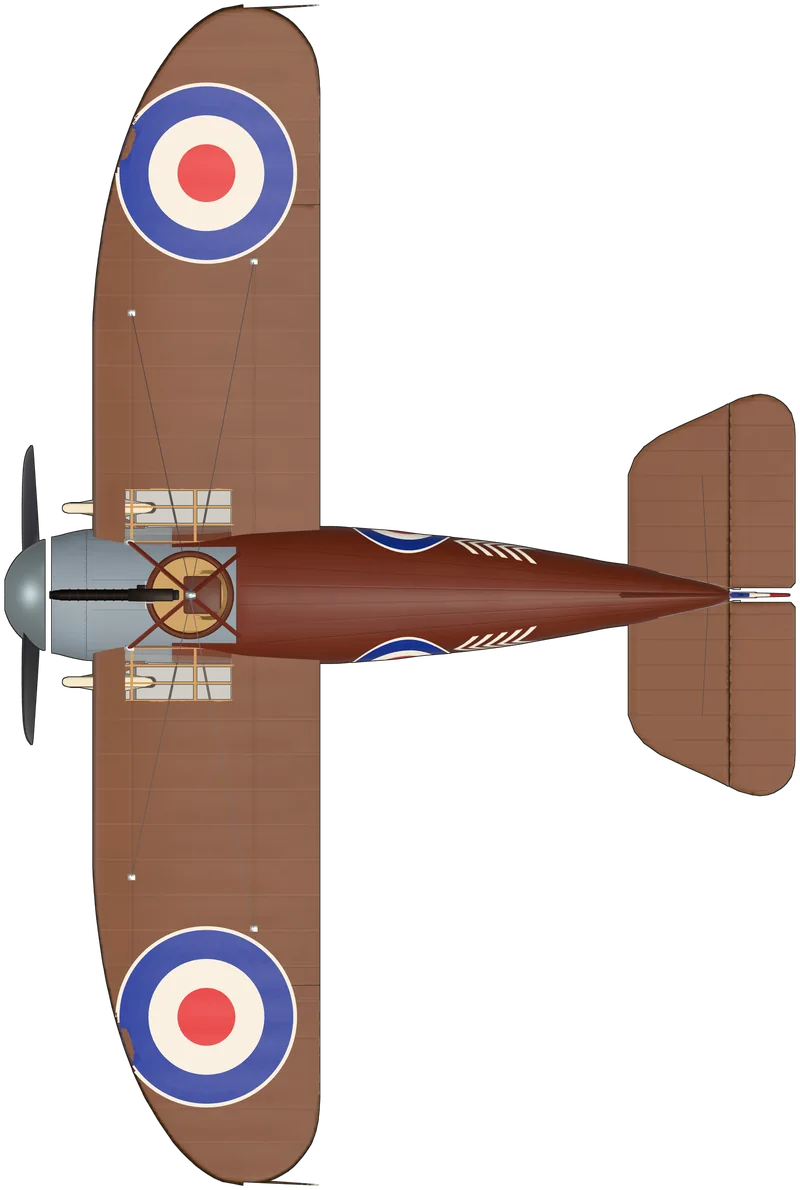
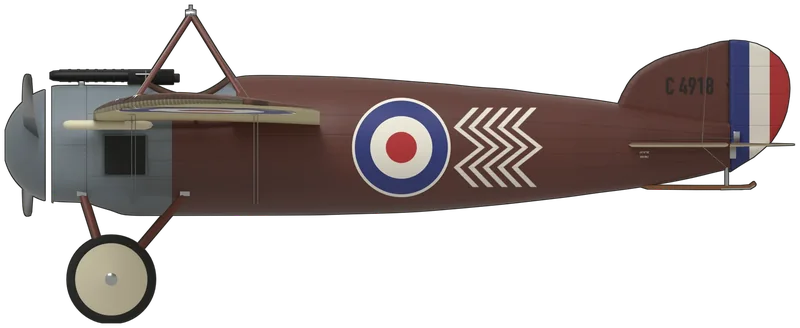
Bristol M.1C

07 · Monoplane scout · M.1C ‘C4918’ (G-BWJM)
Side view of the Bristol M.1C, M.1C ‘C4918’ (G-BWJM)
Port side
Top view of the Bristol M.1C, M.1C ‘C4918’ (G-BWJM)
Plan, from above
Front view of the Bristol M.1C, M.1C ‘C4918’ (G-BWJM)
Head-on

Frank Barnwell designed the M.1 at Filton in 1916 as a private venture: a clean, wire-braced shoulder-wing monoplane with a round fuselage, a large spinner and a rotary engine, and clear panels in the wing roots so the pilot could see downwards. Fred Raynham first flew the prototype, the Clerget-powered M.1A, on 14 July 1916. It was much faster than the biplane scouts of the day, and the War Office ordered four M.1Bs for evaluation, which confirmed a top speed of about 130 mph.

The M.1C was the only British monoplane fighter to see squadron service in the First World War; the RFC’s distrust of monoplanes kept it away from the Western Front.

C4918 is a reproduction built by members of the Northern Aeroplane Workshops at Mirfield, Yorkshire, the volunteer group that also built Shuttleworth’s Sopwith Triplane and Camel.

First flight
14 July 1916
Role
Monoplane scout
Maker
British & Colonial Aeroplane Company, Britain
Engine
Le Rhône 9J nine-cylinder rotary, 110 hp
Crew
1
Wingspan
9.37 m (30 ft 9 in)
Length
6.22 m (20 ft 5 in)
Height
2.36 m (7 ft 9 in)
Top speed
130 mph
Built
~130
In service
1917–1918

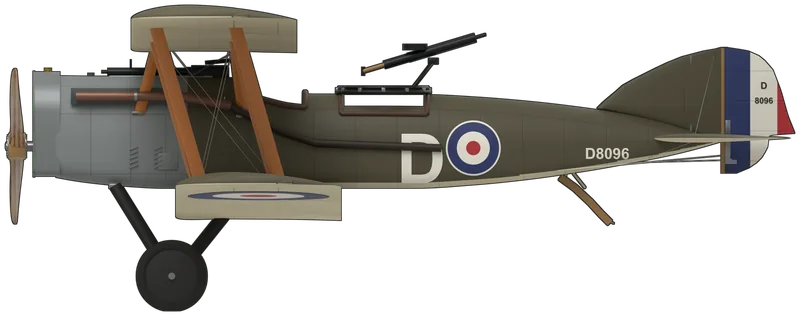
Bristol F.2b Fighter

08 · Two-seat fighter · F.2B Fighter D8096 (G-AEPH)
Side view of the Bristol F.2b Fighter, F.2B Fighter D8096 (G-AEPH)
Port side
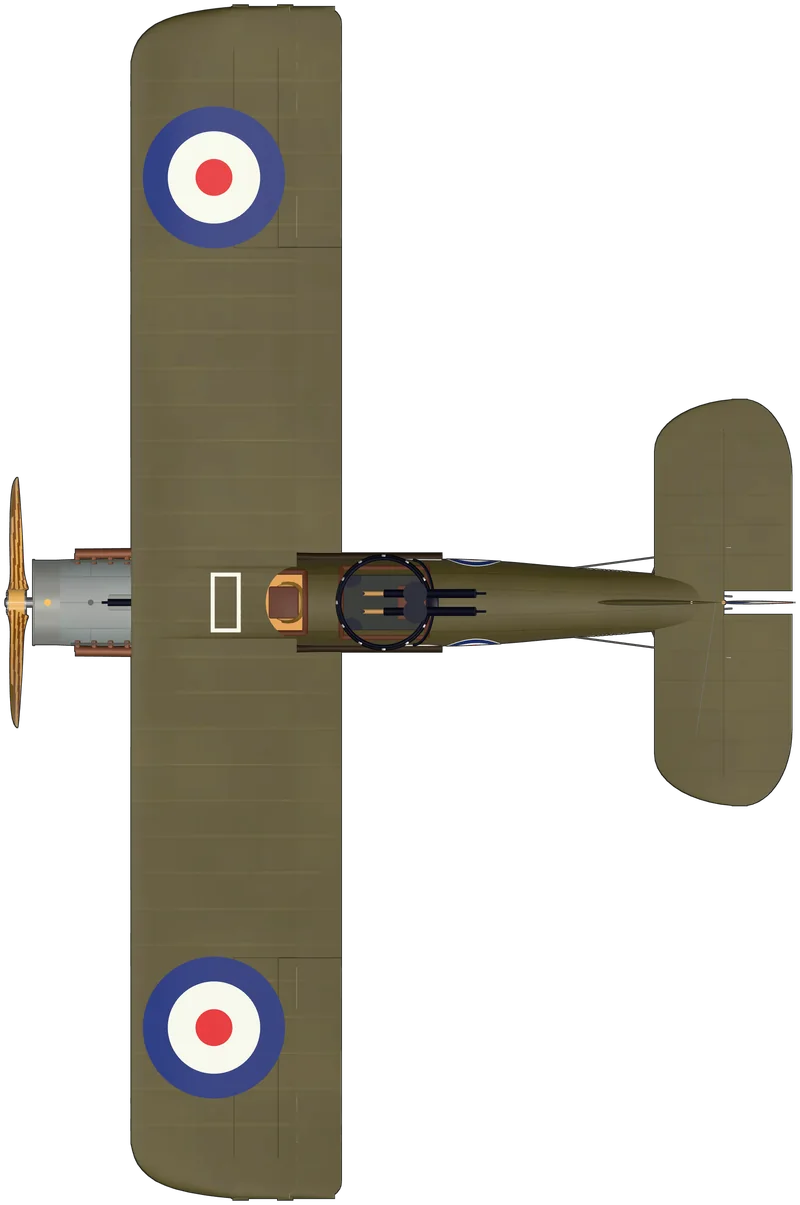
Top view of the Bristol F.2b Fighter, F.2B Fighter D8096 (G-AEPH)
Plan, from above
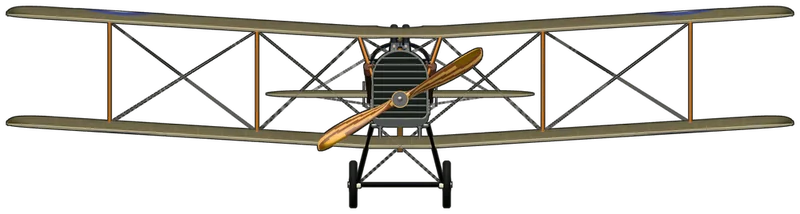
Front view of the Bristol F.2b Fighter, F.2B Fighter D8096 (G-AEPH)
Head-on

Frank Barnwell drew the Bristol Fighter at Filton in 1916 as a two-seat reconnaissance machine built around the new Rolls-Royce Falcon, and the prototype flew on 9 September 1916. Its odd arrangement was the point: the fuselage was slung midway between the wings, clear of the upper wing and carried on short struts above the lower one, so the pilot could see over the nose and the observer could swing his Lewis gun on a Scarff ring through most of the sky. A Vickers gun fired forward through the propeller.

William Leefe Robinson, who won the VC for shooting down the first German airship over Britain in 1916, was shot down and captured on the Bristol Fighter’s very first patrol over the Front.

D8096 is the only genuine Bristol Fighter still flying.

First flight
9 September 1916
Role
Two-seat fighter
Maker
British and Colonial Aeroplane Company (Bristol), Britain
Engine
Rolls-Royce Falcon III V-12, 275 hp
Crew
2
Wingspan
11.96 m (39 ft 3 in)
Length
7.87 m (25 ft 10 in)
Height
2.97 m (9 ft 9 in)
Top speed
123 mph
Built
5,329
In service
1917–1932

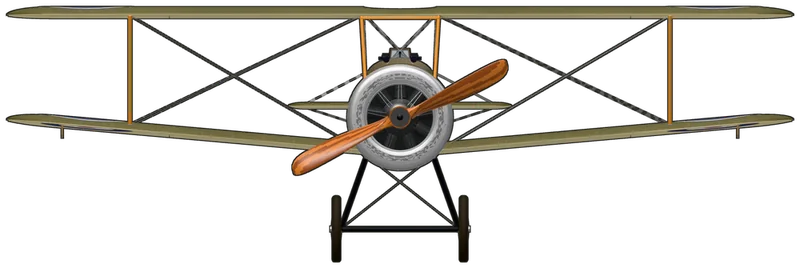
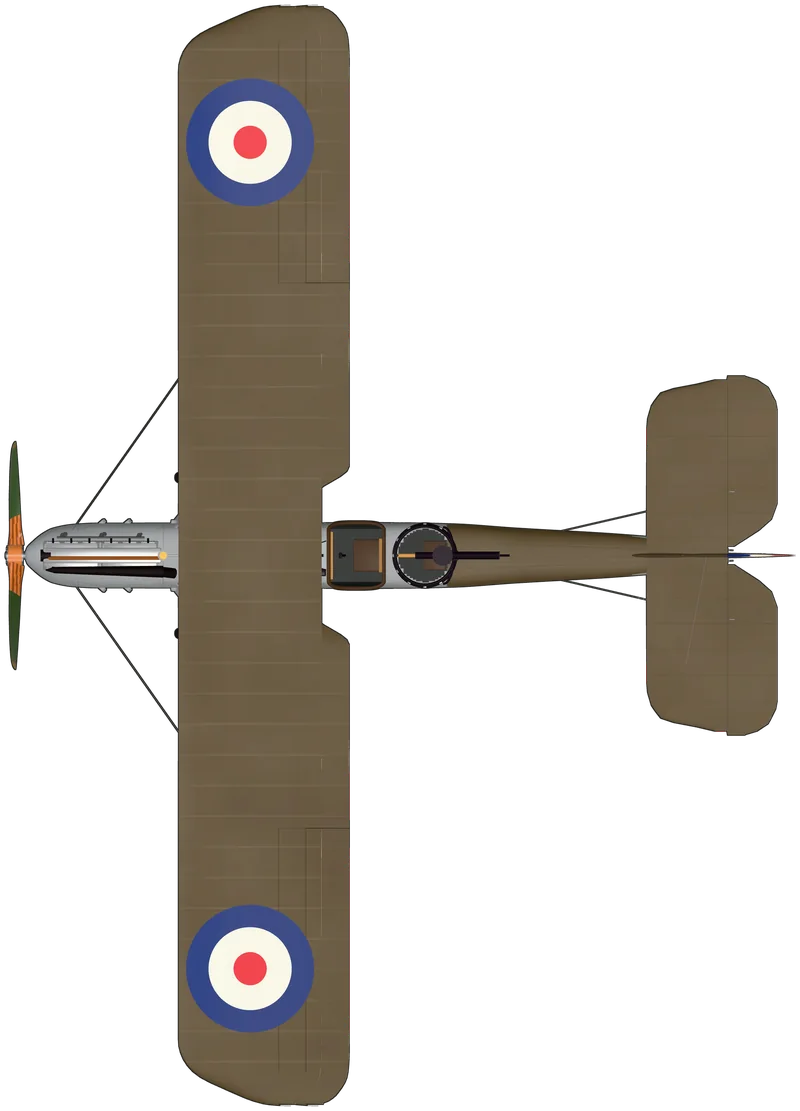
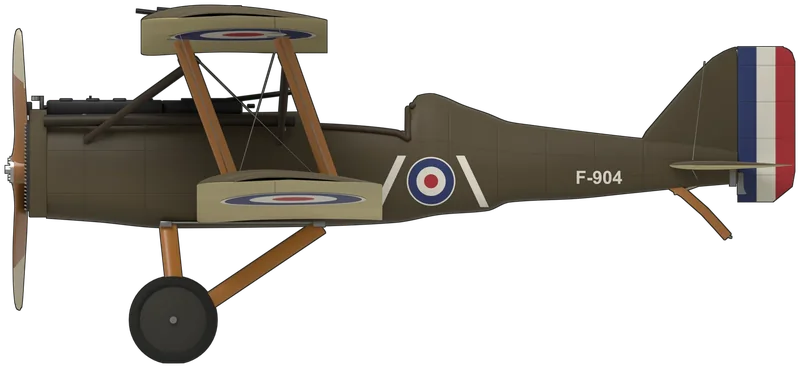
Royal Aircraft Factory S.E.5a

09 · Biplane fighter · S.E.5a F904 (G-EBIA)
Side view of the Royal Aircraft Factory S.E.5a, S.E.5a F904 (G-EBIA)
Port side
Top view of the Royal Aircraft Factory S.E.5a, S.E.5a F904 (G-EBIA)
Plan, from above
Front view of the Royal Aircraft Factory S.E.5a, S.E.5a F904 (G-EBIA)
Head-on

The S.E.5 was designed at the Royal Aircraft Factory at Farnborough by Henry Folland, John Kenworthy and Frank Goodden, and first flew in November 1916. Built round a geared Hispano-Suiza V-8, it was strong, stable and fast in a dive, and it made a steady gun platform.

The Lewis gun on its Foster mount could be pulled down so the pilot could change the drum, or fired upwards at an enemy beneath.

F904 is one of the few genuine S.E.5as left and is kept in flying condition by The Shuttleworth Collection at Old Warden, Bedfordshire, with a Wolseley Viper engine.

First flight
22 November 1916
Role
Biplane fighter
Maker
Royal Aircraft Factory, Britain
Engine
Wolseley Viper (geared Hispano-Suiza 8) V-8, 200 hp
Crew
1
Wingspan
8.11 m (26 ft 7 in)
Length
6.38 m (20 ft 11 in)
Height
2.89 m (9 ft 6 in)
Top speed
138 mph
Built
5,205
In service
1917–1920s

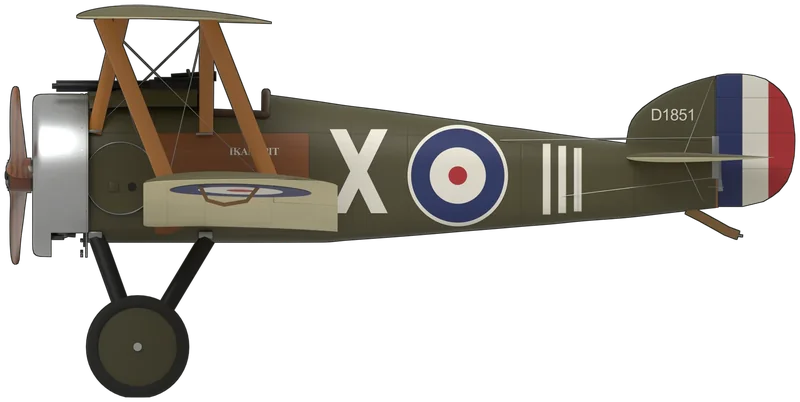
Sopwith Camel

10 · Biplane scout · Camel F.1 G-BZSC (‘D1851’)
Side view of the Sopwith Camel, Camel F.1 G-BZSC (‘D1851’)
Port side
Top view of the Sopwith Camel, Camel F.1 G-BZSC (‘D1851’)
Plan, from above
Front view of the Sopwith Camel, Camel F.1 G-BZSC (‘D1851’)
Head-on

Herbert Smith designed the Camel at Kingston as the Pup’s successor, and Harry Hawker flew the first one at Brooklands on 22 December 1916. Sopwith called it the F.1, but the metal fairing humped over the breeches of its two synchronised Vickers guns gave it the name that stuck. It was the first British fighter with twin synchronised guns as standard, and everything heavy, the rotary engine, the guns, the pilot and the fuel, sat within the front seven feet of a short, deep fuselage.

The Camel turned right so much faster than left that pilots who wanted to turn ninety degrees to the left often went round 270 degrees to the right instead.

G-BZSC is the Shuttleworth Collection’s airworthy Camel reproduction, built to the original drawings by the Northern Aeroplane Workshops of Batley, West Yorkshire, the volunteer group that had already built the Collection’s Sopwith Triplane.

First flight
22 December 1916
Role
Biplane scout
Maker
Sopwith Aviation Company, Britain
Engine
Clerget 9B nine-cylinder rotary, 130 hp
Crew
1
Wingspan
8.53 m (28 ft 0 in)
Length
5.72 m (18 ft 9 in)
Height
2.59 m (8 ft 6 in)
Top speed
115 mph
Built
5,490
In service
1917–1920

Airco DH.9 / DH.9A

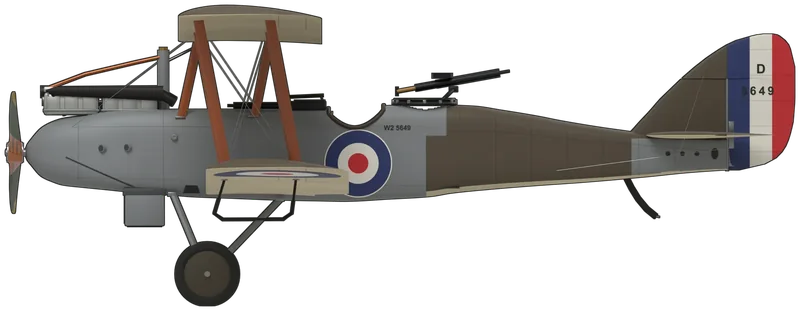
11 · Day bomber · DH.9 D5649
Side view of the Airco DH.9 / DH.9A, DH.9 D5649
Port side
Top view of the Airco DH.9 / DH.9A, DH.9 D5649
Plan, from above
Front view of the Airco DH.9 / DH.9A, DH.9 D5649
Head-on

Geoffrey de Havilland designed the DH.9 at Airco in 1917 as the successor to his DH.4 day bomber, and a converted DH.4 flew as the prototype from Hendon in July 1917. It kept the DH.4’s wings and tail but had a new fuselage, with the pilot moved aft to sit just in front of the observer and his Scarff ring, so the two could talk, instead of being separated by the main fuel tank. It was to have the new 300 hp BHP engine, built as the Siddeley Puma, and after the Gotha raids on London that summer the government ordered it in vast numbers to give the new Royal Air Force a bombing force of its own.

The two DH.9s at Duxford were found in 1999 in an elephant stable at the Maharaja’s fort in Bikaner, Rajasthan, where they had lain since arriving in India as an Imperial Gift after the First World War.

D5649 is one of a handful of DH.9s known to survive.

First flight
1917
Role
Day bomber
Maker
Aircraft Manufacturing Company (Airco), Britain
Engine
Siddeley Puma six-cylinder inline, 230 hp
Crew
2
Wingspan
12.92 m (42 ft 5 in)
Length
9.27 m (30 ft 5 in)
Height
3.44 m (11 ft 3 in)
Top speed
123 mph
Built
~4,000
In service
1918–1937

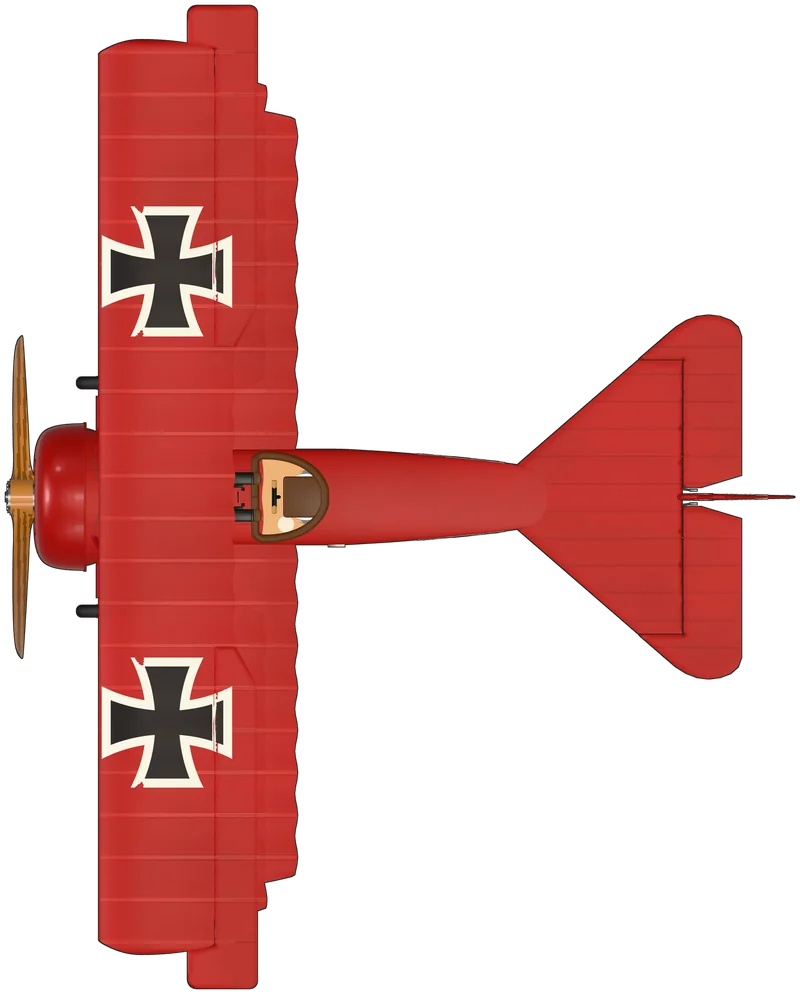
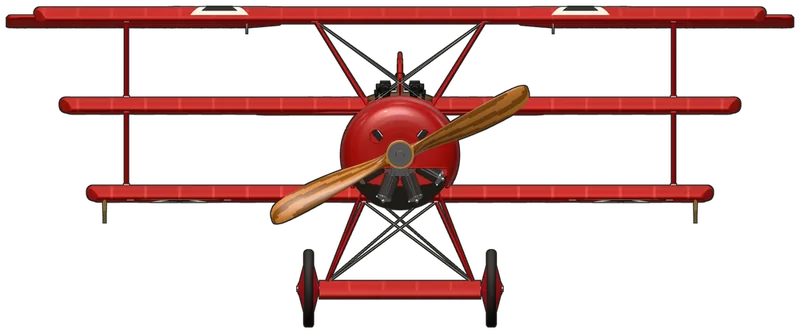
Fokker Dr.I

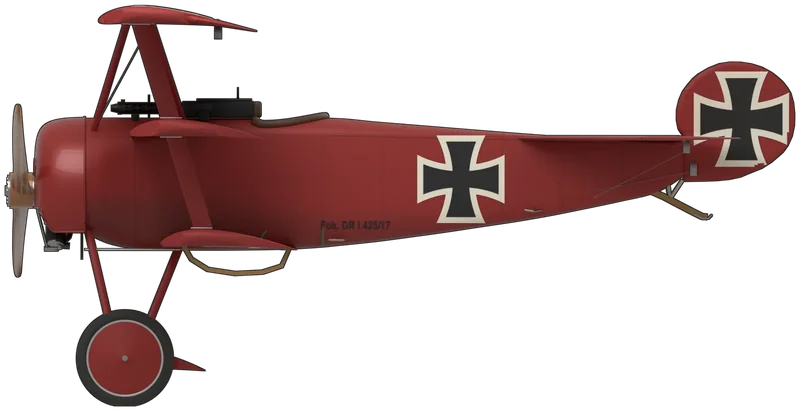
12 · Triplane fighter · Dr.I 425/17
Side view of the Fokker Dr.I, Dr.I 425/17
Port side
Top view of the Fokker Dr.I, Dr.I 425/17
Plan, from above
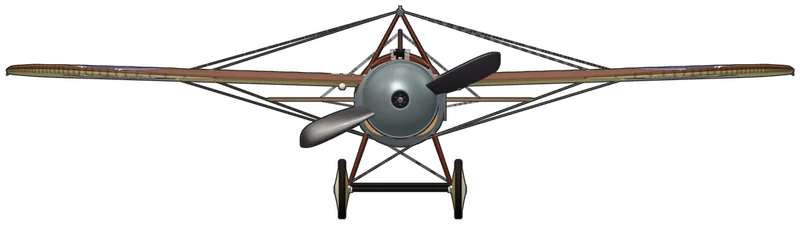
Front view of the Fokker Dr.I, Dr.I 425/17
Head-on

Fokker’s triplane answered the British Sopwith Triplane, which had impressed German pilots in 1917. Reinhold Platz’s design used three short, deep cantilever wings with no bracing wires, giving a phenomenal rate of climb and turn at the cost of speed.

The Dr.I had a small aerofoil around its axle, in effect a fourth wing.

Richthofen’s 425/17 left the factory in Fokker’s streaked olive and was doped red all over by Jasta 11.

First flight
1917
Role
Triplane fighter
Maker
Fokker, Germany
Engine
Oberursel Ur.II nine-cylinder rotary, 110 hp
Crew
1
Wingspan
7.19 m (23 ft 7 in)
Length
5.77 m (18 ft 11 in)
Height
2.95 m (9 ft 8 in)
Top speed
115 mph
Built
320
In service
1917–1918

Compared

Specifications at a glance

Span, length, speed and production for every aircraft on this page.

Specifications compared
AircraftFirst flewRoleSpanLengthTop speedBuiltUK museums
Royal Aircraft Factory B.E.21912Reconnaissance biplane11.28 m8.31 m72 mph~3,5006
Avro 5041913Trainer and Home Defence biplane10.97 m8.97 m95 mph8,9706
Bristol Scout D1914Biplane scout7.49 m6.3 m94 mph3743
Sopwith Pup1916Biplane scout8.08 m5.89 m112 mph1,7704
Sopwith Triplane1916Triplane scout8.08 m5.74 m117 mph1473
Royal Aircraft Factory R.E.81916Reconnaissance and artillery-spotting biplane12.98 m8.5 m103 mph4,0772
Bristol M.1C1916Monoplane scout9.37 m6.22 m130 mph~1302
Bristol F.2b Fighter1916Two-seat fighter11.96 m7.87 m123 mph5,3294
Royal Aircraft Factory S.E.5a1916Biplane fighter8.11 m6.38 m138 mph5,2058
Sopwith Camel1916Biplane scout8.53 m5.72 m115 mph5,4906
Airco DH.9 / DH.9A1917Day bomber12.92 m9.27 m123 mph~4,0002
Fokker Dr.I1917Triplane fighter7.19 m5.77 m115 mph3201

Questions

Asked and answered

What was the most successful British fighter of the First World War?

The Sopwith Camel is credited with shooting down more enemy aircraft than any other Allied type, although it was tricky to fly. The S.E.5a, faster and easier to handle, was flown by many of the leading British aces.

Where can I see First World War aircraft in Britain?

The Shuttleworth Collection at Old Warden flies several original First World War aircraft, and the RAF Museum in London, the Imperial War Museum and the Fleet Air Arm Museum all hold examples. Each profile below links to the museums that hold one.

Did First World War aerodromes have runways?

No. They were open grass fields, so aircraft could always take off and land into the wind. Hard runways only became common in Britain during the Second World War.

More dioramas

Other collections

The models and drawings are procedural interpretations built from published dimensions, three-view drawings and photographs of each airframe, and the airfield is a compressed impression of its period, not a plan of a real station. Aircraft shown overhead (Dr.I) did not operate from airfields like this one. Treat the museum aircraft as the reference.