3D model
Turn it over
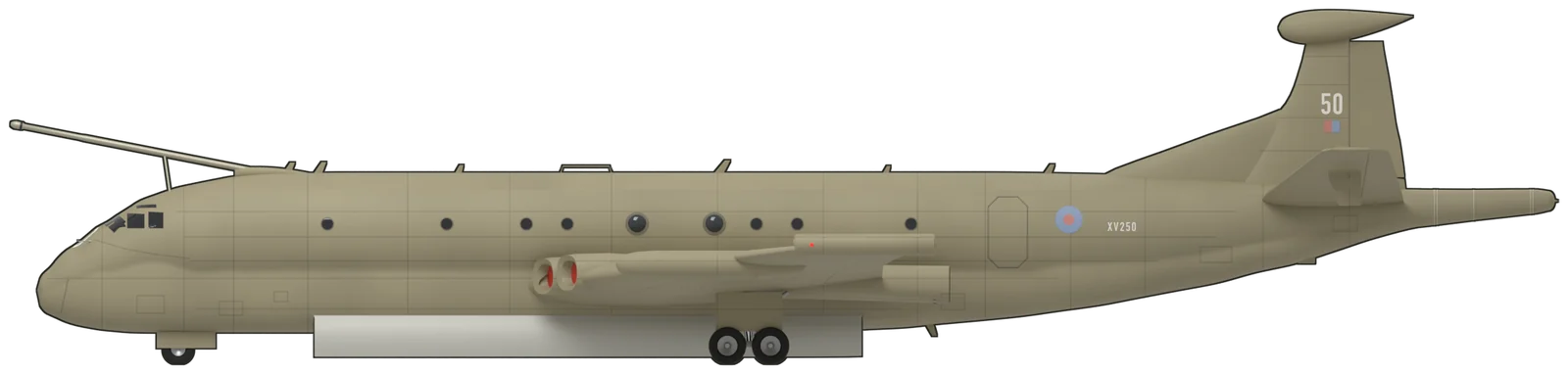
A procedural model built in Blender from published dimensions, drawings and photographs, painted as XV250 ‘50’ of the Kinloss Wing, a maritime patrol aircraft in the overall hemp scheme with low-visibility pale red and pale blue roundels and fin flash, a white ‘50’ on the fin and nose, the MR.2’s Searchwater radome, in-flight refuelling probe, tailplane finlets, wing-tip ESM pods and MAD tail boom, with its bomb-bay doors open, as it is displayed at the Yorkshire Air Museum, Elvington. Drag to orbit, scroll or pinch to zoom · download .glb (1.0 MB)
History
The Nimrod MR.2
In the early 1960s the RAF needed a successor to the piston-engined Avro Shackleton for hunting submarines over the North Atlantic. Hawker Siddeley answered with a rebuild of the de Havilland Comet 4C airliner: the Comet’s wing and upper fuselage were kept, Rolls-Royce Spey turbofans replaced the Avons in the wing roots, and a new unpressurised lower lobe was added beneath the cabin to carry a long weapons bay, with a search radar in the nose, a magnetic anomaly detector in a boom behind the tail and a tall fin. The first prototype, a converted Comet, flew on 23 May 1967, and the type was named Nimrod after the ‘mighty hunter’ of the Book of Genesis.
The Nimrod MR.1 entered service in October 1969 and equipped squadrons at Kinloss in Moray, St Mawgan in Cornwall and, for a few years, Luqa in Malta. It was the first jet maritime patrol aircraft in front-line service: it could dash to a search area at jet speed, then shut down two engines to loiter at low level for hours. From 1979, 35 aircraft were rebuilt as the MR.2 with the Searchwater radar, a new acoustic processor and a new tactical system. In the Falklands War of 1982 refuelling probes were fitted within weeks so that the aircraft could patrol the South Atlantic from Ascension Island, and the finlets added to the tailplane to restore stability with the probe became a permanent feature. Three further aircraft served as R.1 electronic intelligence gatherers with No. 51 Squadron.
The Nimrod’s later years were troubled. The AEW.3 airborne early warning version was cancelled in 1986 after years of radar problems, and the RAF bought the Boeing E-3 Sentry instead. On 2 September 2006 Nimrod MR.2 XV230 caught fire and broke up over Afghanistan, killing all fourteen on board, and the review that followed criticised the safety case for the ageing fleet. The MR.2 was withdrawn on 31 March 2010, the much-rebuilt MRA4 was cancelled that October before entering service, and the last R.1s retired in June 2011. The RAF went without a maritime patrol aircraft until the Boeing P-8 Poseidon arrived in 2020.
This airframe
Nimrod MR.2 XV250
XV250 was built at Woodford as an MR.1, first flew on 21 January 1971 and was delivered to Kinloss on 18 February 1971. In 1972 it joined No. 203 Squadron at Luqa in Malta, returning to Kinloss in 1975, and in June 1982 it went back to Woodford for conversion to MR.2 standard, flying again on 10 June 1983. It served with the Kinloss Wing until the type was withdrawn on 31 March 2010, and on 13 April 2010 it made the last flight of an MR.2 into Elvington, where it stands as a tribute to the crew of XV230. Museum volunteers keep it in running condition and its engines are run in front of visitors. The model shows it as displayed there: overall hemp with low-visibility pale red and pale blue roundels and fin flash, a white ‘50’ on the fin and nose, the refuelling probe and tailplane finlets of the MR.2P, the Searchwater radome, ESM pods on the wing tips and the fin top, the MAD boom, red blanks in the intakes and jet pipes, and its bomb-bay doors open.
Where to see one
In the gazetteer
The gazetteer records the Nimrod MR.2 in 5 UK collections. The airframe modelled here is marked.