Types you’ll see alongside
Avro Anson, de Havilland Canada Chipmunk, Hawker Hurricane, Mignet HM.14 ‘Flying Flea’, Slingsby glider family.
Aircraft hub · 1925 · Interwar
Put the aeroplane in the golf-club car park and gave every light aircraft since its family name. The gazetteer currently lists it at 2 UK museums.
Last verified 2026-10-11 against the gazetteer Compendium. Airframes move — confirm on museum pages before travel.
On charge
The gazetteer records 3 de Havilland DH.60 Moth airframes (including cockpit sections and replicas where noted) across 2 UK collections, in 2 regions: East of England, Northern England.
| Museum | City | Region | Airframes recorded |
|---|---|---|---|
| North East Land, Sea and Air MuseumsChecked 2026-10-08 | Sunderland | Northern England | de Havilland DH.60G Moth replica BAPC.168 Replica |
| The Shuttleworth CollectionChecked 2026-10-08 | Biggleswade | East of England | de Havilland DH.60 Cirrus Moth G-EBLV de Havilland DH.60X Hermes Moth G-EBWD |
3D model
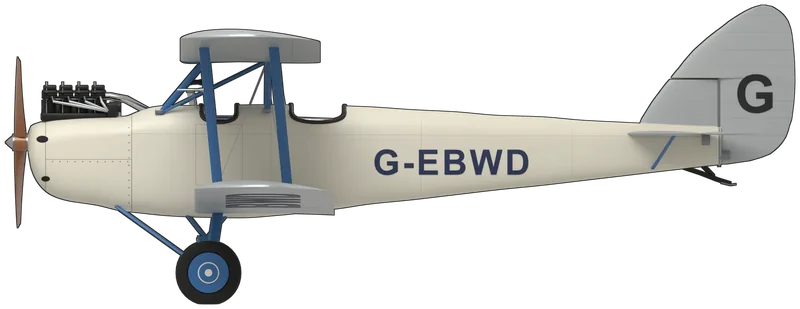
A procedural model built in Blender from the type’s published dimensions, painted as G-EBWD, the Shuttleworth Collection’s de Havilland DH.60X Moth, bought by Richard Shuttleworth in 1932 and the founding aircraft of the Collection, flown from Old Warden ever since: Geoffrey de Havilland’s wooden, fabric-covered two-seat light biplane of 30 ft span with folding, slightly staggered wings, single pairs of interplane struts, tandem open cockpits, a split-axle undercarriage and the upright four-cylinder 115 hp Cirrus Hermes II fitted in 1933, its cylinder heads standing proud of the cowling, shown standing tail-down on its wheels and tail skid as displayed and flown at Old Warden: cream fuselage and cowling with navy ‘G-EBWD’ on both sides, aluminium-doped wings, tailplane, fin and rudder with a black ‘G’ on the rudder and navy registration across the upper and lower wings, blue struts, undercarriage and corrugated centre-section tank, blue wheel covers with a white ring, a polished starboard exhaust and a varnished wooden propeller with an aluminium hub cap (shape from the L’Aéronautique three-view of May 1927 and the NACA three-view, scaled to G-EBWD’s 30 ft span, with the engine, undercarriage and markings following photographs of G-EBWD). Drag to orbit, scroll or pinch to zoom · all 385 models · download .glb (791 KB) · Plate 54 in The Hangar
Computed from the survey
Avro Anson, de Havilland Canada Chipmunk, Hawker Hurricane, Mignet HM.14 ‘Flying Flea’, Slingsby glider family.
East of England has 1 collection recording the type.
de Havilland DH.60 Cirrus Moth; de Havilland DH.60G Moth replica; de Havilland DH.60X Hermes Moth.
Type notes
| Type | de Havilland DH.60 Moth (Cirrus/Hermes) |
|---|---|
| UK museums holding one | 2 |
| Airframes recorded in this survey | 3 |
Serials are the gazetteer's survey snapshot of what each collection records on charge — restorations move between workshops and reserve hangars, so check the museum page for opening times and current display status before travelling. Every type across 119 museums is indexed in the Compendium.
Aircraft questions
The Aviation Gazetteer records 3 de Havilland DH.60 Moth airframes in UK collections.
The Shuttleworth Collection has the most in this survey, with 2 recorded airframes.