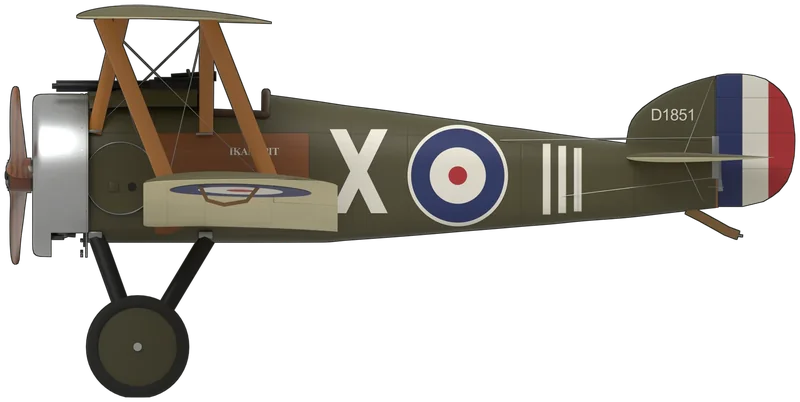
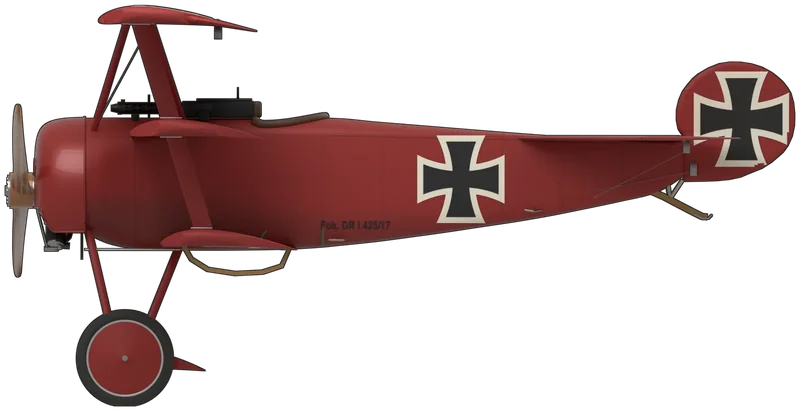
Specifications compared

| Variant compared | Camel F.1 | Fokker Dr.I |
|---|---|---|
| First flight | 22 Dec 1916 | 5 Jul 1917 |
| Entered service | Jun 1917 | Oct 1917 |
| Max speed | 113 mph (182 km/h) | 112 mph (180 km/h) at 8,500 ft (2,600 m) |
| Engine | Clerget 9B rotary, 130 hp | Oberursel Ur.II rotary, 110 hp |
| Armament | 2 × .303 in Vickers machine guns | 2 × 7.92 mm MG 08 'Spandau' machine guns |
| Number built | 5,490 | 320 |
| Crew | 1 | 1 |
Two rotary-engined dogfighters
Herbert Smith's Camel flew on 22 December 1916 and reached the front in June 1917. Its engine, pilot, guns and fuel, some 90% of its weight, sat in the front seven feet.
The Fokker Dr.I answered a British design. In April 1917 Anthony Fokker saw a captured Sopwith Triplane and asked Reinhold Platz to build a triplane. The Dr.I flew on 5 July 1917, and deliveries to squadrons began that October.
Both used rotary engines, whose spinning cylinders produced strong gyroscopic and torque effects.
Sopwith later built two-seat Camels to ease pilots' conversion to the type.
Handling and performance
Torque made the Camel turn right much faster than left, which a skilled pilot could exploit. A stall led straight into a dangerous spin. Pilots joked that it offered a wooden cross, the Red Cross or a Victoria Cross.
The Dr.I was exceptionally manoeuvrable and its initial climb was excellent. But it was slower than contemporary Allied fighters in level flight and in a dive. Its performance fell away at height.
German rotaries also suffered from poor substitute castor oil in 1918, causing many engine failures.
The record
Sopwith and its subcontractors built 5,490 Camels. Their pilots were credited with 1,294 enemy aircraft. Late in the war Camels also flew ground attack.
Only 320 Dr.Is were built, and front-line strength peaked at 171 in late April 1918. Wing failures dogged the type. Heinrich Gontermann was killed in one in October 1917, and Lothar von Richthofen was badly hurt after another in combat with Camels.
Poor workmanship was only part of the cause. In 1929 NACA research found the upper wing carried more lift than the lower one.
The myth: the Red Baron's triplane
The Dr.I is famous as Manfred von Richthofen's aircraft, and he was killed in one on 21 April 1918. Yet only his last 19 victories came in Fokker triplanes. The Dr.I's fame owes more to him than to its record.
Where to see a Camel and a Fokker Dr.I
Stow Maries Great War Aerodrome is the only gazetteer museum with both, as a Camel replica fuselage and a Dr.I replica under construction. For an original Camel, the Royal Air Force Museum London holds F6314.
| Museum | Adult entry | Airframes | Headline exhibit |
|---|---|---|---|
| Stow Maries Great War AerodromeChelmsford, Essex | £12 | 11 | The aerodrome itself: 24 listed RFC buildings, plus flying examples of Great War types on event days (a Fairey Swordfish cameo got… |
Frequently asked
Was the Sopwith Camel better than the Fokker Dr.I?
Over the war as a whole, yes. Camel pilots were credited with 1,294 victories; the Dr.I was slower, suffered wing failures and only 320 were built. In a slow turning fight the triplane was a dangerous opponent.
How many victories did the Red Baron score in the Fokker triplane?
His last 17 in the Dr.I, plus two in the F.I prototype. Most of his earlier victories came in other types.
Where can I see a Camel and a Fokker Dr.I together?
At Stow Maries Great War Aerodrome in Essex, where both are replicas. The only original Camel in the gazetteer is at the Royal Air Force Museum London.