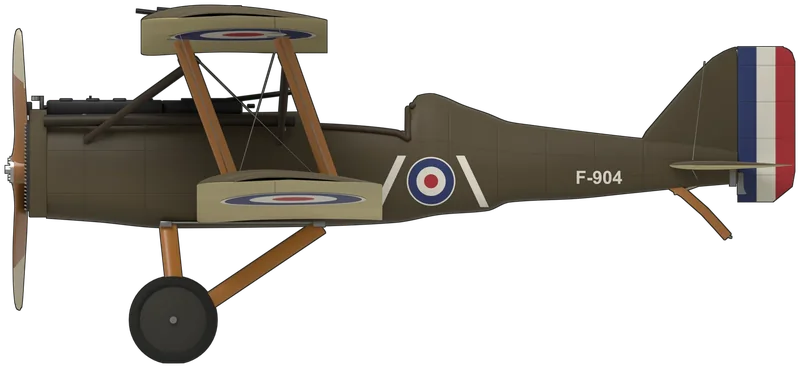
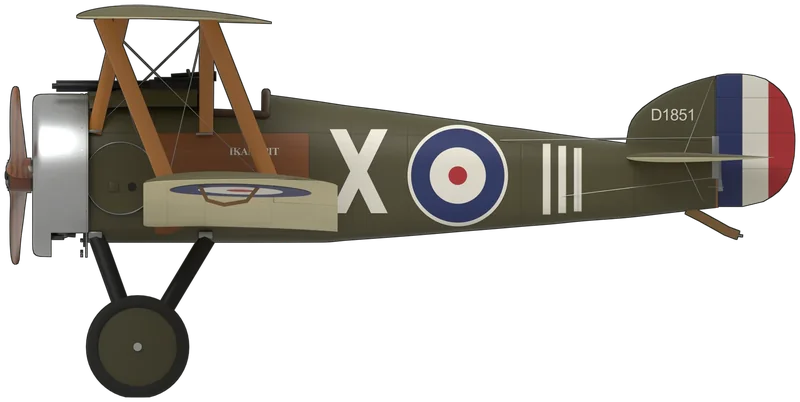
Specifications compared


| Variant compared | S.E.5a | Camel F.1 |
|---|---|---|
| First flight | 22 Nov 1916 (S.E.5) | 22 Dec 1916 |
| Entered service | Mar 1917 | Jun 1917 |
| Max speed | 138 mph (222 km/h) | 113 mph (182 km/h) |
| Engine | Hispano-Suiza 8 or Wolseley Viper water-cooled V8, 150–200 hp | Clerget 9B rotary, 130 hp |
| Armament | 1 × .303 in Vickers, 1 × .303 in Lewis on the top wing; 4 × 25 lb bombs | 2 × .303 in Vickers machine guns |
| Number built | 5,205 (S.E.5 and S.E.5a) | 5,490 |
| Crew | 1 | 1 |
Two approaches
The S.E.5 was designed at the Royal Aircraft Factory by Henry Folland, John Kenworthy and Frank Goodden. It flew on 22 November 1916 and reached squadrons in March 1917. It used a water-cooled Hispano-Suiza V8 or, later, a Wolseley Viper.
The Camel flew a month later and reached the front in June 1917. It used a rotary engine, with the pilot, guns and fuel packed close behind it.
Handling and performance
The S.E.5a was inherently stable, which made it an excellent gun platform. It was also one of the fastest aircraft of the war, at about 138 mph. It could stand high-g manoeuvres and resist battle damage, and it had a noticeably lower accident rate than the Camel.
The Camel turned faster, especially to the right, and was deadly in a close fight. It was also unforgiving: a stall led straight into a spin, and solo training on the type caused heavy casualties.
Armament differed too. The S.E.5a had one synchronised Vickers and a Lewis gun on the top wing. The Camel had twin Vickers firing through the propeller.
The record
5,205 S.E.5s and 5,490 Camels were built. The S.E.5 reached the front first, but problems with the geared Hispano-Suiza engine left it in short supply until well into 1918. More squadrons therefore flew Camels.
Camel pilots were credited with 1,294 enemy aircraft. Aces including James McCudden of No. 56 Squadron flew the S.E.5a.
Together they ensured there was no repeat of Bloody April. The Camel left RAF service in January 1920.
The myth: the Camel was the best British fighter
The Camel is the better-known name. In most respects, though, the S.E.5 had the superior performance. The writer Robert Jackson notes it has been called the Spitfire of the First World War.
Each suited a different pilot. Old hands could exploit the Camel's agility, while the S.E.5a let average pilots fight and survive.
Where to see a S.E.5a and a Camel
The Royal Air Force Museum London shows an original of each, S.E.5a F938 and Camel F6314. The Shuttleworth Collection flies original S.E.5a G-EBIA beside a Camel replica, and Brooklands Museum shows replicas of both.
| Museum | Adult entry | Airframes | Headline exhibit |
|---|---|---|---|
| Brooklands MuseumWeybridge, Surrey | £24–£27 | 32 | Concorde G-BBDG, the British production-test aircraft, bookended by a Wellington bomber dredged out of Loch Ness in 1985 and the only… |
| Montrose Air Station MuseumMontrose, Angus | £10 | 14 | The 1913 fabric itself, plus the resident ghost stories (Montrose is Britain's most famously haunted airfield, a claim the volunteers… |
| Royal Air Force Museum LondonLondon, Greater London | Free | 88 | Avro Lancaster R5868 'S-Sugar' — 137 operations, the RAF's highest-scoring surviving heavy — under the same roof as a Vulcan, a… |
| Stow Maries Great War AerodromeChelmsford, Essex | £12 | 11 | The aerodrome itself: 24 listed RFC buildings, plus flying examples of Great War types on event days (a Fairey Swordfish cameo got… |
| The Shuttleworth CollectionBiggleswade, Bedfordshire | £19.50 | 55 | The 1934 DH.88 Comet 'Grosvenor House', winner of the MacRobertson England–Australia air race, restored to fly; and the Edwardians —… |
Frequently asked
Was the S.E.5a faster than the Camel?
Yes. The S.E.5a reached about 138 mph, the Camel about 113 mph.
Which was easier to fly, the S.E.5a or the Camel?
The S.E.5a, by a wide margin. It was stable and forgiving, while the Camel's rotary engine made it tricky and prone to spinning.
Where can I see an S.E.5a and a Camel together?
The Royal Air Force Museum London has an original of each. The Shuttleworth Collection flies an original S.E.5a alongside a Camel replica.