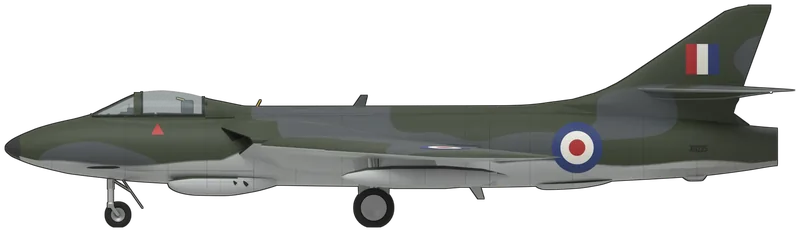
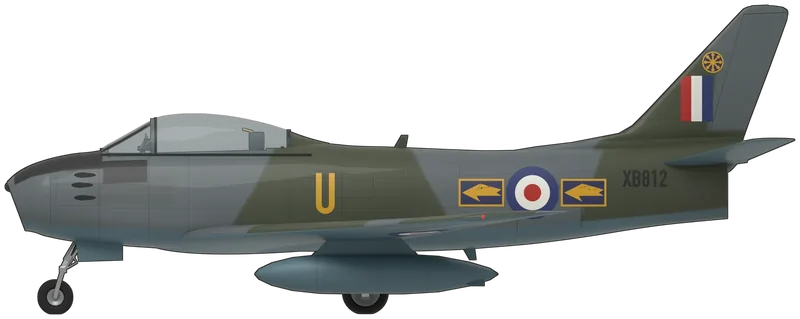
Specifications compared
| Variant compared | Hunter FGA.9 | F-86F Sabre |
|---|---|---|
| First flight | 20 Jul 1951 (prototype) | 1 Oct 1947 (prototype) |
| Entered service | 1954 (type) | 1949 (type) |
| Max speed | 623 mph (1,003 km/h, Mach 0.94) at 36,000 ft | 687 mph (1,106 km/h) at sea level |
| Engine | Rolls-Royce Avon 207, 10,145 lbf | General Electric J47-GE-27, 5,910 lbf |
| Armament | 4 × 30 mm ADEN cannon; up to 7,400 lb underwing | 6 × .50 in M3 Browning MG; up to 5,300 lb underwing |
| Number built | 1,972 | 9,860 (all variants) |
| Crew | 1 | 1 |
Origins
The F-86 Sabre flew on 1 October 1947. It was America's first swept-wing fighter able to meet the MiG-15, and it fought some of the first jet-against-jet battles over Korea.
The Hunter's prototype flew on 20 July 1951, flown by Neville Duke. It entered RAF service in 1954, years after the Sabre.
Sabres in RAF colours
Britain needed a modern day fighter before the Hunter was ready. Canadair built 438 Sabre Mk 4s, and almost all went to the RAF under a mutual aid programme.
They equipped 11 RAF squadrons, most of them in West Germany with NATO. Two squadrons flew them from Britain with Fighter Command. The Hunter then replaced the Sabre, the Meteor and the Venom.
The Sabre Mk 4 kept its American General Electric engine. Later Canadian Sabres used the more powerful Avro Canada Orenda.
Performance and armament
The F-86F had a General Electric J47 of 5,910 lbf and six .50 in machine guns. The Hunter FGA.9 had a Rolls-Royce Avon of over 10,000 lbf and four 30 mm ADEN cannon.
The Hunter's guns sat in a removable pack, so ground crew could rearm it quickly. Early Hunters were short of fuel, and their Avons could stall or flame out when the cannon fired. The new Avon 203 of the F.6 cured the surge.
Published top speeds are quoted at different heights, so they are not directly comparable. Both were transonic day fighters of the same generation.
The record
On 7 September 1953 a modified Hunter set a world air speed record of 727.63 mph over Littlehampton. The record stood for less than three weeks.
9,860 Sabres of all versions were built, against 1,972 Hunters. The Hunter went to 21 overseas air forces. Its Black Arrows display team once looped 22 Hunters in formation.
Hunters also flew in combat with the RAF. In Aden in 1964, Hunter FGA.9s flew precise rocket strikes for SAS patrols in the Radfan.
Where to see a Hunter and a Sabre
The Royal Air Force Museum Midlands shows Canadair Sabre F.4 XB812 in RAF markings alongside its Hunters. Midland Air Museum (F-86A) and North East Land, Sea and Air Museums (F-86D) also hold both types.
| Museum | Adult entry | Airframes | Headline exhibit |
|---|---|---|---|
| Midland Air MuseumCoventry, Warwickshire | £11 | 66 | Vulcan XL360 with cockpit access and volunteer-led tours (ask for the instrumentation talk), plus the Whittle jet heritage collection a… |
| North East Land, Sea and Air MuseumsSunderland, Tyne and Wear | £7.50 | 46 | NELSAM in Sunderland mixes Vulcan XL319 (flew in when the airport still existed), a Pucará from the Falklands, trams, buses and a… |
| Royal Air Force Museum MidlandsShifnal, Shropshire | Free | 78 | TSR-2 XR220, one of two survivors of the most gifted aircraft Britain ever cancelled, sharing floor space with the stainless-steel… |
Frequently asked
Did the RAF fly the Sabre?
Yes. Canadair-built Sabre Mk 4s equipped 11 RAF squadrons in the mid-1950s, mostly in West Germany, until Hunters replaced them.
Which had the heavier guns, the Hunter or the Sabre?
The Hunter, with four 30 mm ADEN cannon. The Sabre carried six .50 in machine guns.
Where can I see a Hunter and a Sabre together?
At the Royal Air Force Museum Midlands, Midland Air Museum and North East Land, Sea and Air Museums.