Specifications compared


| Variant compared | Lynx AH.1 / AH.7 | Gazelle AH.1 |
|---|---|---|
| First flight | 21 Mar 1971 | 7 Apr 1967 (SA.340) |
| Entered service | 1977 (Army deliveries) | 1973 (British forces) |
| Max speed | c. 175 kn (Super Lynx); record 400.87 km/h (G-LYNX, modified) | 310 km/h (167 kn) at sea level (SA 341G) |
| Engine | 2 × Rolls-Royce Gem turboshafts | 1 × Turbomeca Astazou III turboshaft |
| Armament | Up to 8 × TOW anti-tank missiles (AH.1); door guns | Usually unarmed in Army service; machine guns, rockets or missiles optional |
| Number built | c. 450 (to 2009) | c. 1,700 (all, including 262 by Westland) |
| Crew | 2–3 | 1–2 |
One agreement, two helicopters
In February 1967 Britain and France signed a helicopter cooperation agreement. Westland would lead the Lynx, then the WG.13, with a 30% French share. Britain would buy the French Gazelle and Puma.
Westland took a 65% share in building Gazelles for the British forces and produced 262 of them. The French Army later cancelled its armed Lynx, but the French Navy bought the type.
The Gazelle
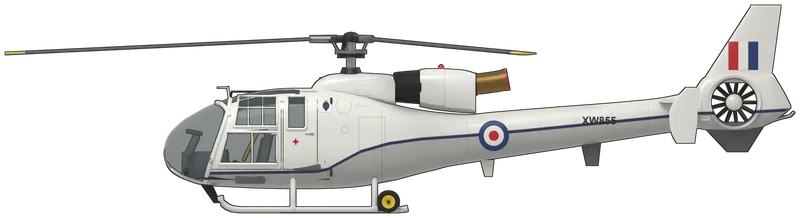
The Gazelle flew on 7 April 1967. It was the first helicopter with a fenestron, a shrouded fan in place of a tail rotor. It was also the first adapted for single-pilot instrument flying.
In British service it flew as a trainer and as the Army's light observation helicopter. Army Air Corps Gazelles served in the 1991 Gulf War and Kosovo, and in Northern Ireland. The Army retired its last on 31 October 2023.
The RAF also flew Gazelle HT.3 trainers, delivered from July 1973 and retired in August 1997.
The Lynx
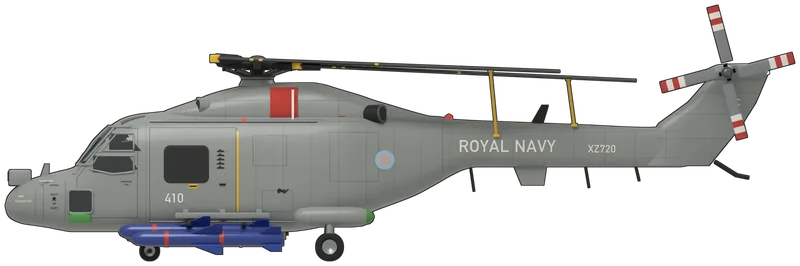
The Lynx flew on 21 March 1971. The Army's AH.1 entered service from 1977 for transport, escort, reconnaissance and anti-tank work with eight TOW missiles. Navy versions hunted submarines and carried Sea Skua anti-ship missiles.
It is fully aerobatic and can loop and roll. In 1972 Lynx XX153 set speed records over 15 and 25 km at 321.74 km/h.
In 1986 the modified demonstrator G-LYNX reached 400.87 km/h, an absolute speed record for helicopters that still stands. The Royal Navy retired its Lynx in 2017 and the Army in 2018.
The later AH.7 added a new tail rotor derived from the Westland 30, a stronger airframe and better defensive aids.
The myth: the Lynx is the fastest helicopter ever
It holds the official record for conventional helicopters. Compound designs with extra propulsion have flown faster, but they compete in a different category. About 450 Lynx and 1,700 Gazelles were built.
In British service the Lynx has been succeeded by its own descendant, the AW159 Wildcat.
Where to see a Lynx and a Gazelle
The Army Flying Museum shows record-breaker Lynx XX153 and a Lynx AH.7 with Gazelle AH.1 ZA737. The Helicopter Museum keeps G-LYNX, still the fastest conventional helicopter, alongside a Gazelle cockpit.
| Museum | Adult entry | Airframes | Headline exhibit |
|---|---|---|---|
| Army Flying MuseumStockbridge, Hampshire | £18 | 43 | Middle Wallop's Army Flying Museum covers everything the Army has flown from observation balloons to Apaches, with superb dioramas and a… |
| East Midlands AeroparkDerby, Leicestershire | £5 | 35 | East Midlands Aeropark: a Vulcan, Nimrod R1 and Buccaneer parked on grassy mounds overlooking EMA's runway — half museum, half premier… |
| Fleet Air Arm MuseumYeovil, Somerset | £21 | 97 | Concorde 002 (G-BSST), the first British-assembled Concorde, which made her maiden flight from Filton in 1969 and now headlines a hall of… |
| Newark Air MuseumNewark, Nottinghamshire | £12.50 | 95 | Vulcan XM594, with cockpit tours occasionally given by former Vulcan aircrew, which reviewers describe with the reverence normally… |
| South Yorkshire Aircraft MuseumDoncaster, South Yorkshire | £7.50 | 109 | Doncaster's South Yorkshire Aircraft Museum sprawls across the old RAF Doncaster site: dozens of airframes and helicopters, strong… |
| The Helicopter MuseumWeston-super-Mare, Somerset | £15 | 108 | G-LYNX, the modified Westland Lynx that took the absolute helicopter world speed record (249.09 mph) in 1986 and holds it still; parked… |
| Ulster Aviation Society (Maze Long Kesh)Lisburn, County Antrim | By appointment | 63 | The Shorts family — SC.1 vertical take-off research aircraft included — plus a Buccaneer, Phantom, Wildcat, and a newly arrived AV-8… |
Frequently asked
Is the Lynx the fastest helicopter?
It holds the official speed record for conventional helicopters, 400.87 km/h, set by G-LYNX in 1986. Compound helicopters are counted separately.
Why did the British Army fly a French helicopter?
Under the 1967 Anglo-French agreement, Britain bought the Gazelle and Puma while France bought into the Lynx. Westland built most British Gazelles.
Where can I see a Lynx and a Gazelle together?
The Army Flying Museum, The Helicopter Museum, the Fleet Air Arm Museum and four more gazetteer museums hold both.