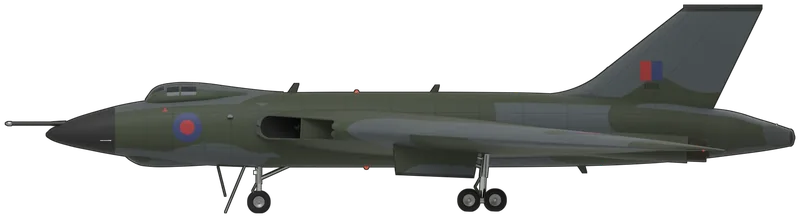
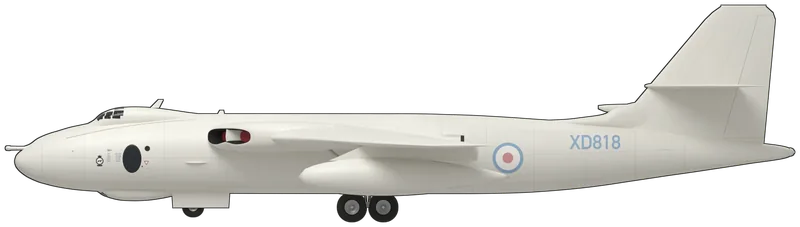
Specifications compared
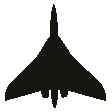
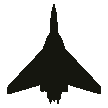
| Variant compared | Vulcan B.1 | Valiant B.1 |
|---|---|---|
| First flight | 30 Aug 1952 | 18 May 1951 |
| Entered service | Sep 1956 | 1955 |
| Max speed | Mach 0.96, 561 kn (646 mph) at altitude | 567 mph (913 km/h) at 30,000 ft |
| Engine | 4 × Bristol Olympus 101–104, 11,000 lbf each | 4 × Rolls-Royce Avon RA28 Mk 204, 10,000 lbf each |
| Armament | 21 × 1,000 lb bombs or one nuclear weapon; no guns | 21 × 1,000 lb bombs or one 10,000 lb Blue Danube; no guns |
| Number built | 136 (including prototypes) | 107 |
| Crew | 5 | 5 |
Insurance and ambition
The Vulcan and Victor were the ambitious answers to the 1947 bomber requirement. Of the three V-bombers, the Vulcan was thought the most advanced and so the riskiest.
Vickers offered a more conventional design that could be ready sooner. George Edwards's Valiant used a moderately swept wing, with four Rolls-Royce Avons buried in the roots. It flew on 18 May 1951, over a year before the Vulcan.
The Valiant entered service in 1955 and was the first V-bomber to become operational. The Vulcan followed in 1956.
Performance and service
Their B.1 versions were close in performance. Both carried 21 bombs of 1,000 lb or one large nuclear weapon. The Vulcan's delta wing gave it more room to grow, and the B.2 had engines of 20,000 lbf.
In October 1956 Valiants flew from Malta to bomb Egyptian airfields during the Suez crisis. In the same years they dropped every British nuclear weapon detonated after release from an aircraft, at Maralinga and in the Grapple tests.
Later B(K).1 Valiants could be fitted out as tankers. No. 214 Squadron used them to develop RAF air-to-air refuelling, flying non-stop to Cape Town and Singapore.
The record
Vickers built 107 Valiants. In 1964 fatigue and corrosion were found in the wing spar attachments, after the fleet had moved to low-level flying. Repair was judged not worth the cost, and the Valiant was withdrawn in January 1965.
Avro built 136 Vulcans. They served the RAF until 1984, and XH558 flew as a display aircraft until 2015.
From 1962 the V-force moved to low-level flying to get under Soviet surface-to-air missiles. That put far more stress on the Valiant's wing.
The myth: the Vulcan was the only V-bomber to fight
The Vulcan's Black Buck raids of 1982 are well known. Yet Valiants had bombed Egyptian airfields 26 years earlier. The Valiant was the first V-bomber to go to war, and the only one to drop live nuclear weapons.
Where to see a Vulcan and a Valiant
Only the Royal Air Force Museum Midlands shows a complete Valiant, XD818 of the Grapple tests, and it stands near Vulcan XM598. IWM Duxford, City of Norwich Aviation Museum and Morayvia each pair a Vulcan with a Valiant nose section.
| Museum | Adult entry | Airframes | Headline exhibit |
|---|---|---|---|
| City of Norwich Aviation MuseumNorwich, Norfolk | £9 | 33 | City of Norwich Aviation Museum at Horsham St Faith: Norfolk's largest, ~30 airframes including a Vulcan and Nimrod with bookable… |
| IWM DuxfordCambridge, Cambridgeshire | £29 | 146 | Concorde 101 (G-AXDN), the pre-production development aircraft and the fastest Concorde of them all at Mach 2.23 — plus an SR-71A… |
| MorayviaForres, Moray | £8 | 35 | Nimrod XV244 (complete, and the crew who operated her sometimes give the tours) alongside a Sea King in RAF SAR yellow — the machine that… |
| Royal Air Force Museum MidlandsShifnal, Shropshire | Free | 78 | TSR-2 XR220, one of two survivors of the most gifted aircraft Britain ever cancelled, sharing floor space with the stainless-steel… |
Frequently asked
Which V-bomber came first?
The Valiant. It flew in May 1951 and entered service in 1955, a year before the Vulcan.
Did the Valiant drop a nuclear bomb?
Yes, in tests. Valiants of No. 49 Squadron dropped all of Britain's air-dropped nuclear test weapons, at Maralinga in 1956 and over the Pacific in 1957.
Where can I see a Vulcan and a Valiant together?
At the Royal Air Force Museum Midlands, home of the only complete Valiant. Three other museums show a Valiant cockpit beside a Vulcan.