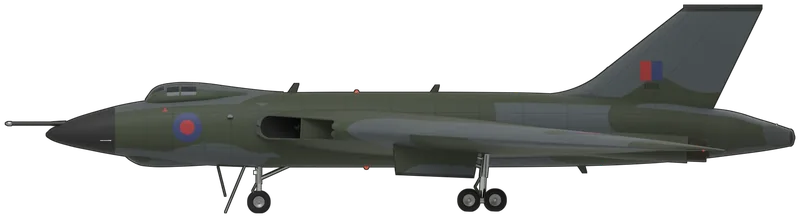
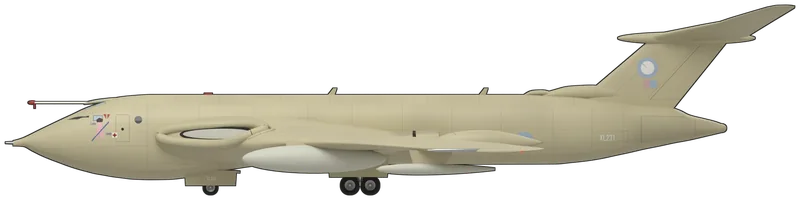
Specifications compared

| Variant compared | Vulcan B.1 | Victor B.1 |
|---|---|---|
| First flight | 30 Aug 1952 | 24 Dec 1952 |
| Entered service | Sep 1956 | Apr 1958 |
| Max speed | Mach 0.96, 561 kn (646 mph) at altitude | 545 kn (627 mph) at 36,000 ft |
| Engine | 4 × Bristol Olympus 101–104, 11,000 lbf each | 4 × Armstrong Siddeley Sapphire, 11,050 lbf each |
| Armament | 21 × 1,000 lb bombs or one nuclear weapon; no guns | Up to 35 × 1,000 lb bombs or one nuclear weapon; no guns |
| Number built | 136 (including prototypes) | 86 |
| Crew | 5 | 5 |
One specification, two wings
Both answered Specification B.35/46 of January 1947. It asked for a bomber to carry a 10,000 lb bomb 1,500 nautical miles at 45,000 ft.
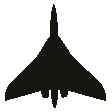
Avro chose a large delta wing and tested it on small Avro 707 research aircraft. Handley Page chose a compound-sweep crescent wing, which the writer Bill Gunston rated the most efficient high-subsonic wing of 1947.
The Vulcan flew on 30 August 1952 and the Victor on 24 December 1952. The Vulcan entered service in 1956, the Victor in 1958.
Both ended up as large four-jet bombers with a crew of five and engines buried in the wing roots.
Performance
The B.1 versions had similar engines of about 11,000 lbf each. The Vulcan cruised at Mach 0.86 and topped out at Mach 0.96. The Victor reached 545 knots at 36,000 ft.
On 1 June 1956 a production Victor exceeded the speed of sound in a shallow dive. Ground observers from Watford to Banbury heard the boom.
The Victor's bomb bay held up to 35 bombs of 1,000 lb, against 21 for the Vulcan. Neither carried defensive guns; both relied on height, speed and electronic countermeasures.
The later B.2 versions of both had bigger wings and engines. The Vulcan B.2's Olympus 301s gave 20,000 lbf each.
The record
Avro built 136 Vulcans, including prototypes. Handley Page built 86 Victors. Many Victors became tankers as Polaris submarines took over the nuclear deterrent.
The RAF retired the Vulcan in 1984. The Victor was the last V-bomber in service, retiring on 15 October 1993.
In the 1970s modified Vulcans took over maritime radar reconnaissance from the Victor. In the 1991 Gulf War, eight Victor K.2s refuelled coalition aircraft from Bahrain.
The myth: Black Buck was a Vulcan raid
In 1982 Vulcans bombed Port Stanley airfield in the Black Buck raids. To cross the South Atlantic, each Vulcan needed several refuellings from Victor tankers. Each mission consumed about 1.1 million gallons of fuel.
Where to see a Vulcan and a Victor
The Royal Air Force Museum Midlands shows a complete Vulcan B.2 and Victor K.2, and IWM Duxford pairs Vulcan XJ824 with Victor XH648. City of Norwich Aviation Museum and Midland Air Museum add Victor cockpits beside complete Vulcans.
| Museum | Adult entry | Airframes | Headline exhibit |
|---|---|---|---|
| Bournemouth Aviation MuseumChristchurch, Dorset | £10 | 29 | The sit-anywhere policy itself — one entry fee, no per-cockpit charges, a full BAC 1-11 flight-deck sim in a shed, and thousands… |
| City of Norwich Aviation MuseumNorwich, Norfolk | £9 | 33 | City of Norwich Aviation Museum at Horsham St Faith: Norfolk's largest, ~30 airframes including a Vulcan and Nimrod with bookable… |
| IWM DuxfordCambridge, Cambridgeshire | £29 | 146 | Concorde 101 (G-AXDN), the pre-production development aircraft and the fastest Concorde of them all at Mach 2.23 — plus an SR-71A… |
| Midland Air MuseumCoventry, Warwickshire | £11 | 66 | Vulcan XL360 with cockpit access and volunteer-led tours (ask for the instrumentation talk), plus the Whittle jet heritage collection a… |
| RAF Manston History MuseumRamsgate, Kent | £7 | 22 | RAF Manston's history museum spans 1916 RNAS days to Cold War Meteors, with strong 1940s room-sets — and it sits next door to the… |
| Royal Air Force Museum LondonLondon, Greater London | Free | 88 | Avro Lancaster R5868 'S-Sugar' — 137 operations, the RAF's highest-scoring surviving heavy — under the same roof as a Vulcan, a… |
| Royal Air Force Museum MidlandsShifnal, Shropshire | Free | 78 | TSR-2 XR220, one of two survivors of the most gifted aircraft Britain ever cancelled, sharing floor space with the stainless-steel… |
Frequently asked
Which was faster, the Vulcan or the Victor?
Their top speeds were close. The Victor B.1 reached 545 knots at 36,000 ft, and one exceeded Mach 1 in a dive in 1956. The Vulcan B.1 was limited to about Mach 0.96.
Why did the Victor stay in service longer than the Vulcan?
Its large fuselage and wing made a good tanker. Converted Victors refuelled the Black Buck Vulcans in 1982 and served until October 1993.
Where can I see a Vulcan and a Victor together?
The Royal Air Force Museum Midlands and IWM Duxford both hold complete examples of each. Several other museums pair a Vulcan with a Victor nose section.