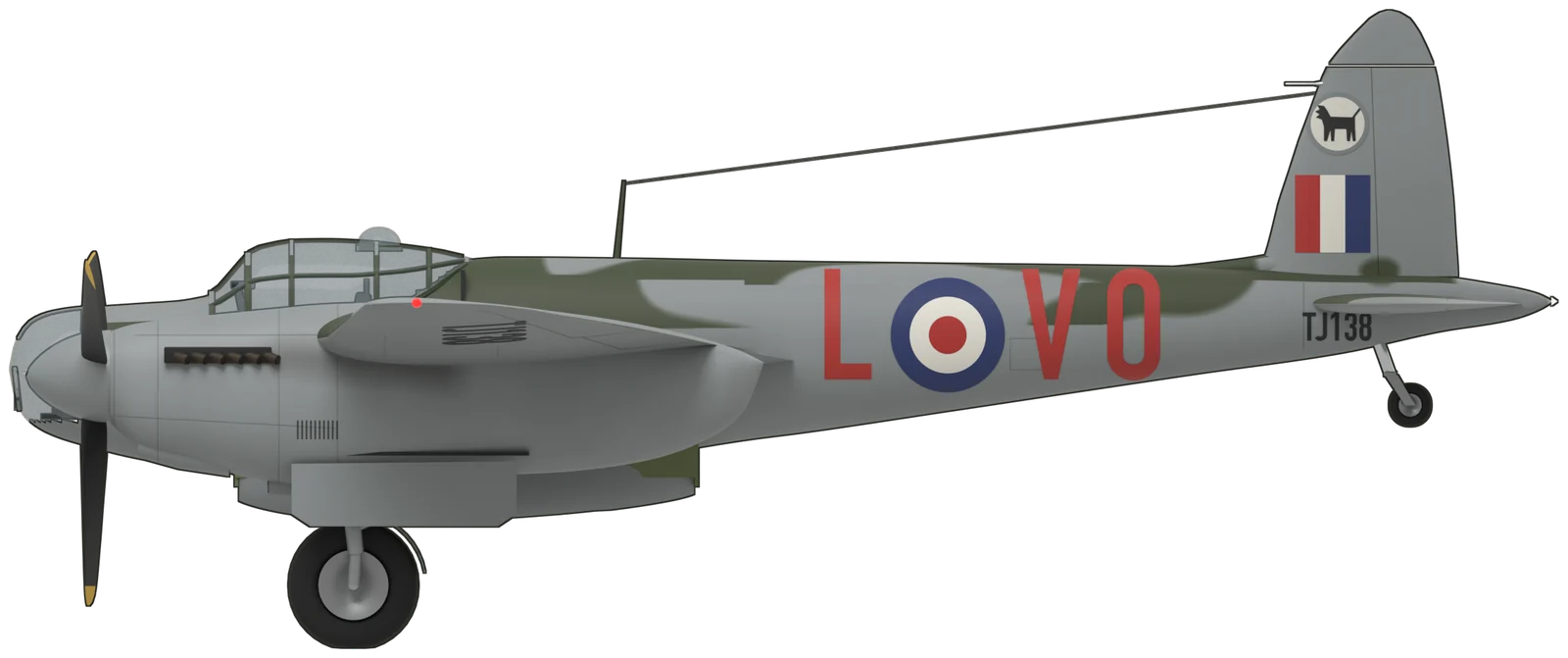
3D model
Turn it over
A procedural model built in Blender from published dimensions, drawings and photographs, painted as TJ138 ‘VO-L’ of No. 98 Squadron, a post-war B.35 in Dark Green and Medium Sea Grey with Medium Sea Grey undersides, Type D roundels, red squadron codes and the squadron’s Cerberus badge on the fin, as it is displayed in the Bomber Hall at the Royal Air Force Museum, London. Drag to orbit, scroll or pinch to zoom · download .glb (1.3 MB)
History
The Mosquito B.35
De Havilland proposed the Mosquito in 1938 as an unarmed bomber that would rely on speed rather than guns to survive. It was built almost entirely of wood, with a fuselage of plywood skins over a balsa core, so it could be made by furniture and joinery firms without using scarce light alloy. The Air Ministry ordered a prototype in March 1940; W4050 was built in secret at Salisbury Hall in Hertfordshire and first flew from Hatfield on 25 November 1940, with Geoffrey de Havilland Jr at the controls.
The Mosquito proved faster than most fighters of its day and turned its hand to nearly every job: bombing, photo-reconnaissance, night fighting, anti-shipping strikes and low-level precision raids such as the attack on Amiens prison in February 1944. Pathfinder Mosquitoes marked targets for the heavy bombers, and the Light Night Striking Force sent them to Berlin night after night. In all, 7,781 were built in Britain, Canada and Australia.
The B.35 was the last bomber version. It had two-stage Merlin 113 and 114 engines for high-altitude performance, a pressurised cabin and the bulged bomb bay that could hold a 4,000 lb ‘cookie’. It first flew in March 1945, too late for the war, and served with Bomber Command and with squadrons in Germany until the Canberra replaced it in the early 1950s. Many were then converted into TT.35 target tugs, and the last RAF Mosquitoes, flying with No. 3 Civilian Anti-Aircraft Co-operation Unit at Exeter, retired in 1963.
This airframe
B.35 TJ138
TJ138 was built at Hatfield in 1945 and flew with No. 98 Squadron in the British occupation forces in Germany, based at Celle. It was converted to a TT.35 target tug in the 1950s and later flew meteorological ‘THUM’ sorties from Woodvale before it was retired. It is now displayed in the Bomber Hall at the RAF Museum in London, standing on its wheels with its bomb doors open. The model shows it in 98 Squadron markings as ‘VO-L’: Dark Green and Medium Sea Grey upper surfaces over Medium Sea Grey undersides, Type D roundels on the fuselage and upper wings, red codes, the serial under the wings and the squadron’s Cerberus badge above the fin flash.
Where to see one
In the gazetteer
The gazetteer records the Mosquito B.35 in 5 UK collections. The airframe modelled here is marked.