3D model
Turn it over
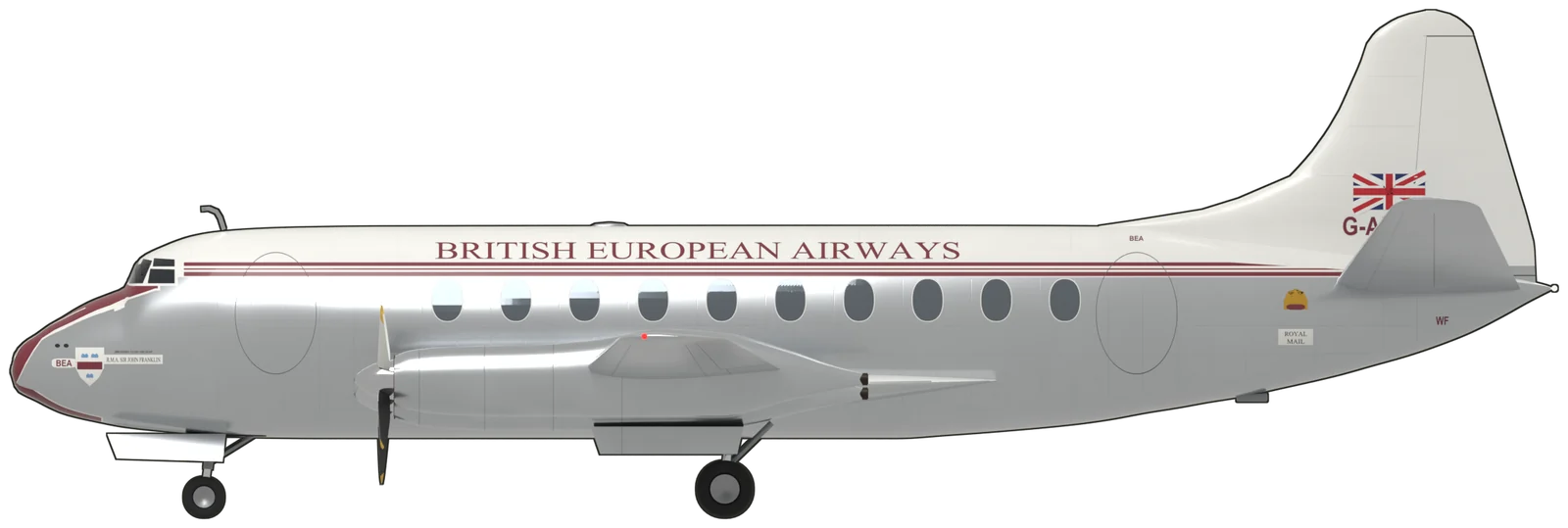
A procedural model built in Blender from published dimensions, drawings and photographs, painted as G-ALWF ‘Sir John Franklin’, the oldest surviving Viscount, in British European Airways’ 1950s scheme of polished metal and a white roof over a maroon cheat line, with a maroon nose, ‘BRITISH EUROPEAN AIRWAYS’ titles and the Union Flag on a white fin, as it is displayed at IWM Duxford. Drag to orbit, scroll or pinch to zoom · download .glb (2.7 MB)
History
The Viscount 701
The Viscount began with the wartime Brabazon Committee, which asked for a short-range airliner to replace the DC-3 after the war. Vickers chose four of Rolls-Royce’s new Dart turboprops, a gas turbine driving an ordinary propeller, and a pressurised cabin with large oval windows. The prototype, G-AHRF, first flew from Wisley on 16 July 1948 with Mutt Summers and Jock Bryce at the controls.
The 32-seat prototype was too small to pay its way, and British European Airways ordered the stretched Viscount 700 instead, with more powerful Darts and room for over forty passengers. On 29 July 1950 the prototype flew BEA passengers from Northolt to Paris, the first scheduled service by a turbine-powered airliner, and on 18 April 1953 BEA’s Viscount 701s opened the first regular turboprop route, from London to Rome, Athens and Nicosia. Passengers liked the speed, the smoothness and the quiet, and the airlines liked the bookings.
Trans-Canada Air Lines and then Capital Airlines in the United States bought it, rare sales for a British airliner in North America, and the stretched 800 and 810 series followed. Vickers built 445 Viscounts before production ended in 1964, making it the most successful British airliner of all. Many went on to second and third operators around the world, and a few were still flying in Africa in the 2000s.
This airframe
Viscount 701 G-ALWF
G-ALWF, Vickers’ fifth production Viscount, first flew at Weybridge on 3 December 1952 and was delivered to BEA on 13 February 1953, in time for the first Viscount services that April. BEA named it ‘Sir John Franklin’ in its Discovery class, after the Arctic explorer. It later flew with Cambrian Airways, and when it retired it was recognised as the oldest Viscount in existence. On 12 April 1972 it made its last flight, from Cardiff to Liverpool, after 28,299 hours and 25,398 landings, and it was later moved to Duxford, where the Duxford Aviation Society looks after it in the airliner line-up. The model shows it as restored in BEA’s 1950s scheme: polished metal with a white roof over a maroon cheat line, a maroon nose with the BEA letters, ‘BRITISH EUROPEAN AIRWAYS’ above the windows and the Union Flag on a white fin.
Where to see one
In the gazetteer
The gazetteer records the Viscount 701 in 5 UK collections. The airframe modelled here is marked.